This paper was first presented at GPD 2025.
Link to the full GPD 2025 conference book: GPD_2025_ConferenceProceedingsBook.pdf

Authors: Malvinder Singh Rooprai a, Michael Haerth b
a. Senior Technical Program Manager, Kuraray INDIA
b. R&D Film Scientist, Kuraray Europe GmbH, GERMANY
Abstract
In recent decades, global warming has been pushing the design temperatures that engineers need to consider for various materials used in building construction. Laminated safety glass made with the most common interlayer material i.e., Polyvinyl Butyral (PVB), is highly compliant to temperature and load durations. On the other hand, Ionoplast interlayers, originally developed for the hurricane market in the US after the catastrophic Hurricane Andrew in 1992, have now gained a worldwide acceptance. This acceptance is attributed to the fact that Ionoplast interlayers have shear modulus values 100 times higher than those of PVB, even at elevated temperatures like 50°C. In recent years, stiff PVBs have been introduced as a new class of structural interlayers, offering modulus values in between the standard PVB and the Ionoplast for most time-temperature scenarios. This paper presents experimental data on an “Improved” stiff PVB version (referred as B231) designed to address the limitations of “other” stiff PVB products. B231 exhibits up to twice the relaxation modulus of current stiff PVB interlayers, resulting in significantly better post-glass breakage behavior and enhanced design flexibility by applying the coupling approach. Additionally, the improved interlayer formulation provides superior long-term open edge stability, as evidenced, for example, by the results of the salt spray test (5000 hours, according to ASTM B117-11), and a more neutral color while maintaining sufficient impact performance. These advancements open new design possibilities for façade engineers, making the improved stiff PVB an attractive alternative to Ionoplast interlayers in temperature-controlled environments.
Article Information
- Published by Glass Performance Days, on behalf of the author(s)
- Published as part of the Glass Performance Days Conference Proceedings, June 2025
- Editors: Jan Belis, Christian Louter & Marko Mökkönen
- This work is licensed under a Creative Commons Attribution 4.0 International (CC BY 4.0) license.
- Copyright © 2025 with the author(s)
1. Introduction
In the past two decades, standards for the use of glass in many countries have evolved, mandating more use of laminated safety glass than in the past, specifically in high rise buildings. Polyvinyl Butyral (PVB) interlayer is the most specified interlayer for laminated glass applications in buildings. Undoubtedly, it’s the benchmark for rating the performance of all other interlayers like Ionoplast & Stiff PVB. Ionoplast interlayers were originally invented to meet the new hurricane glazing standard requirements in the US, implemented in the wake of hurricane Andrew in 1992 which caused catastrophic damage to the buildings in Florida. With their 100 times higher stiffness and 5 times more strength than PVB, Ionoplast interlayers quickly gained significant traction all over the globe, for other applications involving elevated temperatures like 50°C, long duration loads, and post breakage strength requirements. Stiff PVB interlayers, introduced to the market in recent years, too have found an acceptability in the market due to their ability to provide a performance that is comparable to Ionoplast interlayers, in applications with design temperatures below 30°C and short duration loads.
2. Relaxation Modulus Measurement
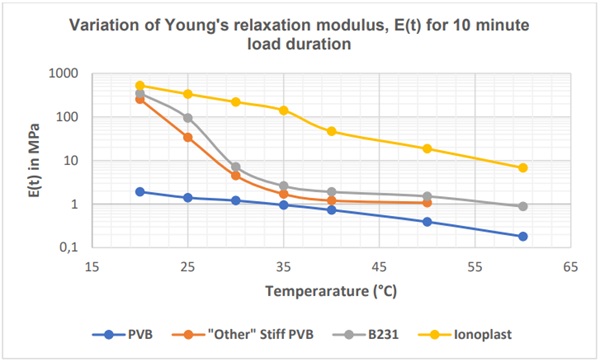
Fig.1 & 2 show the comparison of Young’s relaxation modulus E(t) data for 10 minute and 1 minute load durations for various interlayer options available to a facade engineer.
Ionoplast interlayer is the first choice for a structural interlayer as it depicts higher modulus for temperature range of 25-60°C among all interlayers. B231 (grey curve) recorded higher modulus values compared to “other” stiff PVB (orange curve) for temperature range of 25-60°C, suggesting higher post breakage strength as well, which has been experimentally verified in this paper. No modulus data was available for “other” stiff PVB for 60°C.
3. Improved Structural Strength
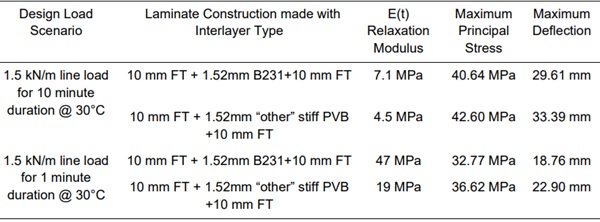
Table 1 shows a comparison of maximum deflection and principal stress values determined through FEM analysis in SJ Mepla software for a cantilevered, laminated glass balustrade (height = 1100 mm and width = 1500 mm) modelled using 2 x 8mm fully tempered glass with 1.52 mm thick B231 interlayer & “other” stiff PVB interlayers, subjected to 1.5 kN/m line load at 30°C for load durations of 10 minute & 1 minute. The bottom edge of the glass was modelled with linear elastic type support in SJ Mepla. Lower deflections and stress values for B231 laminates provide engineers with the possibility of designing the same glass construction to withstand higher loads.
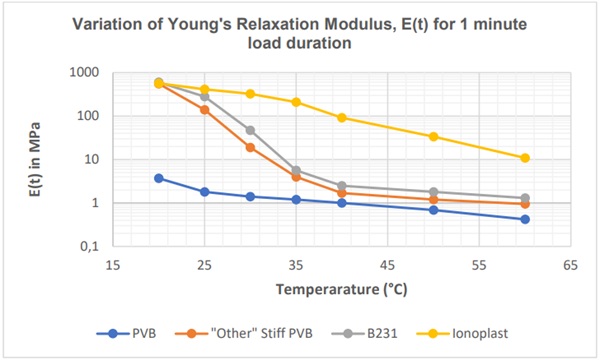
Table 1: Comparative Structural Performance Analysis Results in SJ Mepla for a cantilevered, laminated glass balustrade made with B231 & other stiff PVB interlayers.
4. Improved Post Breakage Strength
For some applications of laminated glass, like skylights, free standing balustrades, and floorings, ensuring a high degree of post breakage strength is very important. Fully tempered glass laminates with PVB interlayers, with minimal support conditions, generally have a poor post breakage strength at elevated temperatures, and thus fail to meet the residual strength requirements mandated by standards like DIN 18008. Post breakage strength of glass laminates made with B231 and “other” stiff PVB was compared experimentally through (i) 4-point bend test on broken glass beams and (ii) point load test on broken glass balustrade.
5. Comparison of Post Breakage Strength Determined Experimentally
5.1. Four Point Bend Test on Broken Glass Beam
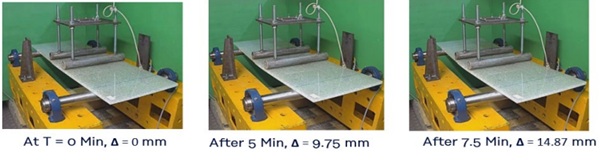
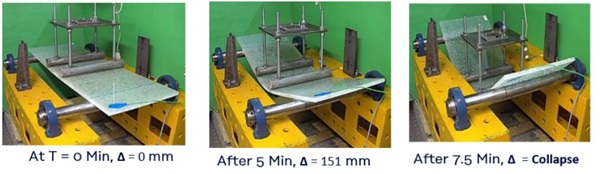
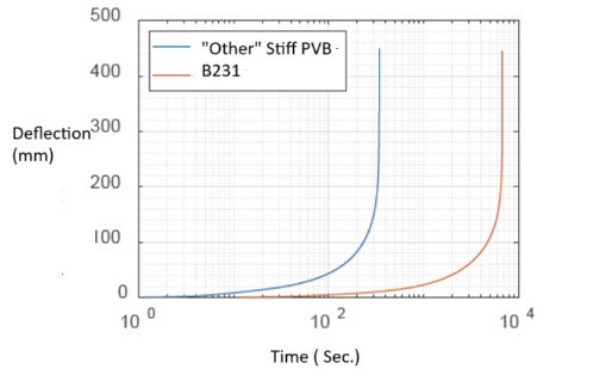
Five specimens were tested for each of the two sample types. The glass beams, measuring 1100 x 360 mm were subjected to static creep load of 100 N. The test set up is shown in Fig. 3 & 4. Glass beams made with B231 interlayer exhibited better creep resistance than those made with “other” stiff PVB interlayer, as indicated by recorded lower deflections overtime as shown in the graph in Fig.5.
5.2. Line Load Test & Point Load on Cantilevered Glass Balustrade
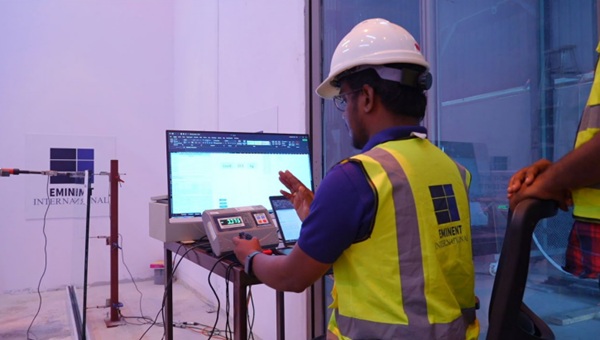
A 1.5 kN/m line load test was conducted at 30°C, in a controlled temperature environment on cantilevered glass balustrades having a standard height of 1100mm with linearly supported bottom edge in a U Channel. Test was performed on two sample types i.e., glass laminates made with B231 interlayer & “other” stiff PVB interlayer. Fig. 6a & 6b show the test set up for the line load test & point load test for post breakage strength conducted at Eminent Test Lab Inc. Hyderabad in India.
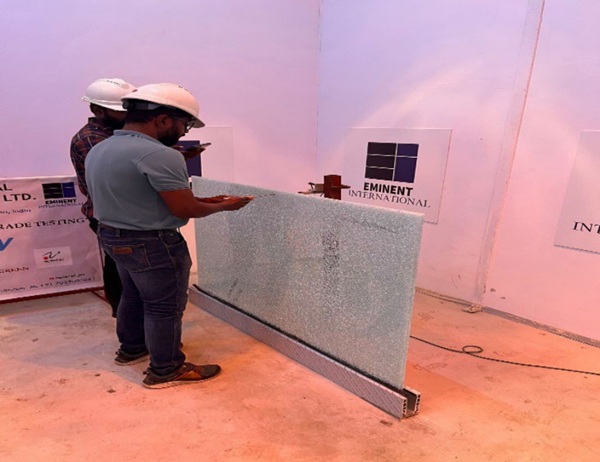
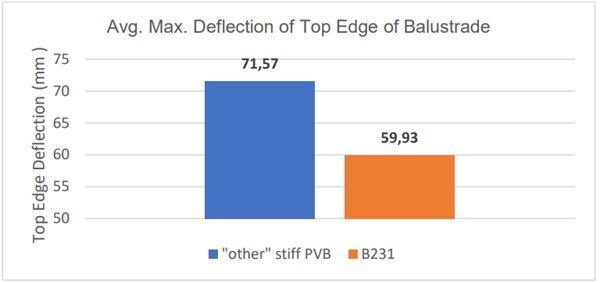
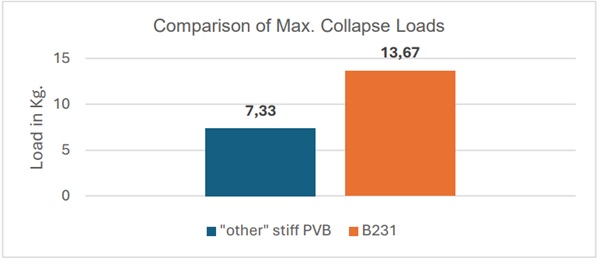
Three specimens were tested for each sample type to observe the maximum deflection at the top edge of the balustrade when subjected to the line load. Specimens made with B231 interlayers recorded their average maximum deflection significantly lower than those made with “other” stiff PVB interlayers. The comparison of the average of maximum top edge deflections for all specimens is shown in Fig.7. After the line test, the glass laminates were broken with a center punch and then subjected to a point load applied at the middle of the top edge to observe the maximum load required to cause the complete collapse. Higher collapse loads for B231 in Fig. 8, is indicative of higher post breakage strength.
6. Salt Spray Test for Edge Stability
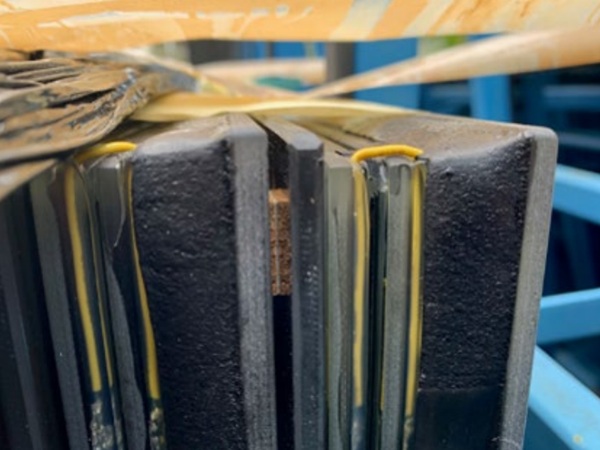
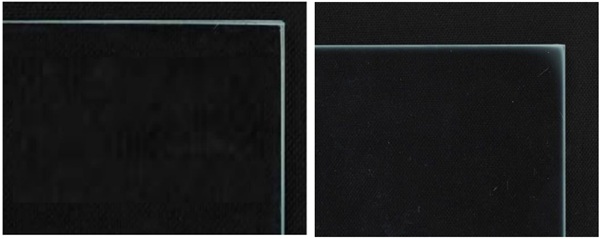
When edges of a laminated glass are exposed to the environment, the general practice followed in the industry is to cap the edges to avoid the potential risk of delamination due to the hygroscopic nature of PVB interlayers. Salt Spray test was conducted on 3 specimens each of B231 and “other” stiff PVB as per DIN EN ISO 9227:2023-03 - NSS for 5000 Hrs at IFO GmbH, Germany. After 5000 hours, all B231 specimens recorded no visible sign of cloudiness or delamination at the edges, whereas “other” stiff PVB specimens recorded cloudiness at the edges just after 3000 hours as shown in Fig.9 below.
7. Neutral Color Appearance
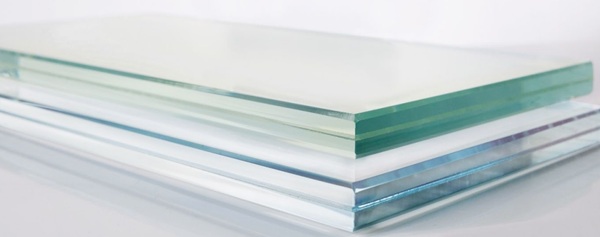
Another important aspect of “exposed edge” applications of laminated glass is the visual appearance of the glass edges especially when they are in close visual range of the human eye. B231 laminate (bottom) has an aesthetically better appearance due to its relatively neutral color appearance compared to the “other” stiff PVB (top) laminate that appears greenish in Fig. 10. The relatively neutral color appearance of B231 not only provides higher light transmission but also makes it a suitable choice for glass constructions using extra clear / low iron glass, often employed in shopfront glazings for highend fashion brands.
8. Conclusions
- B231 interlayers have a higher Young’s relaxation modulus value than “other” existing stiff PVB interlayers.
- Higher modulus of B231 compared to “other” stiff PVB translates to higher structural performance that is confirmed by FEM Analysis in SJ Mepla of a balustrade subjected to a line load.
- Higher modulus of B231 over “other” stiff PVB translates to high post breakage strength as well that is validated experimentally through 4-point bend test on broken glass beam and collapse load for cantilevered, broken glass balustrade.
- B231 interlayers have an improved durability as confirmed by salt spray test that gives it an advantage over “other” stiff PVB interlayers for exposed edge applications.
References
Kuraray Trosifol® Technical data sheet for Elastic Properties
IFO GmbH, Test Report No. 41054 - Corrosion test on laminated glass films between glass plates
University of Armed Forces, Munich, Test Report No. b-011-23-03 – Comparative residual load bearing capacity test on laminated glass made with B231 & “other” stiff PVB
Eminent Test Lab. Inc. Test Report No. CC13/30/Sep/2024/FR00 – Comparative structural performance testing of laminated glass balustrades made with various structural interlayers in a temperature controlled environment.