Date: 19 May 2026
At glasstec the focus is not only on machinery, energy performance or new coatings. At times, the glass industry’s innovative power becomes visible in special things: two current projects from the line-up of exhibitors show how the sector can also fulfil the most complex requirements or develop solutions for new technologies. In Helsinki, a car park between two listed buildings was transformed into an urban space usable all year round with the help of 190 custom-made, triangular triple IGUs that can be heated all the way through to their edges; installed above a filigree, “forest-like” roof structure they owe their high load-bearing properties to special PVB interlayers care of Kuraray. At the same time, SCHOTT has succeeded in mass-manufacturing high-precision reflective waveguides for Augmented Reality glasses on an industrial scale – a key optical component that integrates digital content into the field of vision and was considered a technology bottleneck until now.
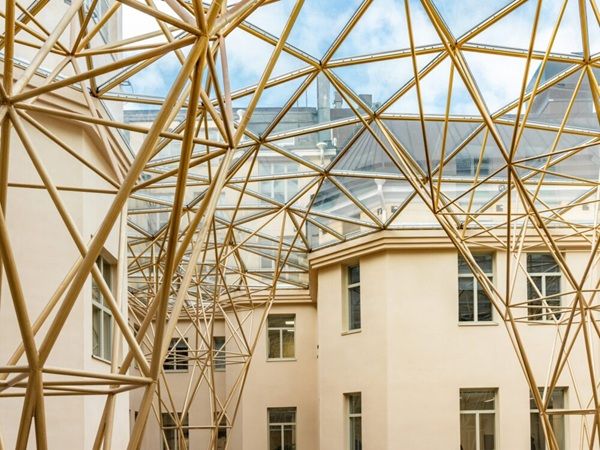
In the centre of Helsinki, at No. 37 Pohjoisesplanadi square, a former car park has been transformed into a roofed urban space for all-year public use. The project forms part of an about 180-year-old set of buildings in the Boulevard Esplanadi area, which was classified as a cultural heritage site of national significance by the Finnish Heritage Agency. The oldest parts of the building go back to Carl Alexander Engel and were completed in 1839. Today, office, retail and food service premises line the new yard, now available for year-round use under a sculptural glass roof. The transformation project was designed by JKMM Architects. Their underlying architectural concept being that the yard is not covered by a conventional glass roof but by the canopy of a forest. Four approximately 14 m high steel pillars branch out into an extremely filigree structure that supports the glass roof and saves plenty of steel compared to more conventional designs. The organic, almost landscape-inspired design language was meant to perfectly harmonise with the historic building– the “new” element should be clearly distinct but not clash with the existing structure.
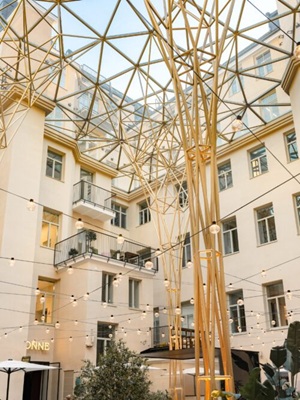
The glass also proved a technical challenge because some 190 triangular, electrically heated triple IGUs by Finnglass were installed. Due to their geometry, each unit is basically a one-off: the triangles have varying edge lengths of around three metres and an 88.4/16/8/16/88.4 build-up. All panes are pre-stressed as TSG-H (toughened safety glass subjected to a heat-soak test) or partially pre-stressed glass and withstand snow loads of up to around seven kilonewton per square meter thanks to Trosifol UltraClear PVB interlayers. This corresponds to more than 700 kilograms of permanent or intermittent load. These highly transparent films also decisively contribute to the high colour rendering index of this glazing; with a CRI value of 94 and an external yellow value specification of < 0.8 (for 1.52 mm thickness) its cloudiness is especially low. In addition, the roof can be actively heated across the entire expanse to melt ice and snow in a controlled fashion and keep views unobstructed. This glazing ensures daylight transmission of 61%, a g-value of 31% for outstanding solar protection and excellent thermal insulation due to a particularly low Ug-value of 0.8 W/m²K (for a roof pitch of 2 degrees!). This project is also gaining recognition beyond its purely technical performance, as evidenced by several awards: Pohjoisesplanadi 37 received amongst others the Finnish Steel Structure Award 2025 and the “Rakentamisen Ruusu” Award from the City of Helsinki. Both awards recognised not only the design but also the urban planning impact: a cold car park became a public space, a place sheltered all year round where people can meet, eat, sit together also during the Finnish winter.
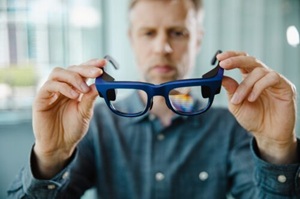
Photo: SCHOTT
Industrial mass production of high-precision glass waveguides
While the project in Helsinki shows how glass can re-define entire urban spaces, SCHOTT pushed the envelope of the material in a different area: the scarcely visible in-lens displays in data glasses. The rendering quality of Augmented Reality is not determined by the software alone but above all by a component called geometric reflective waveguide. Put simply, this reflective glass waveguide forms part of the lens, imports an image from a micro projector, guides it through the lens using embedded semi-transparent mirrors stacked in the lens, to then project it in front of the eye. The real environment remains perfectly visible while the digital information is neatly integrated into the field of vision. To make this work the lens must be manufactured with extreme precision. Even minimal deviations would cause distortions, loss of brightness or colour aberrations.
Photo: SCHOTT
Alongside these waveguides SCHOTT also supplies the high-precision glass wafers – that is all key optical components needed. In Kulim, Malaysia, the company erected a new production site for this in 2024, which can manufacture high numbers of these waveguides. To this end each individual process step in waveguide production was analysed by company accounts: coating here means applying special layers to the glass substrates that later guide the light. The biggest challenge here was to ensure a consistent high quality across thousands of parts without exception. During the following so-called stacking process, several coated glass substrates are precisely arranged and connected with each other. Even the tiniest misalignment would change the image, which is why the team developed new alignment and connection processes that guarantee consistent precision.
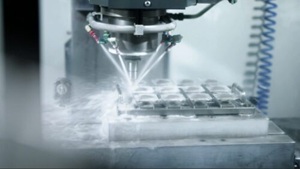
Photo: SCHOTT
During the next step, the slicing, the stacked arrays are cut into thin slices with micron precision – which is the order of magnitude of bacteria or dust particles. After slicing, the surfaces are polished to a high shine because even finest scratches or unevenness would immediately feature in the image. Then shaping is done to give the glass its final geometry; finally, the resulting finished waveguide is subjected to quality assurance for which the team had to develop novel test methods capable of detecting even microscopic defects. All of these steps are designed to achieve a high yield in series production with a view to making wearables such as smart glasses affordable for a mass market.

Photo: SCHOTT
By company accounts, SCHOTT is the first supplier to have succeeded in mass-producing geometric reflective waveguides. The thin, highly efficient waveguides make for both narrow and wide digital fields of vision and are therefore suitable for various AR applications such as navigation or real-time translation all the way to more immersive AR applications.
The upshot of these two impressive projects is that glass solutions are becoming increasingly sophisticated while the complexity of the solution is not immediately visible. glasstec also provides the perfect setting for showcasing the most extraordinary projects and as a trade fair it will once again be the central hub and driving force for exchanging ideas on the future topics in the glass industry from 20 to 23 October 2026 in Düsseldorf.
For more information go to: www.glasstec.de

Marc Everling studied media education (Technical University Brunswick) and has been a communications and marketing specialist in the glass industry for more than 20 years. In 2021 he founded his networking agency specialising in communications consulting and press liaison for companies and associations that work and produce sustainably in the interests of the ecological transformation of the construction sector.
 600450




















Add new comment