This paper was first presented at GPD 2025.
Link to the full GPD 2025 conference book: GPD_2025_ConferenceProceedingsBook.pdf

Authors: Olga Panina a, Nikolai Antipin b, Sergey Shubin c, Petr Gorelchenko d
a. Corning SAS, Finland
b. Finland
c. Finland
d. Corning Inc., USA
Abstract
This research presents a simulation methodology for the Pedestrian Protection test using finite element analysis that enables the generation of robust windshield performance predictions across diverse laminate thicknesses, glass compositions, glass strengthening levels and designs. The approach outlined relies on the application of a nonlocal failure criterion based on critical energy and critical stress. Predictions generated by the model, including deceleration curves, HIC, and fracture patterns, have been validated by empirical test data demonstrating accurate results across a spectrum of windshield shapes, ply thicknesses, and glass compositions. Consequently, the outlined modeling approach may serve as a valuable tool for predicting and comparing the performance of different windshield designs and structures. Using the proposed modeling approach, we studied the performance of asymmetric laminates and unconventional windshield shapes.
Article Information
- Published by Glass Performance Days, on behalf of the author(s)
- Published as part of the Glass Performance Days Conference Proceedings, June 2025
- Editors: Jan Belis, Christian Louter & Marko Mökkönen
- This work is licensed under a Creative Commons Attribution 4.0 International (CC BY 4.0) license.
- Copyright © 2025 with the author(s)
1. Introduction
Safety is an important factor in vehicle design and material selection. Among the many components, the windshield (WS) plays a critical role, not only in protecting the occupants inside the vehicle, but also in protecting pedestrians in case of an accident. Standards (Regulation EU 2019/2144, 2019) were developed to reduce the injuries resulting from collisions with vulnerable road users such as pedestrians, cyclists, and motorcyclists. Vehicles are subjected to evaluation protocol tests (e.g., Euro NCAP) to ensure their safety. In particular, these tests include a pedestrian head impact test for the windshield.
The pedestrian protection head impact test is conducted in accordance with Euro NCAP (Euro NCAP) standards. The test procedure consists of striking the head-form into selected grid point on the windshield and then calculating the head injury criterion (HIC) based on the head-from deceleration during the impact. Two types of head-forms are used: adult (4.5 kg) and child (3.5 kg). The impact angle is 65° for adult head-form and 50° for the child head-form. The impact velocity is 11.1 m/s.
The Head Injury Criterion (HIC) is a measure of the likelihood of head injury arising from an impact. It is defined as:

where t1 and t2 are the initial and final times chosen to maximize HIC, and acceleration a is measured in gs.
Traditionally, windshields consist of two soda-lime glass (SLG) plies with a polyvinyl butyral (PVB) interlayer. The typical thickness of the SLG plies is from 1.6 mm to 2.1 mm. Most conventional windshields have a symmetrical structure (e.g., 2.1 mm/2.1 mm SLG), or a slight asymmetry (2.1 mm/1.6 mm SLG). There are established modeling approaches and calibrated models’ parameters for conventional designs to accurately predict their behaviour in pedestrian protection head impact test [12, 13, 17, 18]. The performance of such designs is well known in the industry as they have been used since 1960’s and have not changed much in recent years.
Nowadays, windshield reliability is becoming increasingly important as replacement costs rise. The incorporation of new technologies such as Heads-Up Displays (HUD) and Automatic Driver Assistance Systems (ADAS) is making windshield replacement more time consuming and costly than in the past (Quain, 2019). Data shows that windshield damage is the most frequently reported insurance claim in the US, accounting for approximately 30% of all auto insurance claims (Campfield, 2003). Investigation of windshield failure modes demonstrated that sharp contact fracture is a primary failure mechanism (69.5%) and that highly asymmetrical constructions, wherein the outer ply is much thicker than the inner ply, have been shown to provide superior sharp impact resistance (Cleary et al., 2020). Therefore, new, innovative solutions for windshield designs are needed to address the reliability challenges, especially sharp impact resistance.
Modern vehicles are getting smarter and using new advanced technologies such as HUD. The quality of the HUD depends on the windshield glass optical quality. Due to the physics of HUD technology, unwanted second “ghost” image is often observed. The severity of this effect depends on the windshield thickness. The optical quality of the HUD could be significantly improved by using thinner glass plies (Leonhard, 2015). At the same time, there is a trend towards larger glazing in vehicles. The lighter the glazing, the better the fuel economy and the lower the CO2 emissions [1, 8]. That is why the industry is looking for new lightweight and thin glass solutions.
In conclusion, there is a pressing need for innovative solutions in windshield technology. These solutions must address current challenges, including enhanced durability, improved optical performance, and weight reduction. New materials like Borosilicate glass, for instance, Corning® Fusion5® glass, and chemically strengthened aluminosilicate glasses, such as Corning® Gorilla® glass along with use of highly asymmetrical constructions can help to overcome these challenges and offer improvements over conventional SLG laminates.
Corning® Gorilla® Glass is a chemically strengthened glass with high flexural strength. Constructions using toughened glass as an innermost ply in windshields laminates has been to provide up to 50% greater durability than conventional windshield with >2x less glass thickness (0.7 mm instead of 1.6 mm), allowing significant weight reduction and improved optical performance compared to traditional SLG designs [4, 9].
Corning® Fusion5® Glass is a purpose-built borosilicate glass for automotive exteriors, designed to help deliver windshields that are lighter, more durable and have better optical performance than conventional windshields. Specifically, Corning® Fusion5® Glass features are (Corning® Fusion5® Product Information Sheet, 2025):
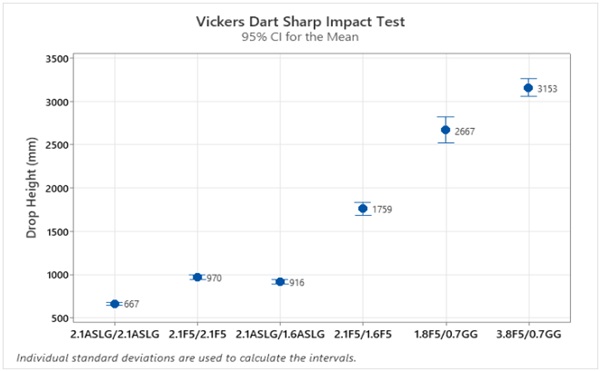
- >2x Better sharp impact resistance (Asymmetric Fusion5® construction vs. traditional windshield, Figure 1). Vickers dart drop test was used to evaluate sharp impact performance. The test determines the drop height for which laminate cracks under the impact of free-falling Vickers dart.
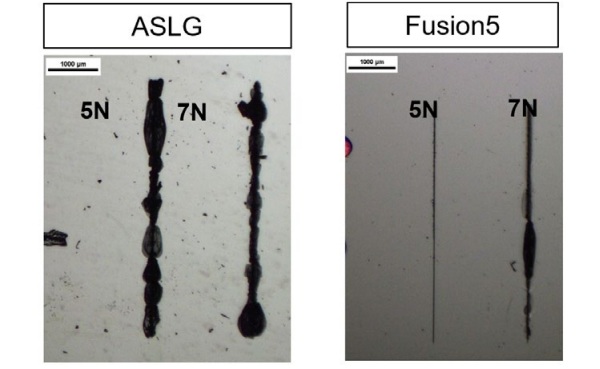
- 5x better scratch performance than SLG (Figure 2).
- >2x better thermal shock resistance.
- 12% Weight savings (over SLG) due to its lower density.
- 2x lower optical distortion over SLG, > 2x lower optics decay (in-use performance).
The performance of novel windshield constructions with Fusion5®, Corning® Gorilla® Glass and asymmetry in the pedestrian head impact test has not been as well-studied as traditional windshields with SLG. There is a limited number of studies on PedPro modeling for windshields with toughened glass (ITF, 2017) and there is no established reliable modeling approach for such glass. Compositions other than SLG, or with high asymmetry are also not well studied and there are no validated modeling approaches for such next generation windshields. The objective of the present study is to demonstrate a simulation methodology for the pedestrian protection head impact test using finite element analysis and its application to different WS constructions, including conventional SLG stacks, and asymmetrical stacks with Fusion5® and Corning® Gorilla® Glass. Modeling predictions were validated over several windshield shapes, glass thicknesses, glass compositions and head-form types. As a result, this study provides an approach to determine the performance of next-generation windshields.
2. Numerial Modeling
The FE analysis has been performed in LS-DYNA explicit solver. The developed model consists of following parts: head-form, laminated glass, rubber gasket. Figure 3 shows a finite-element model of the test for one of the studied WS designs.
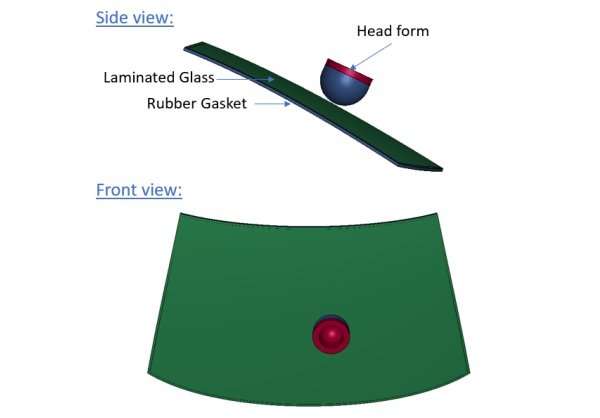
Model parts:
- Laminated glass - three layers structure (Figure 3):
o Outer glass ply – SHELL elements.
o PVB interlayer, 0.76mm thickness, SOLID elements.
o Inner glass ply – SHELL elements.
o Layers are connected by shared nodes.
- Head-form – impactor with brainpan modelled with a rigid material and skin modelled with a soft viscoelastic material (Untaroiu, 2006). The impactor radius – 83 mm (ISO 14513, 2016).
- Rubber gasket – glue that connects windshield to the car frame. FE model consists of WS without actual vehicle or frame support. The windshield is supported along the edges by a rubber gasket which is fixed by the bottom surface. Frictionless contact assumed between the head-form and glass.
Two impact scenarios are considered:
- Adult head impact:
o Impact velocity 11.1 m/s, impact angle 65° to the horizon.
- Child head impact:
o Impact velocity 11.1 m/s, impact angle 55° to the horizon.
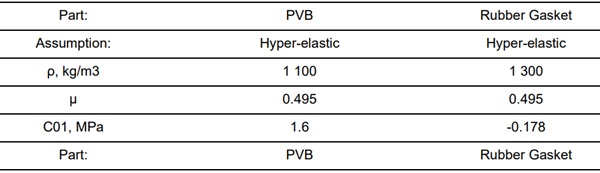
Materials used for windshield model are listed in Tables 1 and 2.
Table 1. Glass Material Properties.
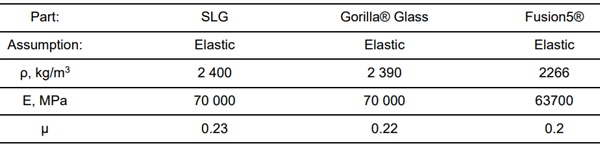
Table 2. Rubber Gasket and PVB Material Properties
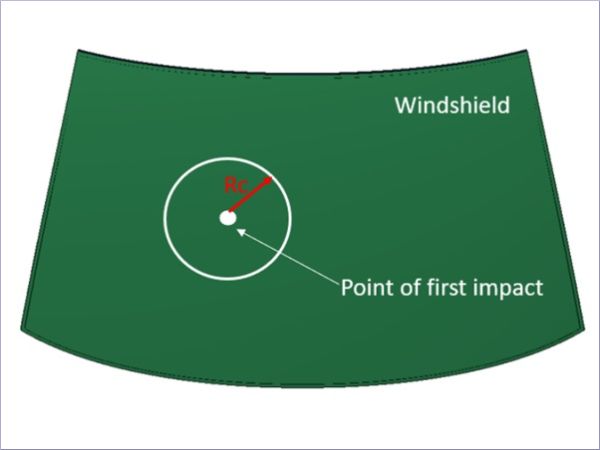
Nonlocal failure criterion (Pyttel et al, 2011) has been used to define glass failure. The criterion is implemented in *MAT_280 (*MAT_GLASS) material model in the commercial finite element solver LSDYNA (LS-DYNA ). The nonlocal criterion developed by Pyttel et al (2011) is a phenomenological criterion, which is based on the hypothesis that strain energy in a finite region around the impact point must reach critical magnitude before failure can occur (Figure 4). For further crack initiation and growth various local criteria could be used, such us Rankine, Mohr-Coulomb, or Drucker-Prager. For the modeling discussed in this article the Rankine criterion (maximum principal stress) has been used.
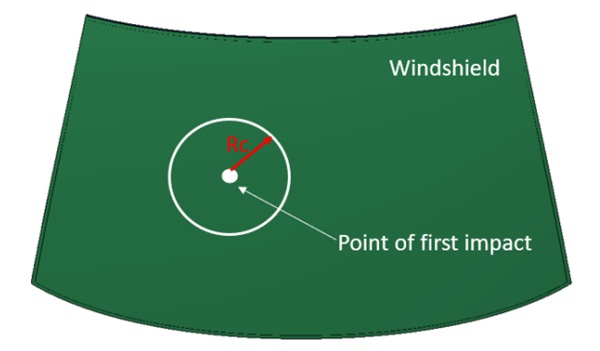
The nonlocal failure criterion integrated in MAT_280 requires following parameters:
- ENGCRT – critical energy for nonlocal failure criterion
- RADCRT – critical radius for nonlocal failure criterion
The nonlocal failure criterion parameters were determined from glass coupon testing, values used for various glasses and thicknesses are listed in Table 3.
Table 3. Nonlocal Failure Criterion Parameters.

3. Validation of the Model
Three WS shapes were considered to validate the model. The WS shape #3 is presented in Figure 3, it has a low curvature and dimensions 1400x900 mm. The WS shape #1 has similar dimensions but surface curvature at impact point is x1.3 times higher. The WS shape #2 is half scaled option of shape #1. Tests were performed for different laminates, impact locations and with different head-forms (adult/child) to demonstrate the model robustness.
3.1. WS Shape
Two tests were carried out on the same laminate to validate the model for different WS shapes:
- Test 1: WS shape 1; 1.85 mm SLG/ 0.76 mm PVB/ 1.85 SLG, central impact, adult head.
- Test 2: WS shape 2; 1.85 mm SLG/ 0.76 mm PVB/ 1.85 SLG, central impact, adult head.
Figure 5 shows the comparison of modeling and testing results.
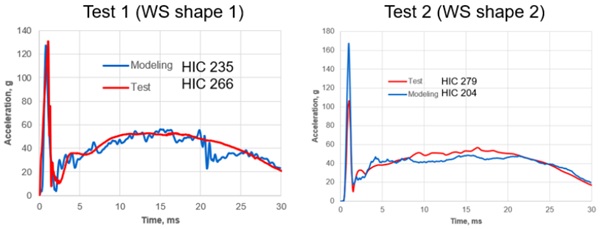
We can see good agreement between modeling and testing in terms of acceleration curve shape and HIC values. Thus, the model provides accurate predictions for different WS shapes.
3.2. Glass Composition
Three tests were carried out to validate the model across different glass compositions and constructions:
- Test 3: WS shape 3; 2.1 mm SLG/ 0.76 mm PVB/ 0.7 mm Gorilla® Glass, impact location A9;-2, adult head.
- Test 4: WS shape 3; 3.0 mm Fusion5®/0.76 mm PVB/1.6 mm SLG, impact location A11;-1, adult head.
- Test 5: WS shape 3; 3.0 mm SLG/0.76 mm PVB/1.6 mm SLG, impact location A11;-1, adult head.
Figure 6 show the comparison of modeling and testing results.
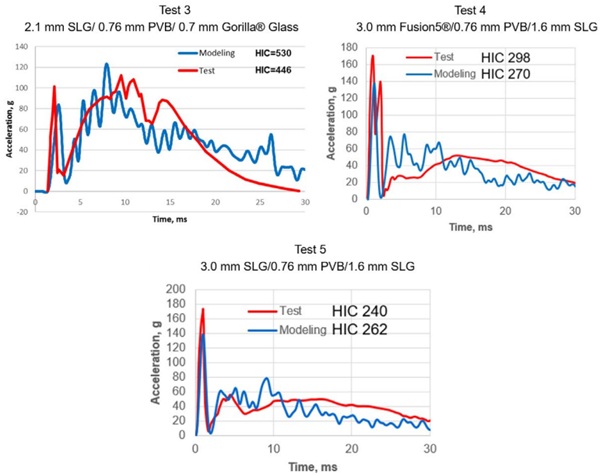
The result of Test 3 demonstrates that the windshield with Gorilla® Glass inner ply successfully passes the PedPro test with the highest score (HIC<650). The model with the nonlocal energy criterion accurately predicts toughened glass behaviour.
From Test 4 and Test 5 we can see that the windshields with SLG and Fusion5® as the outer ply have similar performance in the PedPro test (HIC 240 and 298 respectively). The PedPro test result for asymmetric laminates with SLG and with Fusion5® are both in the green zone (HIC<650). Modeling accurately predicts the response of both glass types.
3.3. Head-Form Type
Tests with adult and child head-form were caried out to validate model for different test scenarios.
- Test 1: WS shape 1; 1.85 mm SLG/ 0.76 mm PVB/ 1.85 SLG, central impact, adult head.
- Test 6: WS shape 1; 1.85 mm SLG/ 0.76 mm PVB/ 1.85 SLG, central impact, child head.
Figure 7 shows the comparison of the modeling and testing results.
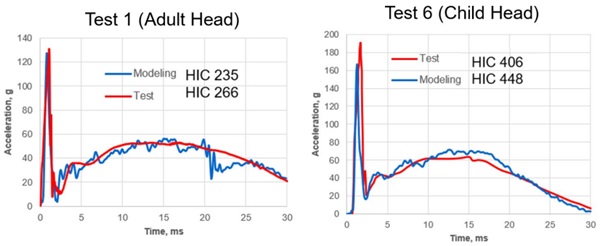
We can see that the model prediction agrees well with the test result for both head-forms. The model has therefore been validated for both test scenarios.
3.4. Validation Summary
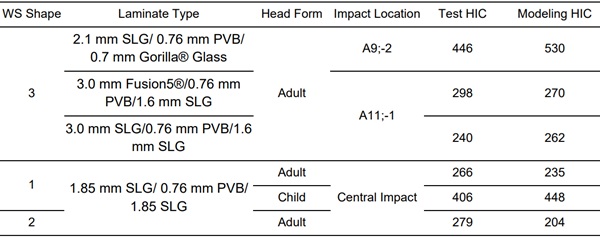
A total of 6 tests were performed to validate the model and demonstrate its robustness. Executed tests cover 3 WS shapes, 3 impact locations, 2 head-forms, 4 laminate types. The laminates tested include different glasses as inner and outer plies: SLG, Fusion5®, Gorilla® Glass. A wide range of glass thicknesses were covered: from 0.7 mm to 3.0 mm. In each test we see good agreement between the test result and the modeling prediction. The tests performed and the corresponding modeling results are summarized in Table 4.
Table 4. Validation Summary
4. Asymmetric WS Constructions Evaluation
In the previous section we demonstrated that the proposed modeling approach works accurately for SLG, Fusion5® and Gorilla® Glass plies, as well as for different glass thicknesses and WS shapes. Thus, this model could be used as a powerful tool to explore the PedPro test performance of different WS designs or laminate types.
The conventional WS shape was chosen to compare PedPro test performance of different laminates. Central impact position with adult head-form was modeled. The following laminate options were selected for comparison:
- 2.1 mm SLG/ 0.76 mm PVB / 2.1 mm SLG – conventional WS structure
- 3.3 mm Fusion5® / 0.76 mm PVB / 0.7 mm Gorilla® Glass
- 3.3 mm Fusion5® / 0.76 mm PVB / 1.2 mm Fusion5®
- 3.0 mm Fusion5® / 0.76 mm PVB / 1.2 mm Fusion5®
- 2.7 mm Fusion5® / 0.76 mm PVB / 1.6 mm SLG
- 2.7 mm Fusion5® / 0.76 mm PVB / 1.6 mm Fusion5®
Laminate Option 1 is a conventional WS structure. Options 2-6 asymmetric are laminates with Fusion5® outer ply, which provides high durability, weight reduction and better optical performance compared to Option 1. Modeling allows to compare performance of these laminates in the PedPro test. Figure 8 shows a comparison of the HIC values obtained.
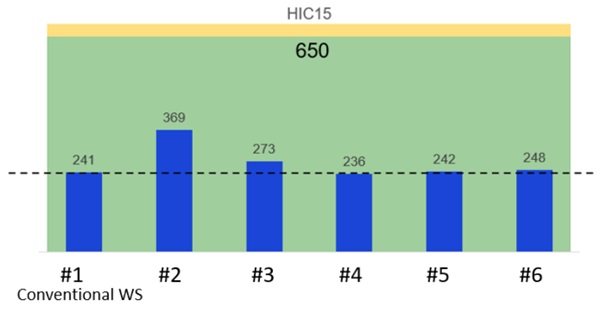
From Figure 8 it can be seen that all HIC values are within the green zone (<650). Conventional WS shows HIC=241. Laminates 4-6 with Fusion5® show almost the same result (236-248). Laminates 2- 3 with 3.3 mm Fusion5® outer ply show slightly higher HIC values, but absolute value is still well below 650.
From this comparison we can conclude that the Fusion5® outer ply or laminate asymmetry in the WS has little effect on the PedPro performance, while providing significant weight, durability, and optical benefits.
5. Conclusions
Novel windshield constructions are needed to replace traditional SLG laminates to meet industry’s increasing demands for reliability, optical performance, and light weight. Innovative asymmetric laminates with Fusion5® and Corning® Gorilla® Glass meet the industry’s needs by providing superior sharp impact resistance, weight reduction and better optical properties compared with conventional laminates. At the same time, a part of the vehicle, the windshield must pass industry standard tests, including the pedestrian protection head impact test. In this article we demonstrated a robust FE modeling approach to predict PedPro test performance for a wide range of windshields, considering laminate asymmetry and different glass types, including toughened glass. Model validation over different WS types and test scenarios was presented. The model allows to assess performance of windshield with standard SLG as well as with toughened and borosilicate glass. Modeling and testing show that:
- Windshields with SLG and Fusion5® outer ply of the same thickness perform similarly in the PedPro test. This means that constructions with Fusion5® do not lead to worse performance in the PedPro test.
- Asymmetric constructions do not worsen the PedPro test performance. HIC predicted by modeling for asymmetric constructions is similar to the conventional WS.
The modeling approach demonstrated can serve as a powerful tool to predict the performance of various WS designs and constructions in Pedestrian protection head impact test.
References
Euro NCAP – The European New Car Assessment Programme. Retrieved from https://www.euroncap.com/
Campfield, R. (2003, May 1), Facts and Findings about Windshields. The Insurance Journal. Retrieved from http://www.insurancejournal.com/services/newswire/2003/05/01/41550.htm
Cleary, T.M., Tremper, T., Huten, T., Strong, D. et al. (2020). Characterization and Quantification of In-Service Windshield Fracture Mechanisms and Evaluation of Laminate Sharp Impact Resistance as a Function of Construction, SAE Technical Paper 2020-01-0607, https://doi.org/10.4271/2020-01-0607
Corning® Fusion5® Product Information Sheet (2025). Retrieved from https://www.corning.com/media/worldwide/csm/documents/COR_US_ProdSheet_Fusion5.pdf
ISO 14513 (2016), Road Vehicles – Pedestrian Protection – Head Impact Test Method.
ITF (2017). Lightening Up: How Less Heavy Vehicles Can Help Cut CO2 Emissions, International Transport Forum Policy Papers 40.
Leonhard, T., Cleary, T., Moore, M., Seyler, S. et al. (2015). Novel Lightweight Laminate Concept with Ultrathin Chemically Strengthened Glass for Automotive Windshields. SAE Int. J. Passeng. Cars - Mech. Syst. 8(1), 95-103, http://dx.doi.org/10.4271/2015-01-1376
LS-DYNA. Keyword user’s manual. Volume II. Livermore Software Technology Corporation (LSTC)
Pyttel, T., Lieberz, H., Cai, J. (2011). Failure criterion for laminated glass under impact loading and its application in finite element simulation, International Journal of Impact Engineering, 38, 4, 252-63, https://doi.org/10.1016/j.ijimpeng.2010.10.035
Quain, J.R. (2019, Feb. 7). When the Windshield Helps Drive the Car, a Repair Isn’t So Simple. The New York Times. Retrieved from https://www.nytimes.com/2019/02/07/business/windshield-repairs.html
REGULATION (EU) 2019/2144 OF THE EUROPEAN PARLIAMENT AND OF THE COUNCIL. (2019, Nov 27).
Untaroiu, C. & Shin, J. & Crandall, J. & Crino, S. (2006). Development and Validation of a Headform Impactor Finite Element Model with Application to Vehicle Hood Design for Pedestrian Protection.