This paper was first presented at GPD 2025.
Link to the full GPD 2025 conference book: GPD_2025_ConferenceProceedingsBook.pdf

Authors: Louis Dellieu, Anna Šikyňová, Julien Jeanfils
AGC Glass Europe, Belgium
Abstract
Vacuum insulated glazing (VIG) represents a breakthrough in energy-efficient construction products. This paper examines the diverse applications of those products in residential, commercial, and heritage buildings, highlighting specific projects that demonstrate their adaptability and superior performances. The need of appropriated product specifications will be detailed, focusing on the design challenge of load calculations to determine optimal thicknesses, balancing thermal performance with structural integrity. Additionally, the paper addresses legal challenges, including compliance with building codes and international standards. This comprehensive overview will provide insights into VIG's development, the strategic approach to overcoming design and legal hurdles, and its successful implementation in real-world projects, emphasizing its role in sustainable building technologies.
Article Information
- Published by Glass Performance Days, on behalf of the author(s)
- Published as part of the Glass Performance Days Conference Proceedings, June 2025
- Editors: Jan Belis, Christian Louter & Marko Mökkönen
- This work is licensed under a Creative Commons Attribution 4.0 International (CC BY 4.0) license.
- Copyright © 2025 with the author(s)
1. Introduction
Vacuum insulating glazing (VIG) represents a significant advancement in the realm of energy-efficient construction products (Cuce & Cuce, 2016). VIG emerges as a pivotal technology, offering superior thermal insulation while maintaining a slim profile. This paper delves into the diverse applications of VIG across residential, commercial, and heritage buildings, showcasing specific projects that underline its adaptability and exceptional performance.
The development of VIG involves meticulous product specifications, particularly in addressing the design challenge of load resistance calculations to determine the optimal thicknesses (Aronen & Kocer, 2017) (Ayvaz & Kocer & Schneider, 2023) (Collins & Fischer-Scripps, 1991). This balance between thermal performance and structural integrity is crucial for the successful implementation of VIG. Furthermore, the paper explores the legal challenges associated with VIG, including adherence to building codes and international standards, which are essential for its widespread adoption.
Through a comprehensive overview, this paper provides valuable insights into the evolution of VIG, the strategic approaches to overcoming design and legal obstacles, and its effective application in realworld scenarios. Emphasizing its role in sustainable building technologies, VIG stands out as a transformative solution in the pursuit of energy efficiency.
2. Structure and Performances of a VIG
2.1. VIG description
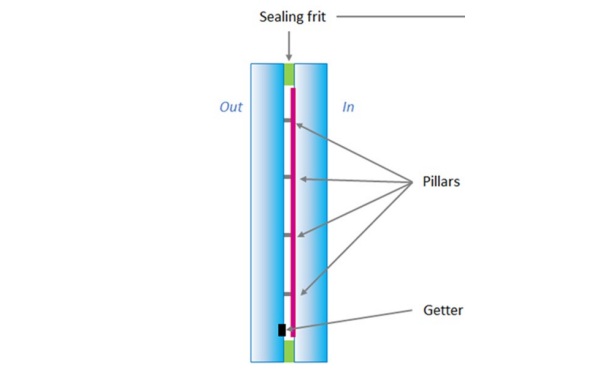
VIG consists of two glass panes separated by a narrow vacuum gap, maintained by strategically placed micro-pillars. These pillars are arranged in a precise grid pattern to ensure constant thickness of the vacuum layer and structural stability. A visible evacuation can be present or not. The edges of the glass panes are sealed with a durable barrier, often made of ceramic or metal, to maintain the vacuum. Additionally, a gas trap is incorporated to preserve the vacuum after manufacturing, ensuring longlasting thermal performance and durability. Coated glass components are generally used in VIG as they significantly contribute to achievement of the very low U-value. Reference can be made to Fig. 1.
2.2. Main product features
VIG showcases a variety of notable features, some of which are highlighted below (this is not an exhaustive list):
Energy Efficiency: By significantly reducing heating and cooling costs, VIG contributes to the overall energy efficiency of buildings, supporting sustainable building practices.
Superior Thermal Insulation: VIG provides exceptional thermal insulation due to the vacuum gap between the glass panes and due to an efficient low emissivity coating, significantly reducing heat transfer and improving energy efficiency and thermal comfort of indoor areas.
Optimized Performance Balance: VIG achieves the thermal insulation (U-value) of triple glazing while maintaining the light transmission (TL) and solar gain (g-value) of double glazing, making it ideal for climates where solar heat is a valuable resource in winter.
Acoustic Insulation: VIG can provide excellent acoustic insulation thanks to the vacuum cavity, reducing noise pollution and enhancing the comfort of building occupants.
Thin Profile: Despite its high insulating properties, VIG maintains a slim profile, making it suitable for various applications without requiring significant changes to existing window frames.
Lower weight: Compared to triple IGU, the weight of VIG is 30% lower.
Adaptability: VIG allows keeping existing window frames, making it an ideal solution for upgrading the thermal and acoustic performance of heritage buildings without altering their historical appearance. In addition, it can be used as an individual component of an traditional double glazing unit resulting in an overall thickness of a double IGU while providing thermal performance better than a triple IGU can provide.
Aesthetic: VIG allows for larger glass surfaces without compromising on thermal performance, enhancing the aesthetic appeal of all types of buildings.
Durability: The design, materials used in VIG, precision of the technology and factory production controlensure its durability and long-term performance, even under varying environmental conditions.
3. Applications of VIG
VIG has emerged as a versatile and highly efficient solution for enhancing the thermal performance of buildings. Its unique properties make it suitable for a wide range of applications across different types of buildings. This section explores the diverse applications of VIG in residential, commercial, and heritage buildings, supported by specific project examples that demonstrate its adaptability and superior thermal insulation capabilities.
3.1. Residential Buildings
In residential buildings, VIG offers significant benefits in terms of energy savings and thermal comfort. Homeowners can achieve substantial reductions in heating and cooling costs due to the excellent thermal insulation properties of VIG. Additionally, VIG helps in maintaining a stable indoor temperature, enhancing the overall comfort of living spaces.
Case Study: Brussels Villa Renovation A notable example is the renovation of a magnificent villa located in Brussels (Fig. 2), where VIG was used to replace single glazing units. The renovation allowed the existing frames to be retained, preserving the old-style windows and maintaining the house's historical character. This upgrade not only improved the thermal insulation of the villa but also ensured that its aesthetic appeal remained intact.

3.2. Commercial Buildings
Commercial buildings, such as offices, shopping centers, and hotels, can greatly benefit from the integration of VIG. The superior insulation properties of VIG help in reducing the operational costs associated with climate control, while also contributing to the building's overall energy efficiency. Moreover, VIG can enhance the aesthetic appeal of commercial spaces by allowing for larger glass surfaces without compromising on thermal performance. Finally, VIG can be considered as an interesting replacement solutions, without the need to change the complete windows structure.
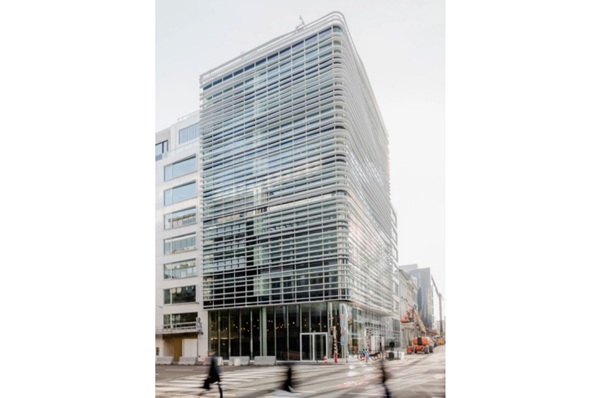
Case Study: Belliard Street Office Building For this project (Fig. 2), VIG used as a component of a double glazing was used to reach unprecedented performances in terms of thermal insulation and acoustics. Belliard Street (Brussels, Belgium) is a highly frequented road, leading to unpleasant noise pollution. Thanks to VIG, it was possible to achieve very high acoustical attenuation in a limited thickness, allowing for increased space inside the building. This innovative solution not only improved the building's energy efficiency but also significantly enhanced the comfort of its occupants by reducing noise levels and stabilizing overall room temperature.
3.3. Heritage Buildings
Heritage buildings often face the challenge of upgrading their thermal performance without altering their historical appearance. VIG offers an ideal solution, as it can be retrofitted into existing window frames, preserving the architectural integrity of the building while significantly improving its energy efficiency.
Case Study: The Court of Justice in Amsterdam This example (Fig. 3) considers a prominent heritage building in the city. The old single units were easily replaced with IGU integrating VIG, which, thanks to its thinness, made it possible to retain the original timber frames while improving thermal insulation. The building's authentic Dutch charm has thus been preserved, ensuring that its historical and cultural heritage remains intact while benefiting from modern energy efficiency improvements.

4. Product Specifications and Design Challenges
The successful implementation of VIG in various building types hinges on meticulous product specifications and overcoming inherent design challenges. VIG technology, while offering superior thermal insulation, requires careful consideration of several factors to ensure optimal performance and structural integrity. This section delves into the critical aspects of product specifications, focusing on the design challenges associated with load resistance calculations.
VIG units are subjected to permanent loads (due to the pillars), variable loads due to temperature gradients between the two environments and external loads, e.g. wind, which are the same than for standard insulated glass. The resulting stresses and deformations in VIG components are assessed according to established principles. It should be noted that, due to the presence of vacuum, climatic loads do not occur with VIG like for traditional insulating glazing.
4.1. Pillars loads
The spacer pillars, arranged in a regular grid with a λ pitch, are positioned with a reference edge between the two glass panes. This arrangement ensures the stable thickness of the vacuum space but also creates point forces at the surface of adjacent glass panes, generating localized permanent stress.
The permanent load, noted 𝜎𝑝 induced by the presence of the pillars depends on the thickness t of each glass sheet and the distance of the pillars. The resulting stresses and deformations must be carefully calculated and summed according to established principles to ensure they remain within allowable values for each combination of actions. This is crucial for maintaining the structural integrity and performance of the VIG units. This pillar load can be calculated following the specifications described in (Collins & Fischer-Scripps, 1991) :

4.2. Warping
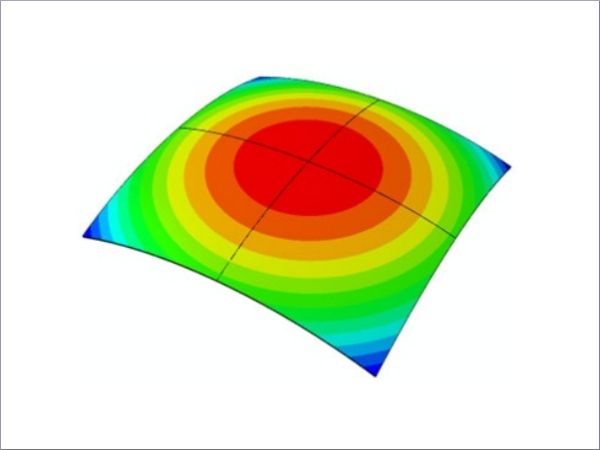
When exposed to temperature differences between the inside and outside of a building, the two glass panes in VIG will have different temperatures (Aronen & Kocer, 2017). If the glass could freely deform, it would tend to take on a spherical shape (Fig. 4).
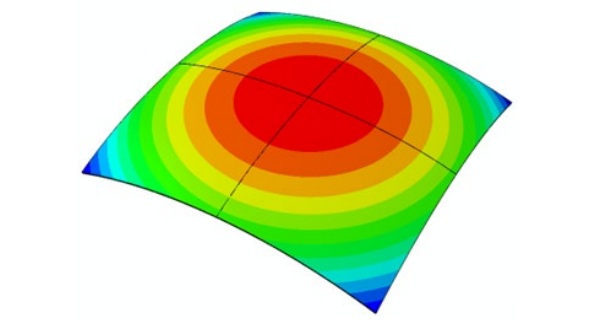
Due to the rigid link between the two panes, this temperature difference induces deformation and stress, so called warping 𝜎𝑡, on the VIG unit.
As the glass must be held inside a frame, this deformation can lead to glass breakage. Fortunately, this feature is a typical engineering challenge, and the solutions to counter it are well known. Introducing some softness between the VIG and its frame, typically through the use of specific gaskets or putty, can effectively mitigate this phenomena. This approach helps to absorb a part of the stresses and prevent breakage, ensuring the structural integrity and declared performance of the glazing.
To address these challenges, detailed finite element methods are employed to analyze and predict the behavior of every type of VIG configuration under different environmental conditions. By using meteorological data from the location where the VIG will be installed, the correct orientation and the exact VIG configuration, the temperature differences, resulting stress and deformations can be accurately calculated.
In case of laminated VIG, the level 3 of interlayer modelling according to the latest version of prEN 19100-1 is used.
4.3. Wind loads
When determining designed wind loadfor VIG, the wind pressure must be calculated according to EN 1991-1-3 taking into account geographical location, building shape and terrain characteristics. Design wind load is applied on a fictive glasswhose thickness corresponds to the sum of nominal thicknesses of both glass panes of the VIG. However, such simplification may only be applied, when validation using four-point-bending test is successful.
In case of laminated VIG, the level 3 of interlayer modelling according to the latest version of prEN 19100-1 is used.
4.4. Other external loads
Other external loads e.g. imposed loads that can be represented as a surface, a line or/and a concentrated load may be required to be assessed. Those are specified in Eurocode and/or national building codes.
These loads are applied on relevant side of the VIG. Such load generally results in significant stress and deflection value requiring increase of thicknesses of glass panes.
In case of laminated VIG, the level 3 of interlayer modelling according to the latest version of prEN 19100-1 is used.
4.5. Load combinations and design strength
As described in chapters 4.1 to 4.4, loads are applied on VIG or its equivalent, and resulting tensile stresses and deformations are generated. Those are then combined according to combination rules described in EN 1990 and EN 16612. The latest available version of prEN 19100-1 can also be applied.
The design bending strength is determined according to EN 16612 or applicable national standard taking into account a proposed load duration from EN 16612 or a nationally determined value, in function of location of the building. As an option, design bending strength can be determined according to the latest available version of prEN 19100-1.
As a final step, resulting tensile stress in each relevant combination is compared to design bending strength of annealed float of the shortest load duration as recommended in EN 16612 and prEN 19100-1.
4.6. Discussion
Designing Vacuum Insulated Glazing (VIG) involves addressing several critical challenges to ensure both optimal thermal performance and structural integrity. The balance between maintaining a thin profile for superior insulation and ensuring mechanical strength is a primary concern.
The presence of micro-pillars, essential for maintaining the vacuum gap, introduces localized stress points that require a precise calculation.
Additionally, even after mitigation through the use of flexible gaskets or putty, differential thermal expansion between the two glass panes, caused by temperature variations, generally induces significant thermal stresses.
Wind loads, which vary based on geographical location, terrain and building shape, necessitate robust structural analysis to ensure the VIG can withstand environmental forces.
Other external loads (surface, line or/and a concentrated load) may be required to be assessed next to above mentioned loads, by Eurocode and national best practice documents.
Addressing these challenges requires a comprehensive understanding of materials physical properties, mechanism of connections between different materials, influences of environmental conditions on VIG, transforming temperature differentials into stress using advanced simulation techniques, and adherence to the latest national and international standards applied to structural integrity of glass. By overcoming these design hurdles, VIG can be successfully implemented in various building types, contributing to energy efficiency and sustainable building technologies.
5. Legal Framework of VIG
The regulatory landscape for VIG is currently evolving, as there is no existing harmonized product standard for VIG. Efforts are underway to develop such a standard, but until it is finalized, manufacturers must navigate alternative routes to ensure compliance to Construction Products Regulation (CPR) and market access.
Two international standards referring to VIG have been published by ISO. Those are ISO 19916- 1:2018, currently in revision, and ISO 19916-3. The new standard ISO 19916-4 specifying pendulum impact testing is currently under development. However, these standards cannot be used as a proof of compliance to the CPR. One viable pathway for CE marking of VIG products is through the European Technical Assessment (ETA) process, facilitated by the European Organisation for Technical Assessment (EOTA), typically used for innovative products. This route is voluntary. Its steps are specified in the CPR. EOTA route allows for CE marking, providing a means for manufacturers to demonstrate conformity with the European law. Notably, an European Assessment Document (EAD) specific to VIG was published in the Official Journal of the European Union (OJEU) in November 2024 (EAD 300021-00-0404), offering a structured framework for obtaining an ETA.
In addition to the EOTA route, it is important to note that some countries may impose additional national requirements for the installation and use of VIG. Depending on whether an ETA has been issued for the VIG in question, various national certifications documents may be required, such as :
- Germany: Allgemeine bauaufsichtliche Zulassung (abZ) and/or Allgemeine Bauartgenehmigung (aBG)
- France: Avis Technique and/or Document Technique d’Application (DTA)
- The Netherlands: Kwaliteitsverklaring
- Belgium: Agrément Technique (ATG)
These certifications address specific national standards that go beyond the scope of the CPR, ensuring compliance with local building regulations.
By navigating these regulatory pathways, manufacturers can ensure that their VIG products are legally compliant and can be confidently marketed and installed across different regions, thereby fostering innovation and adoption of this advanced glazing technology.
6. Conclusions
VIG stands out as a groundbreaking advancement in energy-efficient construction products, offering exceptional benefits in term of energy efficiency, thermal comfort, noise reduction and adaptability across various building types. This paper has explored the diverse applications of VIG in residential, commercial, and heritage buildings, showcasing projects that highlight its superior performance and versatility. The detailed examination of product specifications, particularly the design challenge of load resistance calculations, underscores the importance of balancing thermal performance with structural integrity. Additionally, the paper has addressed a part of the legal challenges associated with VIG, emphasizing the need for compliance with European law, national building codes, international standards and the fact that this innovative product is not covered by any harmonized European product standard. Through a comprehensive overview, this paper has provided valuable insights into the assessment of VIG, the strategic approaches to overcoming design and legal obstacles, and its successful implementation in real-world scenarios. VIG's role in sustainable building technologies is clear, positioning it as a transformative solution in the pursuit of maximizing energy efficiency, thermal comfort and noise reduction.
References
Aronen, A, Kocer, C (2017). Vacuum Insulated Glazing under the Influence of a Thermal Load. GPD 2017
Ayvaz, I, Kocer, C, Schneider, J (2023). Vacuum insulated glazing (VIG) units under wind load. Retrieved from
https://www.researchgate.net/publication/375886669_Vacuum_insulated_glazing_VIG_units_under_wind_load-part_1_global_deformation_and_stresses_on_the_outer_glass_surfaces
Collins, R.E, Fischer-Scripps, A.C., Design of support pillar arrays in flat evacuated windows, Australian Journal of Physics, 44, 73-86, 1991.
Cuce, E, Cuce, P.M. (2016). Vacuum glazing for highly insulating windows: Recent developments and future prospects. Retrieved from https://www.sciencedirect.com/science/article/abs/pii/S1364032115012137
EAD 300021-00-0404, Vacuum insulating glass units, 2024. Retrieved from :
https://www.eota.eu/eads?search=vacuum&product=all&published=all#eads-results
EN 16612, Glass in building - Determination of the lateral load resistance of glass panes by calculation
PrEN 19100-1:2024, Eurocode 10 - Design of glass structures - Part 1: General rules
EN 1991-1-4:2005, Eurocode 1: Actions on structures – Part 1-4 : Wind actions
ISO 19916-1:2018 Glass in building — Vacuum insulating glass - Part 1: Basic specification of products and evaluation methods for thermal and sound insulating performance
ISO 19916-3:2021 Glass in building — Vacuum insulating glass - Part 3: Test methods for evaluation of performance under temperature differences