This paper was first presented at GPD 2025.
Link to the full GPD 2025 conference book: GPD_2025_ConferenceProceedingsBook.pdf

Author: J. Gregory Couillard, Corning Incorporated, U.S.A
Abstract
New innovations are increasingly required in the architecture industry to provide higher performance solutions. Glass compositions, which are almost infinite in number, can be selected by designers to achieve required performance levels in end applications. While soda lime silicate is the most commonly used glass in architecture, other glass families such as borosilicates and aluminosilicates are also employed. This paper describes a boro-aluminosilicate glass, new glass composition type that falls outside the currently defined composition space of existing architectural glasses. Boro-aluminosilicate glass is well-suited for architectural applications with high resistance to thermal stress, bending stress, scratches, and chemical corrosion. With a viscosity compatible with fusion downdraw processing, it is ideal for producing glass panes that are thinner (less than one millimetre) and lighter than soda lime silicates while having a lower carbon footprint. The development of boro-aluminosilicate glass presents a promising solution for architectural applications requiring advanced glass materials.
Article Information
- Published by Glass Performance Days, on behalf of the author(s)
- Published as part of the Glass Performance Days Conference Proceedings, June 2025
- Editors: Jan Belis, Christian Louter & Marko Mökkönen
- This work is licensed under a Creative Commons Attribution 4.0 International (CC BY 4.0) license.
- Copyright © 2025 with the author(s)
1. Boro-aluminosilicate glass
Soda lime silicate is the most well-known glass, commonly used in architecture, automotive glazing, and containers. Other glass families such as borosilicates also have architectural applications (BrandtSlowik, 2023). However, the world of glass is vast, with new compositions being created every year. To overcome some of the limitations of current architectural glass Corning Incorporated has developed a boro-aluminosilicate glass with high resistance to thermal stress, bending stress, scratches, and chemical corrosion. Some examples of boro-aluminosilicate glasses are shown in Table 1.
Table 1: Examples of boro-aluminosilicate glass composition ranges.
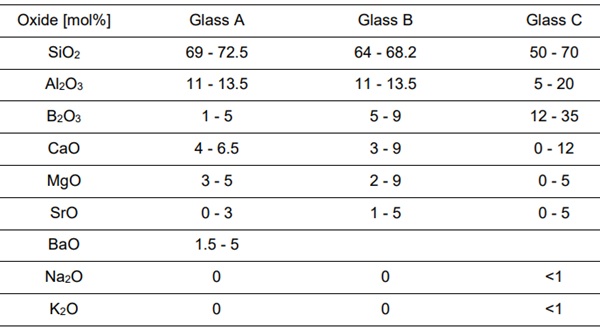
The glasses of Table 1 were selected from Ellison, Kiczenski, Markham, and Mauro (2015), Ellison (2013), and Ellison, Frackenpohl, Mauro, Noni, and Venkataraman (2017), respectively. Note that they are largely alkali-free, and therefore not within the composition ranges specified for soda lime silicate glass in EN 572-1 or alkaline earth silicate glass in EN 14178-1. Similarly, the alumina content exceeds the range for borosilicate glasses in EN 1748-1-1 and the calcium oxide is beyond the range for alumino silicate glasses in EN 15681-1. Boro-aluminosilicate therefore represents a new glass composition space for architecture.
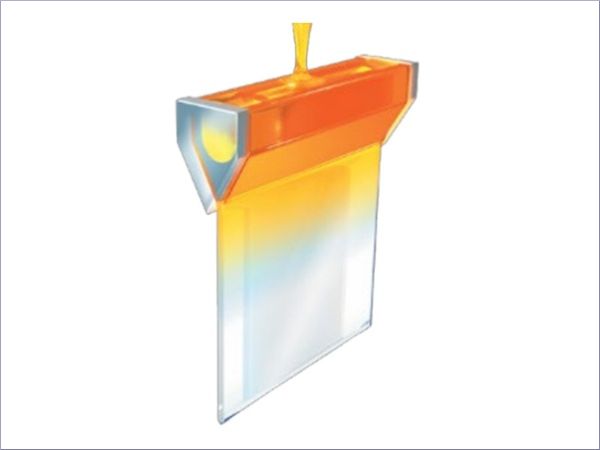
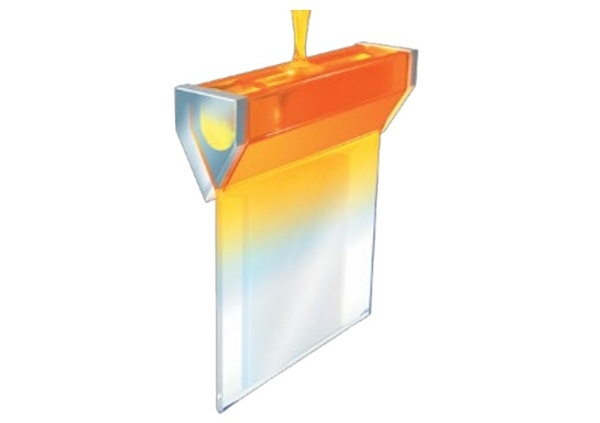
The composition of these boro-aluminosilicate glasses results in a viscosity which is compatible with a fusion downdraw forming process, in which molten glass fills a specially designed isopipe and overflows its edge, fusing together at the bottom of the isopipe as illustrated in Fig. 1. The glass cools and solidifies in midair without contacting tin or other surfaces (Corning, 2023). Fusion forming is ideally suited for ultra-thin glass sheets less than one millimetre in thickness, which enables glazing of reduced thickness and weight. In addition to having lower mass than conventional glass panes, the glass is melted primarily with electricity rather than natural gas resulting in lower embodied carbon (MeyerFredholm, 2025 and UL Solutions, 2022). The resulting glass sheets do not need to be polished, leading to a pristine surface.
2. Optical and Thermal properties
Corning’s ultra-thin glass for architectural applications is a boro-aluminosilcate glass with a low coefficient of thermal expansion (CTE), 3.2 x 10⁻⁶/K over the range 0-300 °C, as compared to 9 x 10- 6/K for soda lime silicate (EN 572-1). This gives it a higher resistance to thermal shock as well as stress from thermal gradients, a known source of glass breakage in architectural applications (e.g. Pilkington 2013). The resistance of boro-aluminosilicate glass against temperature differential and sudden temperature change has not been characterized, however a value of at least 80 K is expected based on glasses with similar CTE (EN 1748-1-1). The difference in CTE between soda-lime silicate glass and boro-aluminosilicate glass also induces compressive stress forming in the boro-aluminosilicate when the two materials are laminated. As a result the boro-aluminosilicate is more resistant to breakage from impact or flexure, which is advantageous for hurricane laminate applications.
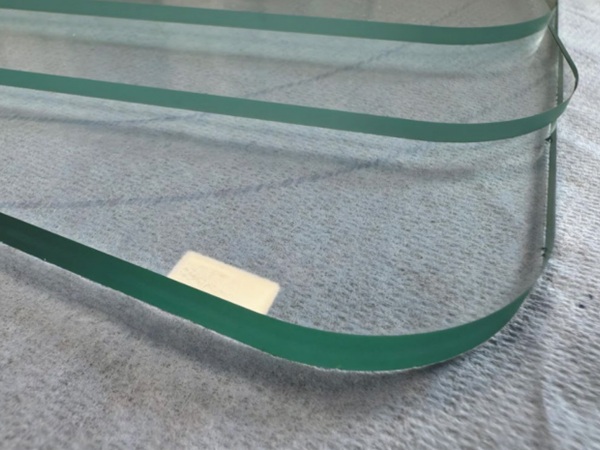
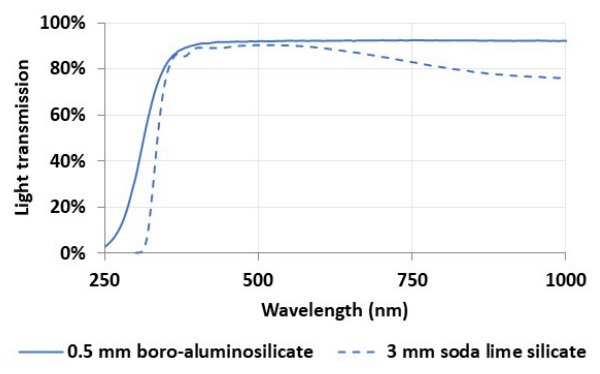
The iron-free composition results in a glass with high light transmission (92% in the visible range) and a neutral colour, as shown in Fig. 2.
3. Chemical durability
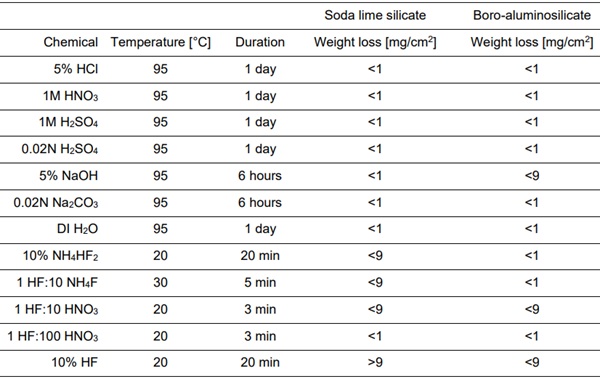
The chemical durability of boro-aluminosilicate glass is comparable to or better than that of soda lime silicate glass for most chemicals, due to the high silica content and lack of alkali ions. Table 2 shows weight loss of glass samples measured after exposure to various highly reactive chemicals. Glass corrosion was minimal for both soda lime silicate and boro-aluminosilicate glass, with most glass samples remaining clear after exposure or exhibiting only slight haze. (Soda lime silicate exposed to 10% hydrofluoric acid is the exception, exhibiting both high corrosion and visible distortion after chemical exposure.)
Table 2: Weight loss from exposure to various chemicals.
4. Mechanical properties
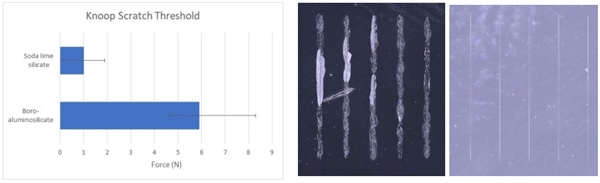
Scratch resistance of boro-aluminosilicate glass was conducted using a Knoop pyramidal diamond point with 1 N to 8 N applied load. Visible lateral cracks were observed forming in soda lime silicate glass at 1-2 N, whereas cracks did not develop in boro-aluminosilicate glass until 6-8 N (Fig. 3). The higher scratch resistance means boro-aluminosilicate glass are less likely to acquire rejectable scratch defects from handling during manufacture or in the end application.
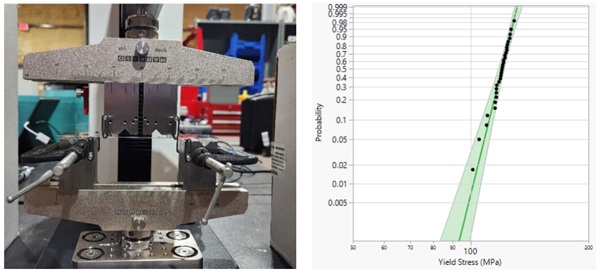
The bending strength of boro-aluminosilicate glass was evaluated using a four-point bend apparatus (Fig. 4). Thirty 152.4 x 38.1 x 0.5 mm glass bars were loaded at a rate of approximately 115 MPa/s until glass breakage was observed (Brackin 2025). The stress corresponding to a 5% probability of breakage was 108 MPa. The high characteristic bending strength is attributed to the pristine fusion surface with few surface flaws.
5. Conclusions
Boro-aluminosilicates are a family of advanced glasses new to the architectural space. They can be manufactured as ultra-thin glass sheets less than one millimetre in thickness, in sizes up to 3050 x 2240 mm, which can enable glazing with reduced thickness, weight, and carbon footprint. The composition causes the glass to perform as well as or better than soda lime of the same thickness under thermal stress, bending stress, scratches, and chemical corrosion. Boro-aluminosilicate glass therefore presents a promising solution for architectural applications. Other papers and talks in this forum will cover processing and commercial applications.
References
Brandt-Slowik, J. (2023). Structure-property correlations in borosilicate in comparison to soda-lime glass. Glass Performance Days Proceedings, 93-96. https://gpd.fi/GPD2023_proceedings_book/
Brackin, M.S. (2025). Presented at Glass Performance Days 2025 Finland
Corning Incorporated (2023), Corning's fusion glass manufacturing process. Retrieved from https://www.youtube.com/watch?v=Zig7vHjyVk8
Ellison, A.J. (2013). Boroalumino silicate glasses. U.S. Patent 8,598,055
Ellison, A.J., Kiczenski, T.J., Markham, S.R., and Mauro J.C. (2015). High strain point aluminosilicate glasses. U.S. Patent 9,162,919
Ellison, A.J., Frackenpohl, J.S., Mauro, J.C., Noni, Jr., D.M., Venkataraman, N. (2017). Alkali-doped and alkalifree boroaluminosilicate glass. U.S. Patent 9,643,884
EN 572-1 (2004): Glass in Building – Basic soda-lime silicate glass products – Part 1: Definitions and general physical and mechanical properties. European Committee for Standardization
EN 1748-1-1 (2017): Glass in Building – Special basic products – Borosilicate float glass – Part 1-1: Definitions and general physical and mechanical properties. European Committee for Standardization
EN 14178-1 (2004): Glass in Building – Basic alkaline earth silicate glass products – Part 1: Float glass. European Committee for Standardization
EN 15681-1 (2016): Glass in Building – Basic alumino silicate glass products – Part 1: Definitions and general physical and mechanical properties. European Committee for Standardization
Meyer-Fredholm, M. (2025) Life Cycle Analysis and Carbon Footprint Calculation at Corning. Presented at Révelor Conference, 6-7 February 2025, Nancy, France
Pilkington North America, Inc. (2013). Thermal Stress. Retrieved from https://www.pilkington.com/media/pilkington/site-content/usa/window-manufacturers/technicalbulletins/ats123thermalstress20130114.pdf
UL Solutions (2022). Environmental Product Declaration – Corning® ATG™. Retrieved from https://spot.ul.com/main-app/products/detail/66cf73cfea496b3a1490e0cd?page_type=Products%20Catalog