This paper was first presented at GPD 2025.
Link to the full GPD 2025 conference book: GPD_2025_ConferenceProceedingsBook.pdf

Authors: Anja Kalesse, Steffen Mosshammer, Johannes Löhnert and Knut Barthel
VON ARDENNE GmbH, Germany
Abstract
Global strategies have been developed to reach net-zero-emissions within the next decades, requiring a substantial reduction of carbon footprint. The building and transport sector are both known to be responsible for consistent shares of CO2 emissions. As the portion of glazing is growing within both industries, glazing has become a key element to control comfortable environment within buildings and vehicles. Besides the usage of insulating glass units (IGUs), thin film based infrared reflecting coatings can help to control heat flux between outside and inside of a building or vehicle. The state-of-the-art technology, PVD thin film coatings on glass has been established and optimized mainly during the last 3 decades. Physically, the reduction of emissivity of the IGU is obtained by applying a series of conducting and non-conducting inorganic layers on the glass. However, the continuous manufacturing of such highly complex layer stacks got progressively challenging in terms of maintaining the tight quality criteria. On the other hand, large area coating tools are itself consuming high amounts of electricity during operation and should be always operated at high yield. To address this task, new digital solutions are available to raise resource efficiency in production to a significantly higher level. We show how software solutions can increase productivity based on savings of time, coating material and energy. Out-of-specification losses due to process drift are reduced or avoided, the energy efficiency of process working points is optimized, and complex changes of production tool states can be automated to reduce resource losses caused by empiric operations or human error. In summary, the new software solutions help minimizing the carbon footprint of the coating process while at same time enabling the higher yield and profit.
Article Information
- Published by Glass Performance Days, on behalf of the author(s)
- Published as part of the Glass Performance Days Conference Proceedings, June 2025
- Editors: Jan Belis, Christian Louter & Marko Mökkönen
- This work is licensed under a Creative Commons Attribution 4.0 International (CC BY 4.0) license.
- Copyright © 2025 with the author(s)
1. Introduction
The fundamental technology for producing resource-efficient coatings for substrates like glass and web was developed 50 years ago. In recent decades, greater resource efficiency of machines has been achieved through the further development of the various components such as rotatable magnetrons. New digital technologies in automation and communication are now taking resource efficiency to a new level.
Even though software alone will not be sufficient for improvements, it leads to strong advantages in production increasing both resource efficiency and profits.
In this presentation, it will be demonstrated how automated algorithms can increase productivity and thus make better use of resources. With certain tools provided to operators, superb coating results are achieved by a stable production and smooth operation of product changes.
By using such software products, coating manufacturers produce less waste, even with very complex coated substrates. Thus, less input material like substrates and target material is wasted as well as energy is saved. Furthermore, energy can be saved through software solutions that determine the most efficient use of process energy for each square meter of coated substrate.
With such effects, the CO2 footprint of a manufacturing company can be reduced. Additionally, production costs are decreased, and production volume is increased, which leads to an increase in sales volume and profit.
2. Digital solutions to improve carbon footprint while increasing product profit
2.1. VA PROCESSMASTER
Closed loop control of coating production
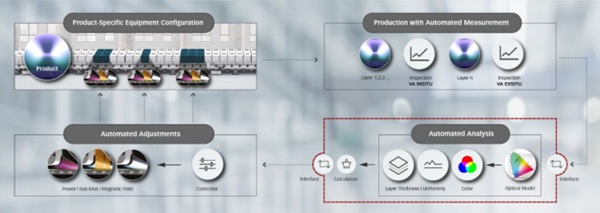
Although the large-scale coating of materials like glass is a very sophisticated and complex industrial process, the available production parameters are largely observed and controlled by human operators. VA PROCESSMASTER offers a solution for monitoring and closed-loop-controlling not only for single processes, but for complete layer stacks. It stabilizes the coating processes by controlling the layer thickness, homogeneity, or the color result (Benecke et al, 2019).
The system is based on the optical information that is already available in the form of spectral measurements based on ex-situ, potentially as well in-situ measurement systems. The spectral information from these measurements of a complete layer stack is converted into layer thicknesses, uniformity and color information for each individual layer based on a defined optical model and an innovative, associated algorithm.
Based on those layer parameters and the calculated difference between actual values and target values, the required machine operation actions, for instance adjusting plasma power, gas flow and magnetic bar settings, are calculated and automatically applied to the machine PLC. For each layer, the corrections can be distributed to multiple power supplies, gas inlets or magnet bars at once. Besides that, components can individually be included or excluded from control.
The suggestion accounts for the delay between coating and measurement, as well as the individual adjustment limits of each component. In case of magnet bars, actual motor movement time, as well as the adjustment limits of each magnet bar are also considered. All controllers can be configured with limits for output setpoints, setpoint change limit per step, reaction threshold (“dead band”).
Finally, the complete measurement and adaption workflow happens continuously 24/7 and prevents the process from drifting away.
Benefits for carbon footprint and profit
Continuous, un-interrupted control allows for very narrow tracking and tracing of process deviations. The algorithm provides a predictable and repeatable action when process deviations occur. This allows product control within the smallest possible window of specification, avoids productivity losses due to false interpretation of process changes and minimizes human error.
As a result, the coating manufacturers create less scrap, even with rather complex coated substrates such as façade glass or windshields for vehicles. Hence, they waste less material and save energy, as, for instance, fewer glass panes need to be melted down again. This will not only lead to a better company carbon footprint but also to reduced costs of goods manufactured and thus higher profit.
In addition, product adjustments can be carried out much faster when switching from one product to another, saving time that is available for additional production volume and, therefore, additional profit. The profit might even be increased as more complex products can be produced even with less skilled operators and less experience.
The control system has been implemented in architectural glass coating production, for instance for Single Low-E (SLE), Double Low-E (DLE) and Triple Low-E (TLE) coatings as well as Anti-Reflective (AR) coatings for automotive glass production. The application range of the software will be even expanded, as the algorithm will be applied to additional and different input and output parameters that are available in real time and whose correlation with the machine settings follows predictable rules. This means that the different advantages are also possible for other layer stacks and substrates such as polymer web.
2.2. VA TIPCOS
Automated tipping point determination and control
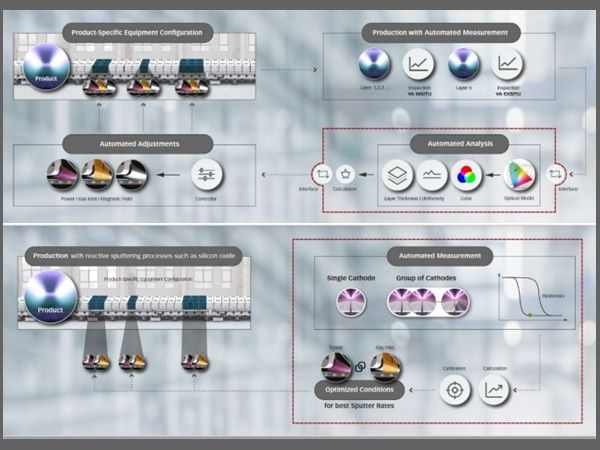
VON ARDENNE has developed a software product called VA TIPCOS that enables automated tipping point determination and control for reactive sputtering processes.
The software can supervise settings of reactive processes for single magnetrons or a group of some adjacent magnetrons with identical process parameters and the same target material. In case of manual or automatic power change, the software will adjust the reactive gas flow to protect the reactive process against exceeding the tipping point, which means the change from the oxidation sputter mode to the metallic sputter mode. If the process settings between the working point and the tipping point are too small or too high, the software can adjust the gas flow, or the software can be configured to release a warning on the screen.
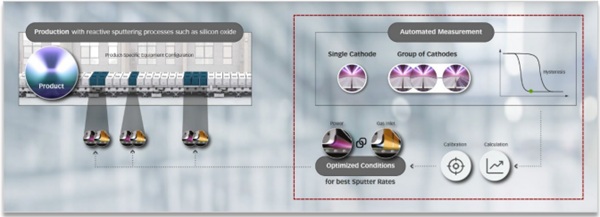
The software has two components. The first one is a windows-based software package for automatic tipping point determination and managing its database. For the detection of the tipping point, the software reduces the gas flow from a maximum reactive gas flow and detects the tipping point of voltage as an indication of changing the sputter mode from oxidation to metallic mode. If some tipping points could be detected, it will start the detection process again from a saved starting point at oxidation mode with a smaller step size in an iterative process until the right precision is obtained.
The tipping point detection can start for a single magnetron or a group of adjacent magnetrons and a single power or a power range. The tipping points are then stored and can be identified by the magnetron ID, the compartment number, the target ID, the target usage and the power. All stored tipping points can be listed and manipulated in a table. Up to five tipping points per magnetron can be selected and transferred over the network to the PLC for process controlling.
The second component is part of the PLC program for the coating machine. This component will monitor the working point and the power and the gas flow settings. This part will use up to five tipping points (pair of power and gas flow settings) per magnetron. Based on these tipping points, the software calculates a fitted curve for tipping points in the power range. Then, the current working point is compared with the calculated tipping point in every PLC cycle. Depending on the configuration, this component will adjust the gas flow or send a warning to the screen when the working point and tipping point distance is out of range.
Benefits for carbon footprint and profit
The TIPCOS algorithms that define and monitor the optimal working point of the sputtering process also help save energy. If the desired coating rate can be achieved with a minimum of the necessary energy, this reduces the energy consumption of the equipment, the peak load and therefore the overall production costs.
Additionally, scrap can be reduced by preventing switching to metal mode. This means that less material and energy is wasted.
Both aspects not only lead to a better carbon dioxide balance (Company Carbon Footprint (CCF) and Product Carbon Footprint (PCF)), but also lower material costs and thus increase profits.
For the economic aspect, the software even supports maximum line speed as the sputter rate can be increased leading to higher production volume in the same time frame.
2.3. SMART OPERATOR
Automated machine ramp-ups, ramp downs & product changes
VA SMART OPERATOR will make it possible to automate ramp-ups and -downs and to switch the machine states between different products during production. The software is prepared to execute socalled action plan changing the coating machine from one machine state to another. A machine state is defined by a constant state of all components including magnetrons, generators, motors, valves, heaters, poly-colds, etc. When a machine is coating a substrate, the machine has a fixed state. The parameters and states of different components will not be changed. Another fixed state is given when the machine is just being evacuated, and no substrate will be transported.
In this context, an action plan is then defined as a list of action steps, meaning all necessary steps, that need to be executed by an operator, for instance to move from evacuated-only state to the coating state.
An action step takes the information what kind of action must be done, such as switching on any main breaker, the gases, some water circuits, etc., and combines it with any start and/or stop condition. The action could be a switch on/off action or a parameter change. The action could also be the switch of other software modules, such as turning the VA PROCESSMASTER on or off. This allows the interaction of various software modules to be adjusted automatically to enable greater autonomy of the coating processes in the future.
All these action steps are stored in the action plan, which can also be described as a sequence of actions or a procedure. The machine states resemble “nodes”, and the action plans are “links” between such nodes like within a network. The steps stored in an action plan can be executed simultaneously or sequentially.
All steps stored in an action plan could be also executed manually via the machine control interface. No other or new type of steps can be stored in an action plan. There is no “hidden” functionality, ensuring transparency in what an action plan will trigger at the PLC.
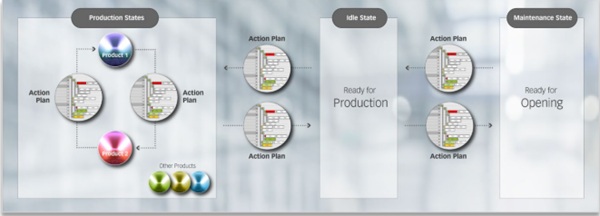
The software is intended to be used by process engineers and operators. The process engineer can create and release the required action plans on any PC. Later, the operator can start the published action plan at the machine PC and monitor the actions performed. For more autonomy, other system triggers such as substrate IDs could start or stop certain action plans in the future.
Benefits for carbon footprint and profit
The main advantage of this software is the ability to automate entire workflows, also by integrating additional software modules. This enables the use of standardized best practices for ramp-up and ramp-down as well as for product changes. This prevents human error, which can lead to malfunctions, for example. Reduced waste will improve the company carbon footprint and lower the production costs.
In addition, operators or process engineers have more time for other tasks, which is particularly important given the shortage of skilled labour that many companies are facing today. Ultimately, this could even lead to lower labour costs as the entire coating process becomes more autonomous with this software.
2.4. VA PLC ADAPTER
New software solutions are often available for new coating machines. However, coating machines are machines that are used in continuous operation and often have a lifespan of at least 15 years. And the older a machine gets, the lower its energy efficiency is compared to new machines.
Therefore, the use of software solutions to improve efficiency and carbon footprint is particularly beneficial for these machines. VON ARDENNE has developed the VA PLC ADAPTER, which enables the use of the process automation solutions on older coating machines. This small software interface transfers data to and from the control system without having to change the legacy software code.
These software-only updates serve to modernize the operation of the coating machines and bring all the above benefits not only to new coating machines, but also to the existing base.
3. Conclusions
By using specific examples (VA PROCESSMASTER, VA SMART OPERATOR, VA TIPCOS), we showed how software-based automation increases productivity based on time savings while reducing resource losses such as material or energy. Out-of-specification losses due to process drift are avoided, the energy efficiency of process working points is optimized, and complex changes of production tool states can be automated and thus optimized accordingly reducing resource losses caused by human error.
As a result, the production will be less and less reliant on the expertise of certain experienced individuals. Instead, best-practice procedures will be translated into stable algorithms that will run consistently in a reliable way all the time.
Thus, the production will be simplified and protected against human failure. If the operators of coating systems can rely on automation for an increasing number of procedures, this will also reduce the number of variables for them during troubleshooting. They will identify the cause of an issue much faster because they can immediately rule out a multitude of possible error sources. That means that the coating system will be operational in a much shorter time. And this will in turn increase the productivity and the efficiency of the used resources.
In summary, modern software solutions can help minimizing the carbon footprint of companies and their coating products while enabling the increase of yield and profit - not only for new coaters but also the installed base.
Reference
Benecke, F., Löhnert, J. & Mosshammer, S., M., (2019), „Digitalization in large area coating - automated process control for complex layer systems”, 62th Annual SVC Technical Conference