This paper was first presented at GPD 2025.
Link to the full GPD 2025 conference book: GPD_2025_ConferenceProceedingsBook.pdf

Authors: Angelica Rota a,c, Gaspard Chantrain b, Marco Zaccaria c, Francesco Fiorito a
a. Polytechnic University of Bari, Italy
b. Aquila ESG Advisors, Belgium
c. AGC Glass Europe, Belgium
Abstract
The reuse and remanufacturing of glass products have emerged as key research topics in the transition toward sustainable glass management. While technical and economic challenges remain the primary issues to address, another crucial aspect lies in understanding the environmental impacts of these practices and quantify the benefits of this strategies compared to the standard glass production. This gap is particularly significant when considering the potential scalability of glass reuse and remanufacturing processes to match current production capacities. This study aims to evaluate the environmental impacts and benefits of scaling up glass reuse and remanufacturing, focusing specifically on insulated glazing units. Through a life cycle assessment (LCA) framework, the research analyses real case studies encompassing all key phases of the process: post-consumer glass collection, disassembly, and preparation for reuse (i.e. quality control and washing). Particular attention is given to identifying the critical parameters influencing environmental outcomes, including material losses and energy consumption at various stages. Preliminary findings indicate that while glass reuse and remanufacturing could substantially reduce resource extraction and emissions compared to primary glass production, the environmental hotspots are highly contingent on process efficiency, material recovery rates, and logistics management. By simulating a scaled-up scenario, this study highlights the potential for these practices to become environmentally competitive with conventional glass manufacturing and processing.
Article Information
- Published by Glass Performance Days, on behalf of the author(s)
- Published as part of the Glass Performance Days Conference Proceedings, June 2025
- Editors: Jan Belis, Christian Louter & Marko Mökkönen
- This work is licensed under a Creative Commons Attribution 4.0 International (CC BY 4.0) license.
- Copyright © 2025 with the author(s)
1. Introduction
1.1. Reuse and remanufacturing of post-consumer glass waste
In recent years, the focus on sustainability has led to increased interest in circular economy practicesmost notably, the reuse and remanufacturing of post-consumer glass. Such practices promise to reduce the demand for virgin raw materials while mitigating the environmental impacts associated with production of new glass and reducing the landfilling of construction and demolition waste. Reuse and remanufacturing of post-consumer glass represent two distinct strategies for extending the material’s lifespan. Reuse applies to the glass itself, while remanufacturing involves using the recovered glass as raw material to create a new product, such as incorporating old uncoated panes into newly assembled IGUs (Rota et al., 2023; Teich et al., 2024). A crucial step in both processes is the dismantling and reuse preparation phase, which includes collecting, disassembling, cleaning, sorting, and assessing the recovered glass. Since these phases directly influence the feasibility and environmental benefits of reuse and remanufacturing, it is essential to evaluate their environmental impact to optimize resource efficiency and driving their implementation.
1.2. Environmental impact metric: LCA Methodology
Despite the potential of reuse and remanufacturing practices, environmental assessments quantifying their impact remain limited. Circularity indicators and assessment methodologies still exhibit uncertainty, particularly when circular principles are integrated into building products and processes, with benefits often materializing only at the end of the building’s lifecycle.
Life Cycle Assessment (LCA) provides a structured methodology for evaluating environmental impacts across all stages of a product’s life cycle, from raw material extraction to disposal. It establishes a baseline for assessing environmental performance and is governed by international standards like ISO 14040 and ISO 14044. However, applying LCA to circular practices presents challenges, particularly in modelling the product’s end-of-life phase and distributing environmental benefits across life cycle stages. Studies, such as those by Van Gulck et al., highlight the variability in scenario modelling and the adoption of the 100–0 allocation approach, which assigns all end-of-life impacts to the initial life cycle due to uncertainties in reuse scenarios(Van Gulck et al, 2022). For glass reuse and remanufacturing, LCA could help pinpoint critical stages where energy consumption, material losses, and emissions are most significant. Standards like EN 15804 and EN 15978 guide circularity assessments, while alternative methodologies, such as those by Hartwell and Overend, extend traditional LCA frameworks to incorporate environmental benefits beyond the first use (Hartwell & Overend, 2024).
In this study, a process life cycle model was developed to evaluate key parameters influencing GWP, including transport distances, energy demands for disassembly and remanufacturing, material recovery rates, and the end-of-life treatment of secondary by-products such as spacers, sealants, and desiccants.
2. Method
2.1. Scope and System Boundaries
The LCA conducted in this study focuses on the disassembly and reuse preparation process operated in an industrial set-up. The goal of this investigation is to assess the environmental emissions of this circular practice and identifying the hotspots of the “preparation for reuse” process. Therefore, the attention of the study is on the steps of the process which could have a greater influence in the emissions of the flat glass reuse.
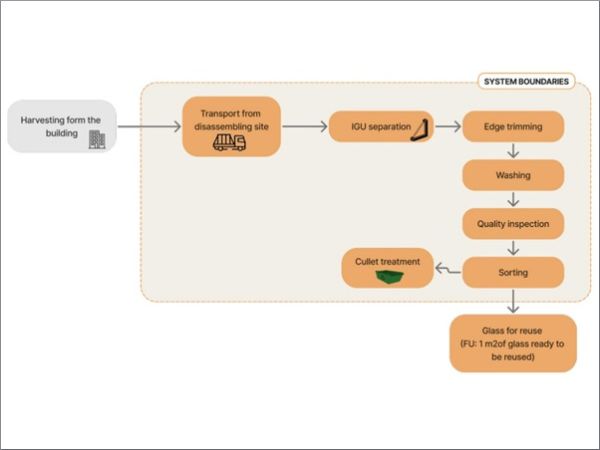
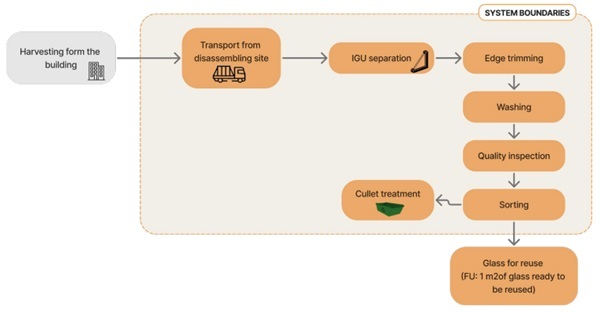
The analysis includes all the phases that would be needed in a scaled-up scenario of glass reuse (Figure 1), namely:
- Collection of glass products: harvesting of the post-consumer glass from façade of the building at the end-of-life.
- Disassembly: Separating glass from other materials and components of the unit.
- Preparation for Reuse: Processes including quality control and washing to ensure the glass meets the necessary standards for reuse or remanufacturing. The system boundaries also include transport emissions, as well as end-of-life waste treatment for the materials collected after the separation of the IGU (e.g. sealants, aluminium of the spacer and desiccant).
2.2. Data Collection and Assumptions
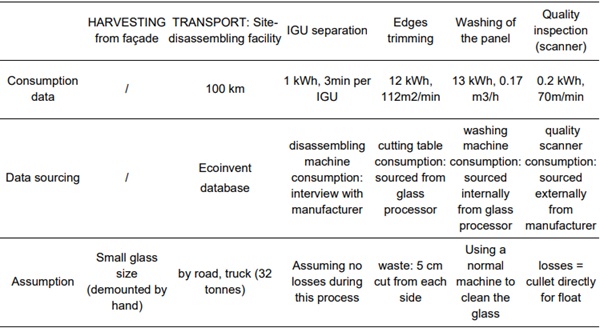
The data collection for the LCA was based on a combination of primary and secondary data sources to model the process. Primary data was obtained from direct measurements (i.e. glass processing plant) and interviews with the machine manufacturer (i.e. IGU disassembling machine), while secondary data was sourced from published literature that follow the EN 15804+A2 standard, LCA databases, and relevant reports. The model considers process efficiency, including yield efficiencies at each stage, as well as energy consumption. The collected data was then normalized to the functional unit of the process (Table 1). The data reported in the table refers to the baseline scenario model.
Several key assumptions were established in the model, including the input material, which consists of a double-glazed unit (DGU 4/16/4) with two monolithic non-coated glass panes. The glazing units collected from the façade are considered to be of small to medium size, which would allow two or three operators to handle and dismounting without the need of tools (e.g. crane).
The disassembling process was assumed to have a 100% yield, and an edge trimming step was included to remove potential contaminants from the edges of the disassembled glass panels. The edge trimming removes 5 cm from each border and it’s assumed that the generated glass waste at this process is sent to the cullet treatment for recycling in the float process.
Table 1: Collection of primary data and assumptions at each process of the model.
2.3. Simulation of different Scaled-Up Scenario
To identify the parameters that have the greatest influence on the potential impacts of reuse and remanufacturing, variations were introduced in the baseline scenario. This study explored the following group of scenarios:
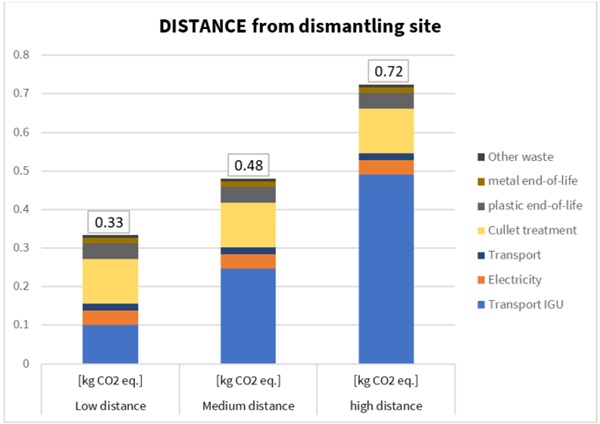
- Transport scenarios: various transportation scenarios were considered by varying the transportation distances, to evaluate the environmental impact of logistics throughout the process.
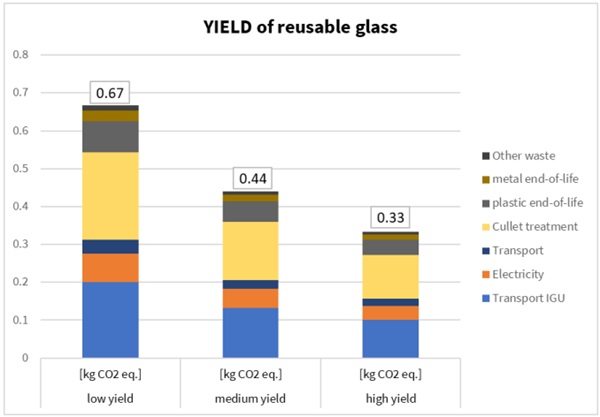
- Yield scenarios: the effect of varying material recovery rates (i.e., glass reuse potential) on emissions was assessed.
In Table 2 a summary of the parameters explored and varied in the different scenarios are shown.
Table 2: Parameters used for the different scenarios simulated in the study.

For the transport scenarios, various distances were chosen to simulate a collection journey with low, medium and high distance between the demolition site and disassembling site. For the yield scenarios, a high, medium and low yield were used in the simulation. The 33% yield was chosen to align with the findings of a previous mechanical investigation by the author (Rota et al., 2023), which established a classification system for glass quality based on surface conditions such as scratches and defects. The study concluded that 33% of the collected and separated glass panes exhibit sufficient mechanical resistance for reuse.
For the baseline scenario a low transport distance of 100km and an high yield of 66% were used to simulate the assessment, representing the best possible scenario based on the data and the assumptions considered in this study.
3. Results of the Assessment
3.1. Life cycle impact assessment (LCIA) of the baseline scenario
The results of the LCA are presented for all process in the present section. The life cycle impact assessment is based on the environmental indicators outlined in EN 15804+A2. The characterization factors for these environmental indicators are provided in Annex C of EN 15804+A2. The results of the assessment focused on two key environmental impact categories:
- Global Warming Potential (GWP): This indicator quantifies the overall contribution of greenhouse gas emissions to climate change. It was selected to assess the environmental impact of the reuse preparation process, considering emissions from transportation, disassembly, and processing activities. GWP is expressed in kilograms of CO₂ equivalent (kg CO₂-eq).
- Energy Consumption: The total primary energy demand (PET) is used as the energy consumption indicator in this study. PET represents the sum of primary energy from renewable sources (PERT) and non-renewable sources (PENRT). This metric accounts for the total energy required throughout the collection, disassembly, and waste processing stages, providing insights into the energy demands of the reuse process.
To facilitate the interpretation of results, the impacts were grouped based on the type of process, e.g. transportation, waste processing, and electricity consumption. This classification provides a clearer understanding of how each process contributes to the overall environmental impact. The results for both Global Warming Potential (GWP) and Total Primary Energy Demand (PET) indicators are presented in Figure 2-3, offering a structured overview of emissions and energy consumption by process category.
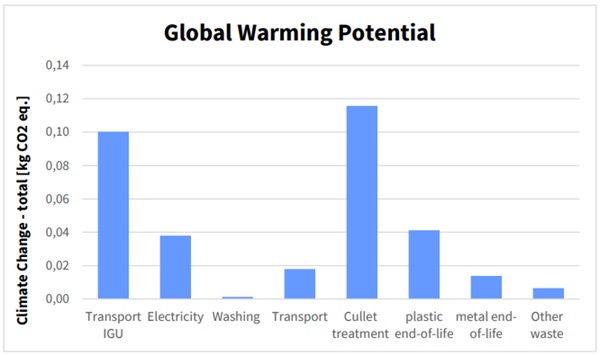
The total amount of GWP is 0.33 kg of CO2 eq. for the whole dismantling and reuse preparation process in a baseline scenario, therefore with a high yield of glass reuse (66%) and a low transport distance (100 km). The cullet treatment process contributes the most to the GWP, indicating that reducing the amount of contaminated glass requiring treatment for recycling could further lower emissions.
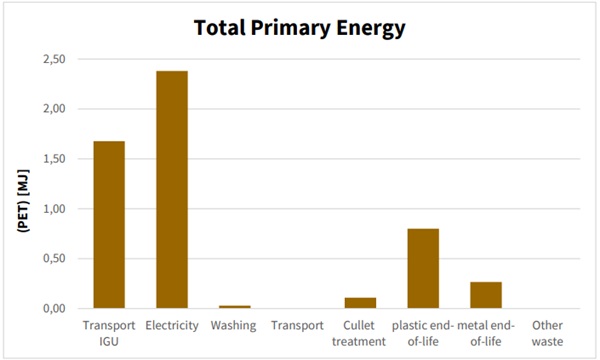
The total amount of primary energy is 5.26 MJ for the whole dismantling and reuse preparation process in a baseline scenario. As expected, the highest energy consumption comes from the electricity used across the various processes.
3.2. LCA results
Different simulations were performed to understand how the various processes impact the total emission. The transport scenarios and the glass recovery rate scenarios were assessed in the study and the results of the climate change indicator are reported in the Figure 4-5. The assessment results indicate that increasing the glass recovery yield leads to lower emissions, highlighting the benefits of maximizing material reuse. In contrast, the transport scenarios show that longer transport distances result in higher emissions, emphasizing the environmental impact of logistics in the reuse process.
4. Discussion
4.1. Interpretation of Results
The present study provides an LCA of the reuse preparation process, focusing on identifying the environmental hotspots associated with dismantling and preparation to reuse of post-consumer glass. It is essential to highlight that this LCA is a process-based assessment rather than a product-level LCA, meaning that the study does not compare the environmental benefits of reuse against alternative endof-life scenarios, such as recycling or landfill disposal. Instead, the goal is to determine which phases within the reuse preparation process contribute most to environmental impact, informing potential optimizations to enhance process sustainability. The baseline scenario was designed with optimistic assumptions, including a high yield of glass recovery (66%) and a relatively low transport distance (100 km). However, in a real-world scenario, the presence of coated glass panes in collected IGUs is expected to reduce the yield, as these panes cannot be reused and must be recycled. This would increase the environmental burden associated with cullet treatment and lower the overall efficiency of the reuse process. The results of the study already indicate that cullet treatment is a significant contributor to GWP, underscoring the importance of optimizing glass sorting and quality assessment to minimize losses.
The sensitivity analysis conducted through transport and yield scenarios confirms the influence of these parameters on environmental performance. The yield scenarios demonstrate that higher recovery rates significantly reduce emissions, emphasizing the environmental advantage of maximizing material reuse. The transport scenarios reveal that increasing transportation distances leads to higher emissions, highlighting logistics as a key factor in the sustainability of the reuse process. These findings reinforce the need to develop local or regional dismantling and processing hubs to minimize transportrelated impacts.
Another key finding of the study is that energy consumption plays a central role in the process’s environmental footprint. Electricity use across various disassembly and cleaning processes was found to be a major contributor to total primary energy demand (PET).
4.2. Limitations and Future Research
Overall, this study provides valuable insights into the critical parameters affecting the environmental performance of post-consumer glass reuse. While the results highlight the potential of glass reuse as a circular strategy, they also indicate areas requiring further optimization to improve feasibility and maximize environmental benefits. Future research should explore different yield rates incorporating the type of glass collected from the IGU, which could include coated panes that are not eligible for reuse; assess the scalability of local processing facilities to reduce transport emissions; investigate the impacts of potential losses in disassembly and cleaning processes and validate the simulation outcomes through additional case studies and pilot projects to refine model parameters.
5. Conclusion
This study highlights the potential environmental benefits of scaling up glass reuse and remanufacturing, particularly in reducing raw material demand and waste. A process-based LCA identified key factors such as material recovery rates, energy consumption, and logistics as critical to environmental performance. However, challenges remain, including the presence of coated panes unsuitable for reuse and the energy intensity of processing. Optimizing sorting, reducing transport distances, and improving process efficiency are essential for maximizing benefits. With targeted improvements and further validation, glass reuse can become a key component of a sustainable construction strategy.
References
CEN (2011) EN 15978 Sustainability assessment of construction works – assessment of environmental performance of buildings – calculation method
CEN (2019) EN 15804:2012+A2 sustainability of construction works - environmental product declaration - core rules for the product category of construction product
Hartwell, R., & Overend, M. (2024). Reclamation potential in the built environment: A method and metric for assessing environmental benefits beyond first use. https://doi.org/10.1016/j.buildenv.2024.111866
International Organization for Standardization. (2006). ISO 14040:2006 – Environmental management – Life cycle assessment – Principles and framework. ISO.
International Organization for Standardization. (2006). ISO 14044:2006 – Environmental management – Life cycle assessment – Requirements and guidelines. ISO.
Rota, A., Zaccaria, M., & Fiorito, F. (2023). Towards a quality protocol for enabling the reuse of post-consumer flat glass. Glass Structures & Engineering, 8(2), 235–254. https://doi.org/10.1007/s40940-023-00233-0
Teich, M., Scherer, C., Schuster, M., Brandenstein, M., & Elstner, M. (2024). Reuse and remanufacturing of insulated glass units. Glass Structures and Engineering. https://doi.org/10.1007/s40940-024-00276-x
Van Gulck, L., Wastiels, L., & Steeman, M. (2022). How to evaluate circularity through an LCA study based on the standards EN 15804 and EN 15978. International Journal of Life Cycle Assessment, 27(12), 1249–1266.
https://doi.org/10.1007/s11367-022-02099-w