This paper was first presented at GPD 2025.
Link to the full GPD 2025 conference book: GPD_2025_ConferenceProceedingsBook.pdf

Authors: Sebastián Andrés López, Thorsten Weimar
Universität Siegen, Chair of Building Structure
Abstract
In the context of residential buildings in Germany, a significant proportion of 209 million window glazing units are in need of energy-efficient modernisation. The replacement of single glass panes, laminated glass, box-type windows and windows with uncoated insulated glass units (IGU), has the potential to save around 10.8 million tonnes of carbon dioxide per year. This equates to approximately 353 million m2 of glass area. As a result, a significant amount of glass waste is generated. An effective waste management strategy is predicated on the ‘7 Rs’: rethink, reduce, reuse, repair, regift, recycle and rot. The replacement of existing windows with new insulated glass units (IGU) results in a significant amount of carbon dioxide emissions during the production process. Glass as a highly durable and infinitely recyclable material is mostly cascaded as cullet into the hollow glass industry as cullet to fulfil the German recycling quota for container glass. However, for the flat glass industry, which has high demands on the optical quality of the glass pane, the utilisation of a considerable proportion of glass cullet during the float glass process is challenging. This has prompted consideration of the potential for reuse of used window glazing, rather than its destruction and melt. This paper presents the results of a research study on used double glazing, which concentrates on non-destructive test methods for measuring the real thickness, the thermal transmission coefficient (Ug-value) and the solar and luminous characteristics. The specimens are taken from the same building and have been exposed to the same environmental conditions for the past three decades without replacement. The objective of the case study is to contribute to the ongoing academic and industrial discourse about the circular economy and sustainability.
Article Information
- Published by Glass Performance Days, on behalf of the author(s)
- Published as part of the Glass Performance Days Conference Proceedings, June 2025
- Editors: Jan Belis, Christian Louter & Marko Mökkönen
- This work is licensed under a Creative Commons Attribution 4.0 International (CC BY 4.0) license.
- Copyright © 2025 with the author(s)
1. Introduction
In modern architecture, glass represents modernity, transparency and lightness allowing a visual exchange between inside and outside. Consequently, a large glass surface is installed in the building envelope over the recent decades. At the beginning of the life cycle of this material, the production process is associated with a high consumption of resources, energy and emissions. The raw materials sand, soda and lime are melted at high temperatures. The molten glass can be drawn off first from a tin bath and cooled to room temperature before being cut. The glass pane is ready for finishing and installation in building applications. (Schneider et al, 2016)
The Circular Economy Act (KrWG, 2024) regulates the German waste disposal at the end of the life cycle. The objective of the act is to promote the recycling of materials through the waste management principles of prevention, reuse, recycling, energy recovery and disposal. Further national and European directives on packaging and the handling of waste increase the pressure on the utilisation of materials beyond their first life cycle. When considered in conjunction with the ‘7 Rs’ of sustainability, the Circular Economy Act emerges as a central component in material design and life cycle assessment. In conjunction with the German Climate Action Plan and the European Climate Targets with a climate neutrality by 2045 respectively 2050 the flat glass industry is confronted with the challenge of achieving climate neutral production processes by implementing green energy or glass cullet from the preconsumer sector (Glaswelt, 2022 and BMBF, 2021). In addition, the building sector must also reduce its emissions. A substantial proportion of energy saving and emission reduction can be achieved by replacing aged glazing in the building envelope. In Germany, it is estimated that 209 million window glazing units in residential buildings are in need of an energy-efficient modernisation (VFF and BF Glas, 2024). At the end of the life cycle of a glazing unit, glass can be melted almost as often as required. The fundamental principles of the cascade principle apply, whereby the raw material, the partial components or the complete product are to be fed into the process that demands the highest possible quality. Consequently, post-consumer glass cullet following a 25-year life cycle are downcycled for utilisation in the melting process for container glass. A second life cycle for the flat glass is not common. A further method of reducing emissions for glazing is to activate the reuse potential. Having a closer look into this topic, it is obviously that there are two predominant approaches for reuse glazing elements: direct reuse, involving the installation of aged glazing units in other locations, and remanufacturing, which involves the separation of aged glazing units into individual components to produce a new product. Both approaches of reuse necessitate a series of tests to ensure the quality and sustainability of each element (Teich et al, 2024).
In the context of residential buildings in Germany, a significant proportion of 209 million window glazing units are in need of energy-efficient modernisation. The replacement of single glass panes, laminated glass, box-type windows and windows with uncoated insulated glass units (IGU), has the potential to save around 10.8 million tonnes of carbon dioxide per year. This equates to approximately 353 million m2 of glass area. As a result, a significant amount of glass waste is generated. An effective waste management strategy is predicated on the ‘7 Rs’: rethink, reduce, reuse, repair, regift, recycle and rot. The replacement of existing windows with new insulated glass units (IGU) results in a significant amount of carbon dioxide emissions during the production process. Glass as a highly durable and infinitely recyclable material is mostly cascaded as cullet into the hollow glass industry as cullet to fulfil the German recycling quota for container glass.
However, for the flat glass industry, which has high demands on the optical quality of the glass pane, the utilisation of a considerable proportion of glass cullet during the float glass process is challenging. This has prompted consideration of the potential for reuse of used window glazing, rather than its destruction and melt. This paper presents the results of a research study on used double glazing, which concentrates on non-destructive test methods for measuring the real thickness, the thermal transmission coefficient (Ug-value) and the solar and luminous characteristics. The specimens are taken from the same building and have been exposed to the same environmental conditions for the past three decades without replacement. The objective of the case study is to contribute to the ongoing academic and industrial discourse about the circular economy and sustainability.
In this regard, the glass elements are to be disassembled in a non-destructive manner and subsequently separated from the frame. Further investigation deals with the detailed description of the glazing. It is necessary to conduct research on the window history, analyse the cross-section, determine the thermal transmission coefficient (Ugvalue) and measure the solar and luminous characteristics. Additionally, the paper addresses and analyses the effect of refurbishments and extensions.
2. Evaluation of Used Double Glazing Unit
2.1. Historical Research and Cross-Section
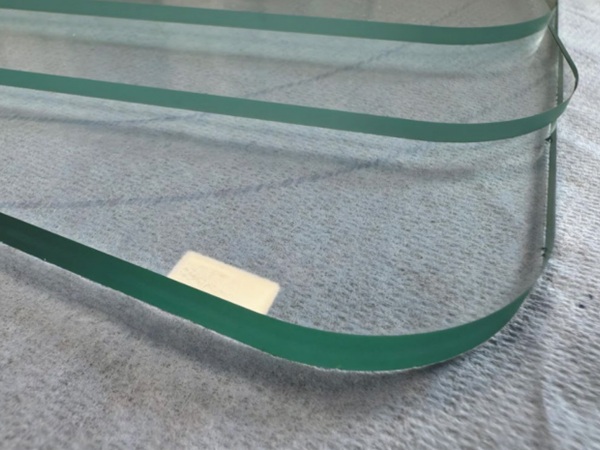
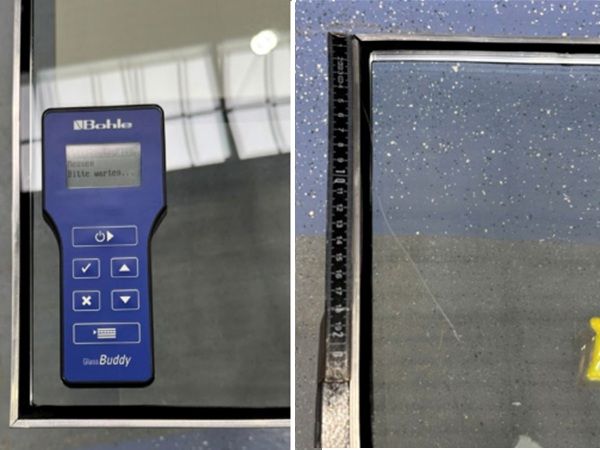
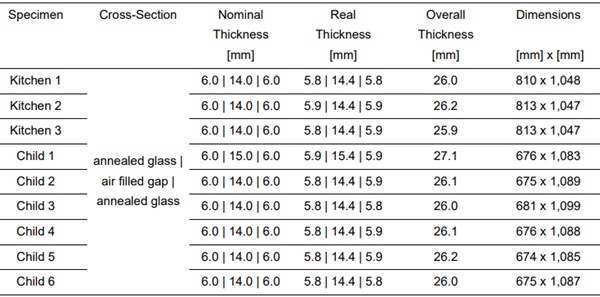
The case study focuses on the analysis of used double glazing from a residential property constructed in 1965 in a small town in Baden-Württemberg, Germany. Before moving in, a renovation aimed at enhancing energy efficiency is initiated, including the replacement of the aged windows. During the renovation, the windows are dismantled, and the insulated glass units (IGU) are extracted for further research. A total of nine used window glazing units are available for analysis. It is noted that all windows are double glazing from 1989, except one (specimen child 1) which is installed in 1995. The insulated glass units (IGU) are composed of annealed glass with aluminium spacer, and contain no coatings or gas filling in the gap. Non-destructive measurements of the real thickness of the cross-section are conducted using a Glass Buddy Plus (2025) from Bohle AG. Preparatory steps in figure 1 include inspecting the glazing, cleaning and checking for defects. Two windows exhibit scratches and cracks near the edge, while two surfaces are polluted with window colour. The summary of the real thickness and dimensions are listed in table 1.
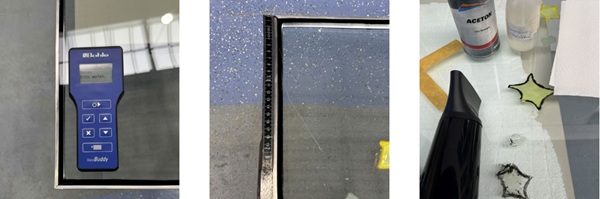
Table 1: Cross-section, real thickness and dimensions of the specimens for the non-destructive analysis of the used double glazing. Kitchen is oriented to the north, child to the south.
2.2. Heat Protection
Heat is transferred via three mechanisms: conduction, convection and radiation. Conduction is defined as the direct transmission of heat through a material. Convection describes the movement of heat through liquids or gases. Collectively, these two mechanisms account for 33 % of the total heat transfer. The remaining 67 % of heat transfer is radiation, whereby heat is transferred without the use of a medium by means of electromagnetic waves. All three mechanisms influence the efficiency of insulation. The thermal transmittance is determined by the material properties, heat conductivity and real thickness and encompasses a calculation method and two test methods with the guarded hot plate and the heat flow meter. Figure 2 provides a more detailed examination of the development of the Ugvalue and the solar heat gain coefficient (SHGC) for glazing in the building envelope over the past 50 years. It is obvious that the values for thermal insulation will continue to improve.
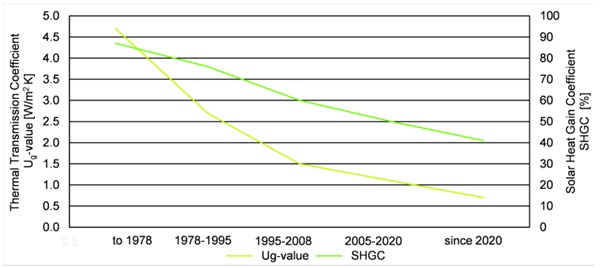
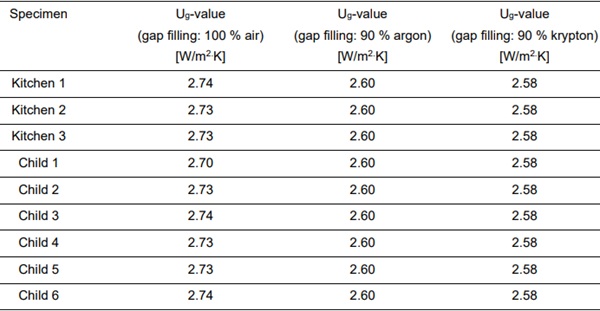
In the mid-1990s, the WSchVO (1995) resulted in a growing requirement in Germany for the use of coatings and gas-filled gaps to achieve Ug-values (Glaswelt (2018)). This study utilises EN 673 (2025) to calculate the thermal transmission coefficient and the real thickness of the double glazing. However, it should be noted that the Ug-value of 2.7 W/m2.K of the used windows no longer meets the current thermal protection requirements (Gebäudeenergiegesetz, 2024). Consequently, further improvements to the double glazing are required before its reuse. One potential solution is to fill the existing gap with noble gases like argon or krypton to reduce the convection. However, the enhancement of the Ug-value with 0.16 W/m2.K is neglectable. Additional leakage tests are necessary to ensure the thermal transmittance over the life cycle. The impact of a new coating in the existing gap to reduce the emissivity of the glass surface has a higher impact, but it is not implementable. Table 2 shows the Ugvalue results for the used double glazing and two versions with 90 % noble gas filling of the gap.
Table 2: Calculated thermal transmission coefficient (Ug-value) for double glazing and filled with 90 % argon or 90 % krypton after EN 673 (2025).
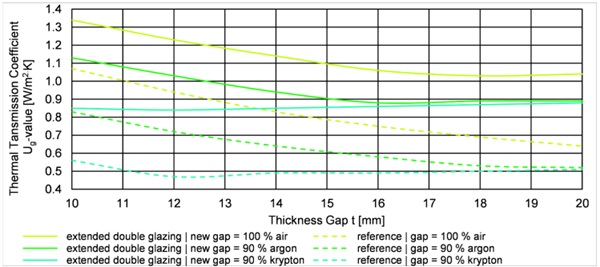
Another potential for improvement involves the development to a tripe glazing with an additional gap with a coated glass pane on position 2 and a gas filling. This modification has the potential to enhance the thermal performance of the glazing, with the Ug-value of up to 0.9 W/(m2.K). This improvement can be achieved by using a coating to reduce the glass emissivity up to 3 % and a gap filling degree of 90 % with noble gas. Due to the absence of a coating on position 5, it is not possible to reach the same Ug-value as a new triple glazing. Nevertheless, the utilisation of the aged double glazing as semifinished product can help to create a cost-effective and more sustainable alternative to a new insulated glass unit (IGU). The comparison between the extended double glazing and a reference as a symmetrical triple glazing with 3 x 6 mm annealed glass and two filled gaps with coatings on position 2 and position 5 is demonstrated in figure 3. The addition of a second gap towards the outside has a high impact on the Ug-value.
2.3. Solar Protection
One property of glass is the transmission capacity of visible light and at the same time also in the near ultraviolet and short-wave infrared range. The radiation is conducted through the glazing, absorbed by the glazing or reflected. Overall, the sum of transmission, reflection and absorption is 100 %. The solar and luminous characteristics of glass in a wavelength range between 250 nm and 2,500 nm is described in EN 410 (2011). Two of the parameters are the light transmittance τ and the solar heat gain coefficient (SHGC). The properties for each specimen are measured with a Lambda 1050+ spectrophotometer from PerkinElmer, Inc. Figure 4 shows the result of the measurements. In total, eight double glazing are produced from the same glass producer, only one specimen is from another producer. Therefore, the curves show low standard deviation so that it can be summarised in an average curve for solar characteristics.
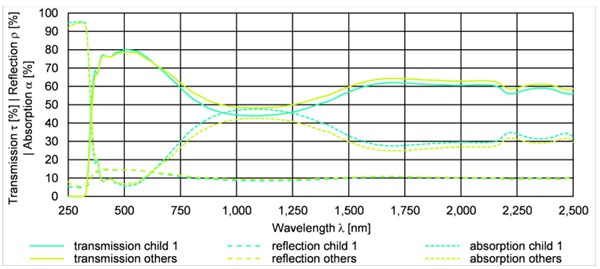
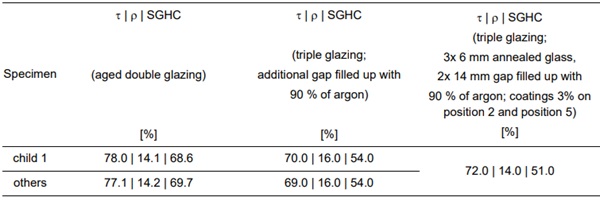
WinSLT Experte (2021) from Sommer Informatik GmbH calculates solar characteristics for each crosssection. By the help of an implementation of the measured values, it is possible to use the old window for the calculation of the extension with an additional gas filled gap. The results in table 3 do not verify between all specimens. A further comparison to common triple glazing shows similar values. The differences can be explained by different glass compositions. In last years, there has been a trend towards low-iron oxide glass panes. The proportion of iron oxide in the raw materials has fallen continuously. This reduces the typical green tint and the transmission is higher than with the used window glass.
Table 3: Measured and calculated transmittance τ, reflection ρ and solar heat gain coefficient (SHGC) for aged double glazing and triple glazing after EN 410 (2011).
3. Conclusion
In future, more used glass will be available on the market. This raises the question of how to deal with the material and how to collect and reuse the material efficiently. In principle, there are various options for used glass panes. These include direct reuse in the original state, separation by type, sorting and reassembly into new insulated glass units (IGU) and laminated or laminated safety glass or the production of glass cullets and downcycling to the hallow glass industry.
However, some aspects of direct reuse remain unanswered. Therefore, this article focuses on nondestructive tests on double glazing, which are necessary for a direct reuse without disassembly and separation. The investigation shows how further use in the second life cycle can be possible. Important properties such as the thermal transmission coefficient (Ug-value), the light transmittance and the solar heat gain coefficient (SHGC) are measured. The results form the basic information for the decision for further addition.
A new challenge is in the improvement of the gap between the existing glass panes when the gap is not filled with gas. The calculation of the Ug-value shows a value of up to 0.9 W/m2.K by adding a new, gas-filled gap with a coated glass pane on position 2. It is noted that the cross-section is produced symmetrically for minimal climatic loads. If an existing gap will be filled with gas, leak tests are necessary. Alternatively, a new sealant can be created with butyl to ensure the long-time quality. For remanufacturing the strength and defects on the surface are needed. Therefore, in a next step, the double glazing will be separated and the glass panes tested for strength.
Acknowledgements
Many thanks to Bohle AG for providing the Glass Buddy Plus. In addition, a special thank for the active support at the Chair of Structural Design during the preparation and the measurements.
References
BMBF (2021) P2X: Glasherstellung mit Grünem Wasserstoff erstmals erfolgreich getestet.
https://www.kopernikusprojekte.de/aktuelles/news/glasherstellung_mit_guenem_wasserstoff_erstmalig_erfolgreich_getestet.
EN 410 (2011) Glass in building - Determination of luminous and solar characteristics of glazing.
EN 673 (2025) Glass in building - Determination of thermal transmittance (U value) - Calculation method.
GEG (2024) Gesetz zur Einsparung von Energie und zur Nutzung erneuerbarer Energien zur Wärme- und Kälteerzeugung in Gebäuden (Gebäudeenergiegesetz). Last change: 01.10.2024.
GlassBuddy Plus (2025). Bohle AG.
Glaswelt (2018) Der Siegeszug des Isolierglases. https://www.glaswelt.de/technische-entwicklung-01/technischeentwicklung-01-der-siegeszug-des-isolierglases.
Glaswelt (2022) Specialist article No 4: Flat Glass Recycling: Current State of Play.
https://www.glasstec.de/de/Media_News/Presse/Pressematerial/Fachartikel/Fachartikel_Nr._4_FlachglasRecycling?local_lang=2.
KrWG (2024) Kreislaufwirtschaftsgesetz - Gesetz zur Förderung der Kreislaufwirtschaft und Sicherung der umweltverträglichen Bewirtschaftung von Abfällen. Last change; 01.01.2024.
Schneider, J.; Kuntsche, J.; Schula, S.; Schneider, F.; Wörner, J.-D. (2016) Glasbau. Grundlagen, Berechnung, Konstruktion. SpringerVieweg.
Teich, M; Scherer, C.; Schuster, M.; Brandenstein, M.; Elstner, M. (2024) Reuse and remanufacturing of insulated glass units. Glass Structure and Engineering, Volme 9, 339-356. https://doi.org/10.1007/s40940-024-00276-x.
WSchVO (1995) Verordnung über einen energiesparenden Wärmeschutz bei Gebäuden (Wärmeschutzverordnung – WärmeschutzV). 01.01.1995.
Verband Fenster + Fassade (VFF), Frankfurt am Main, und Bundesverband Flachglas e. V. (BF Glas), Troisdorf (2024) Mehr Energie sparen mit neuen Fenstern. Aktualisierung Januar 2024 der Studie „Im neuen Licht: Energetische Modernisierung von alten Fenstern“.
WinSLT Experte (2021) Version 7.26. Sommer Informatik GmbH.