Article Information
- Digital Object Identifier (DOI): 10.47982/cgc.10.709
- Published by Challenging Glass, on behalf of the author(s), at Stichting OpenAccess.
- Published as part of the peer-reviewed Challenging Glass Conference Proceedings, Volume 10, June 2026, 10.47982/cgc.10
- Editors: Christian Louter, Freek Bos & Jan Belis
- This work is licensed under a Creative Commons Attribution 4.0 International (CC BY 4.0) license.
- Copyright © 2026 with the author(s)
Authors: David Entwistle a, Hadrien Heuclin b
a Saint-Gobain Glass, United Kingdom
b Saint-Gobain Glass, France

Abstract
Vast quantities of post-consumer glass from commercial buildings are still lost to landfill due to contamination, logistics, and cost barriers. This paper shares key lessons from implementing a new, scalable pathway to recover end-of-life architectural glass and return it to new building glass. Through strategic partnerships with clients, upskilling the deconstruction supply chain, and stewardship of recovered material, Saint-Gobain has developed a cost- and time-effective closed-loop solution. This initiative is the Saint-Gobain Glass Recycling Process, summarised in a six-step circular flow: (1) Diagnosis – Classification of interior/façade types and glass types prior to dismantling; (2) Dismantling – Controlled breaking of glass to prevent contamination; (3) Sorting – Organisation of acceptable cullet types for recycling; (4) Collection – Arrangement of glass flows to ensure compatibility with flat glass production; (5) Melting – Acceptance and integration of cullet into new glass batches; (6) Projects – Reuse of recycled glass in new facades for construction and renovation. This closed-loop system is applicable across various building lifecycle stages—from demolition to new construction—and exemplifies how industrial innovation can drive climate resilience and material circularity in the built environment.
1. Introduction
The Deloitte study (Hestin, M. et al., 2016), suggested that the UK generates more than 200,000 tonnes of post-consumer glass waste each year (circa 1.5M tonnes for Europe). Subsequent analysis based on the annual output of flat glass producers (circa 700,000 tonnes per annum) asserted that this figure was probably conservative (DeBrincat, G. et al., 2018). These figures are quoted frequently and remain, without further investigation, the starting point for evaluating the effectiveness of recovery strategies.
This paper’s focus is on scalable solutions for waste glass from commercial buildings. There is historical context for post-consumer glass (also known as cullet) being successfully returned from commercial buildings back to building glass (e.g. Lloyds of London 2010, Burrell Collection Glasgow 2020, UNESCO Paris 2021, Piraeus Tower Greece 2021, Chalcots Estate London 2022). Although these were valuable learning experiences, they did not provide a template that was adopted for widescale glass recovery.
In moving from “good news” towards good and sustainable practices that can be widely adopted, we do not believe that there is a “one size fits all” solution. Therefore, this required us to differentiate between various factors.
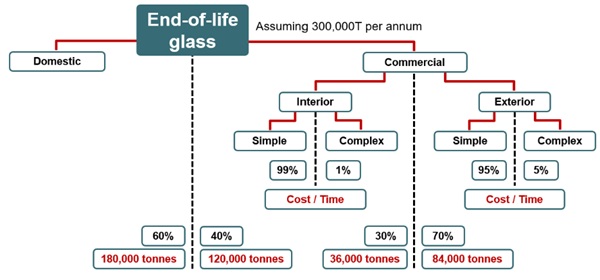
- The distinction between the commercial sector and domestic sector (single family dwellings). The domestic (residential) sector is typified by small quantities of glass in many locations, but the glass is easier to reprocess because of small sizes, thinner glass compositions. The commercial sector is typified by larger quantities of glass in a few locations, however the glass can be more challenging to reprocess.
- The distinction between exterior and interior commercial glass. Exterior glass comprises of insulated glass units often with complex glass compositions, post applied films. Interior glass is typically single toughened or laminated glass often with post applied films. The recovery of exterior and interior glass is not done at the same time and often not done by the same deconstruction contractors. The frequency of interior refit is 2-3 times more frequent than façade replacement.
Our strategy flows from understanding the “what” and “where” before considering the “how” of recovery. Figure 1 is a notional picture (created by the author, as a best estimate and subject to review) of the building glass available with a breakdown of the commercial sector, assuming 300,000 tonnes of waste glass per annum in the UK.
We will draw heavily on our experience gained from completing end of life glass recovery from over 100 commercial projects in London over the past 2-3 years. We will consider how this has been achieved, whether there may be unique factors that have contributed to this and how widely what has been learned can be applied elsewhere.
2. Background
Cullet is of major importance for the glass Industry. Re-melting existing glass to form new flat glass has great environmental benefits. It reduces energy consumption (taking less energy to re-melt glass than to melt the equivalent amount of raw materials), reduces CO2 emissions (some of the raw materials include carbonates which release carbon dioxide), saves natural resources and reduces extraction.
In general terms, each 10% increase in cullet usage results in an energy saving of 2-3% in the melting process and each tonne of cullet used saves between 230-300kg of CO2 emitted when compared to manufacturing glass with 100% virgin materials (Glass for Europe 2010, Glass for Europe 2013, Hartwell, R. et al., 2022, DeBrincat, G. et al., 2018). The CO 2 savings are based on Scopes 1&2 (direct emissions, from economic activity and indirect emissions from energy utilisation) as classified in the Green House Gas Protocol (2001).
Glass manufacturers are now declaring Scope 3 emissions, which covers all indirect emissions that occur up and down the value chain, outside of their production. The significance of the inclusion of Scope 3 means a tonne of cullet represents a further saving of circa 400kg CO2, creating a total overall saving of circa 700kg in the production of one tonne of glass (Saint-Gobain 2026).
Whist other important solutions such as alternative fuels and decarbonisation of raw materials are being developed, their implementation is still some time away. Increasing the recycled content of glass with post-consumer cullet has an immediate impact on reducing carbon and raw material extraction.
There are some examples of flat glass collection in Europe. In 2000 the Dutch building glass industry set up a voluntary recycling scheme. It was formalised by the government in 2002, and Vlakglas Recycling Nederland was founded. It was funded by a recycling fee charged to all producers and importers of glass and IGUs (funding was made legally binding in 2016). The principle is known as extended producer responsibility (EPR), also known as the producer pays, where waste producers are responsible for the treatment and management of this waste. Unfortunately, only around 10% of the post-consumer cullet that Vlakglas processes goes back to building glass and their goal is to increase the amount to 20% (Vlakglas 2021).
In France, construction waste was added to existing EPR streams from 1 January 2023. Prior to this, a network of cullet reprocessors already existed, and they prepared themselves for the change in legislation by upskilling their workforce and upgrading their facilities. The scheme however considers recycling targets but not closed loop recycling so it’s impact may prove to be limited.
3. Barriers
It has been well documented (Bakx, M. et al., 2016, Hestin, M. et al., 2016, DeBrincat, G. et al., 2018, Geboes, E. et al., 2022) that although flat glass can be recycled, it very rarely was. It followed a linear process of being crushed into low grade products (aggregate) or ending up as landfill. When we consider material flow for end-of-life building glass (see Figure 2 created by the author) we see that on average less than 1% is returned back into new glass production.
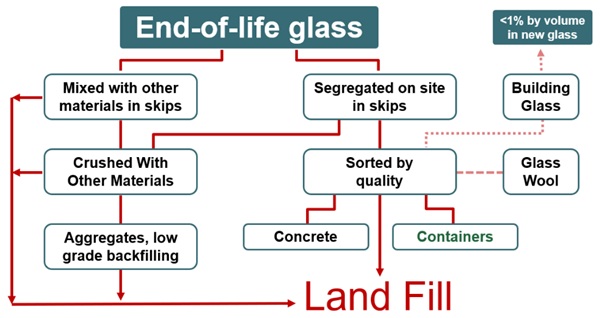
An MSc thesis by the author in 2023 examined the barriers to recovering end of life glass from commercial projects in London and sought to identify the drivers that will open pathways for glass to be recycled.
Data was collected from relevant literature and 57 semi-structured interviews with key stakeholders.
They key challenges were as follows.
- Time and cost
- Unclear pathway back, i.e. no reverse supply chain
- Little perceived payback/benefit/value to the client
- Technical
o For an IGU the value of glass at construction is in the processed product, however at end of life, the processing is the very thing that makes the recovery challenging
o Post applied films/vinyl manifestation
o Structural bonding - Quality control, i.e. contamination risk for the glass manufacturer
4. An Evolving Strategy
In 2021, we formed our strategy for end-of-life commercial glass which was articulated in 2023 into the following principles. These, plus a great deal of background information, were summarised in a paper presented at CGC9 in 2024 (Entwistle, D. 2024).
- Efford vs reward (cost and time factors)
- Recycle not reuse
- Simplicity
- Scalability
- Partnerships
These principles are aimed at reducing or mitigating the risks, whether real or perceived, for all the stakeholders involved in end-of-life glass recovery.
Although there is no “one size fits all”, we have maintained them because we believe that these will produce the greatest impact, on the greatest number of projects, in the shortest time. They create a timely solution which deals with “what can we do now” and “what will have the biggest effect now”. The starting place is always a site audit and the resultant report, which is typically around 19 pages long containing project specific and generic information (see Figure 3). We will cover the details of this in the later sections.
Our strategy will continue to evolve and adapt, and possibly it could change towards reuse (e.g. if government intervention would drive it in that direction).
However, our experience over the past 2-3 years has not brought reuse any closer to reality, outside of the ambitions of a few very determined clients and on a very small scale.
In terms of application this was how our strategy was implemented.
- Work with clients to create value for them
- Produce a site report identifying glass types, compositions, volumes with outline methodology for glass recovery and options for bulk transport
- Utilise the existing deconstruction supply chain
- Provide effective project management
- Strengthen with on-going training and education
- Communicate the many successes through case studies
5. Client Value
We will cover the practical steps in the subsequent points, but it is worth considering what it is that creates value for clients, in such a way that they will impose behavioural changes on a deconstruction industry which may not be receptive to change.
Client motivation will be driven by their perception of value and how it benefits them. Value may be considered in terms of profitability, market perception, public image, reputation, ranking against competitors, moral and ethical considerations.
There has been enough perceived value to encourage a growing engagement from clients in material recovery, for example raised access flooring, carpet tiles, lighting, structural steel.
There has also been an increasing push from local government in London towards CE principles as part of the planning requirements for new developments (more of this in section 9).
As a result, our glass recovery site report has been invaluable in informing/educating clients on the glass types available, what can/cannot be recovered and what will be required per glass type to enable recycling. The contents of the report are now being included in the client’s demolition tender specifications and more recently into the circular economy submittals involved in the planning process.
Although we now have a robust process, the uptake can still be fragile mostly because some clients are wary of imposing it on the deconstruction industry, if they think it puts the project at risk because of additional time/cost factors. It can also be fragile during the execution stage, as the site deconstruction team are often sub-contract labourers and not always made aware of what is required.
6. Glass Recycling Process
Our recycling process (called Glass Forever), is illustrated in a six-step circular flow:
- Diagnosis – Classification of interior/façade types and glass types prior to dismantling
- Dismantling – Controlled breaking of glass to prevent contamination
- Sorting – Organisation of acceptable cullet types for recycling
- Collection – Arrangement of glass flows to ensure compatibility with flat glass production
- Melting – Acceptance and integration of cullet into new glass batches
- Projects – Reuse of recycled glass in new facades for construction and renovation
The aim of this process is to maximise the recovery of flat glass to be re-manufactured into new, high-performance flat glass, aligned to the infrastructure and technology deployed by Saint-Gobain Glass. Glass Forever provides a framework to enable the recovery of end-of-life glass to be implemented safely and with full traceability.
Cullet presents a major challenge to the glass manufacturers because of the potential risks that contaminates, hidden in the broken cullet, bring to glass production. Post-consumer cullet is more likely to contain harmful contaminates (see Table 3) and so glass producers have tried to protect themselves by setting their acceptance criteria high (i.e., a very low tolerance for any contaminates).
Table 1: Some Common Contaminants.
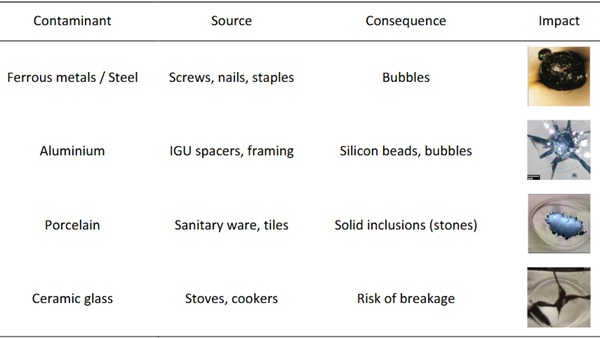
Contaminants which include aluminium, nickel steels, carborundum, tungsten, lead, ceramics, concrete and gypsum, are quantified in parts per million, or grammes per tonne. Typically, they damage the production of glass through creating infusions, inclusions, bubbles, etc., but damage to the furnace is also a possibility.
Our risk reduction strategy for contamination is twofold. It is based on avoidance on site, and this is detailed in in our methodology and we conduct site visits to ensure that the procedures are being followed. It is also based back at our factory in Yorkshire UK where the glass is first inspected and then put through a sophisticated sorting and reprocessing facility which feeds the cullet back into new glass production. This involves a variety of scanners and equipment (magnets, eddy currents) for the detection and elimination of contaminants, and then crushing the glass to a predetermined size ready to be added to the mix of virgin raw materials.
We capture the on-site activity in a cullet agreement contract which will be signed by all parties.
6.1. Diagnosis
A myriad of glazing typologies brings a series of complexities and challenges in determining the best route for disassembly. This is particularly true for façade types which can be window systems, stick curtain walling, unitised curtain walling, double skin facades, point fixed glazing and ground floor treatments. The ability to extract the glass will be influenced by the method of fixing such as beaded, direct bonded, bonded to sub-frames, and subsequent remedial actions such as post applied films, silicone applied to cover up poor workmanship, etc.
Disassembly would have been considerably easier if it had been considered at design stage (Tingley, 2016). However, it was not a consideration in the design and fabrication of most of the current facades on commercial buildings in London and this presents significant time/cost challenges for recovery.
Glazing systems are identified as either Internal Wall Systems (IWS) or External Wall Systems (EWS). Options for dismantling are provided and must be finalised and confirmed in a cullet agreement contract prior to dismantling. The dismantling method and associated activities are still the responsibility of the contractor.
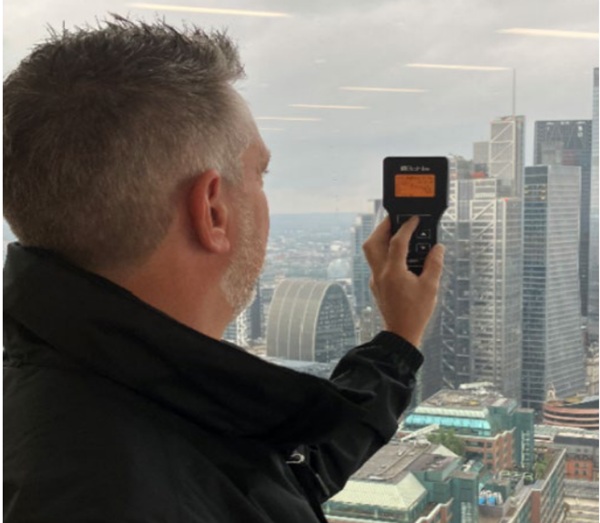
The glass types corresponding to the various IWS and EWS type are identified utilising a Bohle Glass Buddy (see Figure 4) which identifies the glass thicknesses, interlayers, films, cavity widths and coatings. We also record information marked on spacer bars or from stamp marks on the glass (usually identifying a toughened and/or safety glass, or a fire glass). We confirm which types are suitable for recycling, repurposing or available for alternative markets. We confirm an approximate volume of glass and the potential CO 2 saving and the volume of raw material extraction avoided.
6.2. Dismantling
In a busy city location, the “business-as-usual” method for demolishing a façade was to break it up onto the floor plate and remove the debris in wheeled bins to skips. This is done on nearly every occasion by the deconstruction contractor. Sometimes the glass would be segregated, but often not. Glass was often filmed to prevent fragments falling out onto the external scaffold or for safety.
The challenge was to modify this method whilst still satisfying the project cost/time requirements and keeping the risk of contaminates to a minimum. We do remove interior and exterior glass intact, but usually we are adapting the “business-as-usual” approach working through the deconstruction contractors, where the reprocessing/breaking of the glass is done on site.
Interior glass, if toughened, is broken on break out tables and placed in cullet bags. The demolition contractor fabricates the simple timber table with a central hole. The glass is broken and swept into the cullet bag below (see Figure 5). We have used a similar concept on toughened IGUs. We are convinced that the time/cost factors are no different when compared to previous practice.
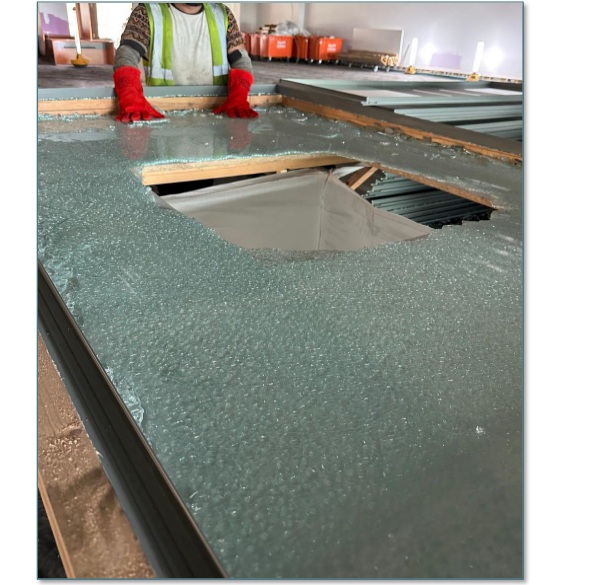
Laminated glass is usually reduced in size utilising a nickel free cutting blade and placed in cullet bags, but we have also removed it in larger sizes in bulk.
Exterior glass is more challenging and has proven more difficult to make the time/cost factors work for the clients. But we do have some great case studies where we have developed new methods for structurally bonded glass.
6.3. Sorting
Laminated/filmed products are processed separately to float/toughened products, as part of the recycling process, when the cullet arrives back at the glass factory. Therefore, we require glass products to be separated and collated on site by product families as shown in Table 2.
Table 2: Product Family Types.
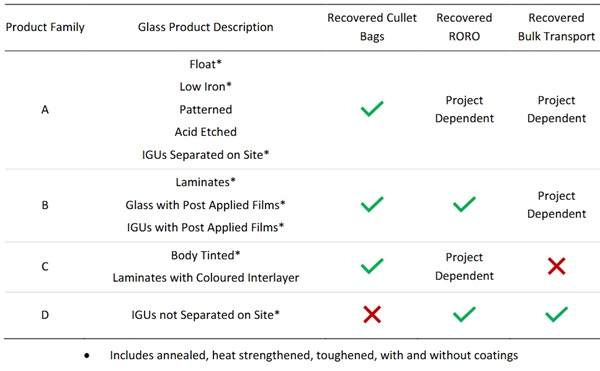
Solid or dark coloured film/vinyl must be removed by the deconstruction contractor before recycling. Clear or light opaque film/vinyl can be accepted. Body-tinted products which are not filmed can be repurposed into alternative products such as glass wool, manufactured by our sister company ISOVER.
We provide purpose-built and tested 1 tonne cullet bags for the collection of glass cullet products. The bags are to be filled to the 1 tonne line to maximise transport efficiency. It is strongly recommended to cover the bags on site to reduce the risk of contamination. Cullet bags are to be clearly marked indicating customer name, project and product family type.
As part of our cullet agreement, the client’s team are made aware of the following.
- It is essential that the culet is kept from contaminates, which can damage the new glass being produced or the furnace. The potential cost to Saint-Gobain Glass ranges from tens of thousands of pounds to potentially millions.
- Any glass that falls onto the floor must not be cleared up and placed in a cullet bag, as it may contain contaminants, such as rubble, concrete, metals etc.
- If contaminates are found when the cullet is inspected by Saint-Gobain Glass, the load will be rejected and sent into alternative markets for downcycling, such as aggregate or glass packaging and we recover the cost of transport for the aborted delivery.
6.4. Collection
The lack of proper collection and sorting of glass to enable the right quality of glass cullet to be diverted to recycling was commonly identified as a major barrier for end of life glass (Glass for Europe 2023, Hartwell R et al., 2022, DeBrincat et al., 2018; WSP Parson Brinkerhoff/DNV GL, 2015).
We provide the transport to collect the cullet and the required quantity of 1 tonne cullet bags. The bags are usually collected using a high-capacity curtain side trailer (euroliner) utilising the return part of a delivery to the London area, to save cost and for further carbon avoidance. The vehicle can take a maximum of 26 bags at a time (circa 18 tonnes).
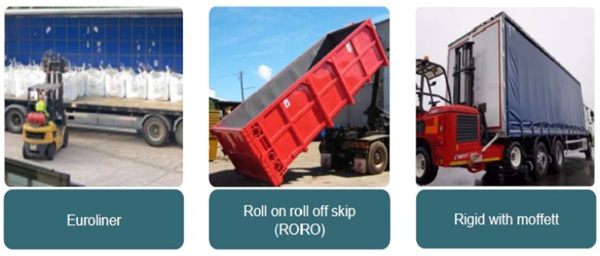
We explore transport options to establish the most cost-effective and efficient method to remove the glass from the site, such as roll-on-roll off skips (RORO), rigid curtain side vehicles, vehicles with rear mounted cranes or forklifts (see figure 6).
When assessing the CO 2 impact of the return journey (circa 290Km), worse case, it is less than 2% of the CO2 savings from cullet use. it is therefore not the climate impact but often the transport cost—driven by low material value, backhauling constraints, and logistics economics—that limits recycling.
6.5. Melting
As a substitute raw material, cullet is hugely important to our pathway to net zero plus avoiding the extraction (with associated environmental consequences) of dwindling natural resources. As such we have engaged directly with clients through Glass Forever to reduce our reliance on the “middlemen” who are waste management companies specialising in glass waste. To them cullet is a marketable product which can be diverted into packaging, insulation, etc., as the market price dictates.
Glass Forever secures the waste stream (i.e. building glass recycled back to building glass), reduces the risk of contamination (i.e. we are aware of the source of the cullet and control its stewardship), provides greater transparency for the clients, and accountability for the deconstruction contractors.
When the cullet arrives at our factory it is weighed and inspected. We log and assign the volume returned and the volume suitable for remanufacture so that at the end of the project we can issue a certificate to the client, confirming these details plus the CO 2 impact and tonnage of raw material extraction avoided. The stewardship of this resource enables us to review the relative effectiveness of the glass recovery process per project and has proved to be valuable in providing feedback to clients.
Laminated glass and glass with applied films is usually shredded and reduced in size so that it can join annealed and tempered glass in the final reprocessing step.
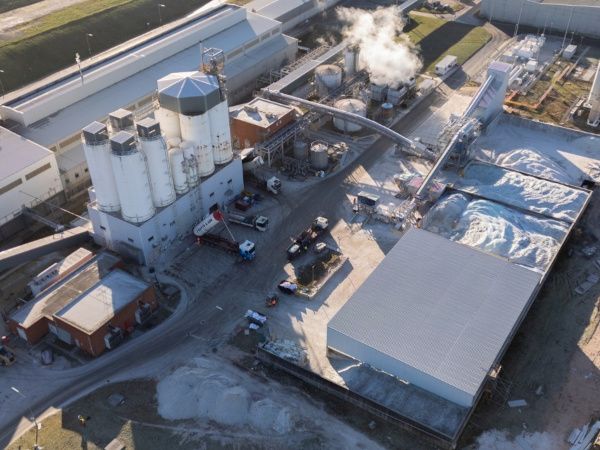
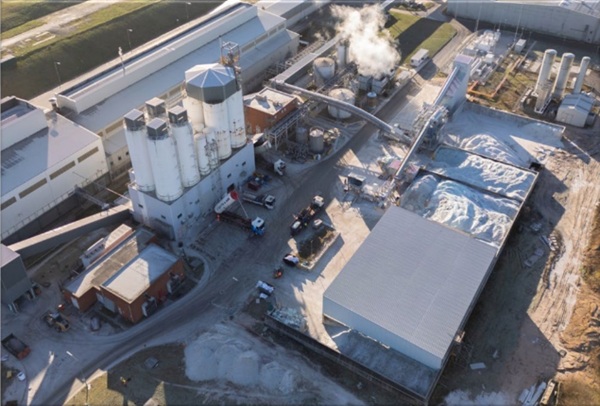
In 2024 we commissioned a high volume, integrated cullet reprocessing facility. It sorts, purifies and weighs the cullet and transports it “furnace ready” to be integrated with the raw materials to be manufactured into new glass (see Figure 7). This was a major upscale of our capacity.
6.6. Projects
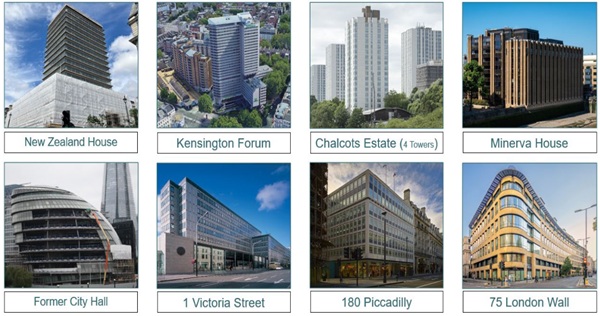
We have completed glass recovery from over 100 commercial projects in London over the past 2-3 years. A few examples can be seen in Figure 8.
Clients are engaging with us at an early stage and becoming more assertive in requiring this to be undertaken by the deconstruction contractors. We are utilising these case studies to encourage more clients to engage with Glass Forever. There is a positive response from clients to full circularity, with us taking their old glass and providing the new glass (especially our low carbon Glass).
Our experiences have forced us to learn and adapt, and we continuously apply what we have learned to the large volume of enquiries that come our way every week.
Our post-consumer recycled content is continually increasing, and the UK is one of the 6 sites in Europe where our low carbon glass is produced (ORAÉ® with 64% recycled content including 57% pre-consumer and 7% post-consumer cullet).
7. Metrics
As we have stated there is very little data outside of the notional volumes mentioned in the introduction. Since 2016 we have had great success in recovering end-of-life glass back from the domestic (residential) sector, but the commercial sector was much more difficult to break into, outside of the few cases mentioned in the introduction.
We have achieved this breakthrough, since 2023, by visiting 261 sites, creating 244 site reports and finding clients and contractors who were willing to make this happen. This would not have been possible without our full-time project manager who is responsible for the surveys, liaison with the deconstruction companies, logistics and reporting. As some of the granular details and statistics are commercially sensitive, we have represented the data in the following tables. The overall volumes of ecovered glass have increased dramatically, growing our post-consumer content in new glass production to about 10% in the UK. An overview of our activity can be seen in Table 3.
Table 3: End of Life Glass - Overview of Activity.
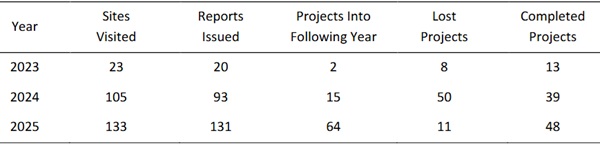
These figures are for London alone. We are still seeing a high volume of lost projects (i.e. glass not recovered to closed loop recycling). This was particularly high in 2024 because many clients were enthusiastic to receive the reports but unsure, unwilling or unable to implement the glass recovery for many of the reasons already covered. It is a key part of our strategy to further engage with such clients.
When we consider the outcomes (Table 4) from the potential volumes that we know about (from our reports) we could more than double our volumes if the glass recovery is undertaken. The volumes returned could be much higher, but some projects are lost, some projects are delayed and even when there is a commitment to glass recovery, we are only getting around 65% of the potential yield. But it is improving.
Table 4: End of Life Glass – Outcomes.
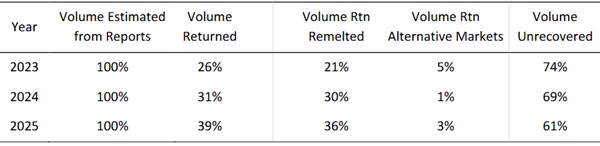
Now we have data we are able to provide feedback to clients on their projects and on the relative performance of different deconstruction contractors. The high volume of visits and reports will be constrained by the fact that we have a resource of one project manager. However, from chasing every enquiry in 2023, we are gradually becoming more selective to focus on the larger projects. This is because there are a considerable number of significant buildings coming up for renovation and we will focus on these to grow our volumes. At the same time, we are creating other routes for smaller quantities of glass to get back to us.
When we consider the glass returned and remanufactured into new glass, the different applications are can be found it Table 5.
Table 5: End of Life Glass by Application.
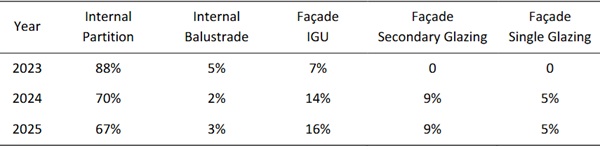
Although most of the glass recovered is from interior partitions, the potential volumes are much higher from façades (see introduction). However, façades are more challenging because the predominant method for removal is for the deconstruction contractors to pull them out/off and deal with the debris. The usual feedback is that cost/time constraints cannot be maintained when glass recovery is followed. We are challenging this, but it will take some years before a different way is accepted and included.
However, there are some major projects coming up for renovation where some element of the aluminium façade grid will be retained and adapted to take new glass. In such cases it is highly likely that a façade contractor will be responsible for the partial deconstruction. Our principles remain the same, but we are adapting our methodologies to this situation.
Ultimately the metric that counts is the volume of waste glass that is returned back into new glass production. BS EN ISO 14021:2016+A1:2021 gives definition to terms used in environmental declarations as a proportion by mass of recycled materials in glass. It considers pre-consumer and post-consumer material as part of the recycled content but not internal waste. In the UK, the pre-consumer element (off cuts from glass processors) has doubled in volume over a 10 year period and is around 20%. Over the same time the post-consumer content has risen from 1% to around 8%.
8. Product Types That Cannot Be Closed Loop Recycled
It is true to say that the majority of interior and exterior glass can be closed loop recycled.
The types that cannot be recycled within Glass Forever are as follows.
- Coloured glass – body tinted or clear glass with coloured films that cannot be removed
- Fire glasses with intumescent interlayers
- Enamelled spandrel panels
- Fritted glass (100% surface covered)
- Glass in small panes with high contaminated risk, i.e. with lead or asbestos beading
- Cast-in-place (CIP) resin laminated glass
The Glass Forever scheme is focused on high volumes. We will take product that we can repurpose such as body tinted glass which can be transformed into glass wool. We would willingly collaborate with other repurposing applications providing it can work with our high-volume activity.
9. London – Typical or Atypical?
The Greater London Authority (the Mayor and the London Assembly) set the overall development strategy in the London Plan (2021). London is split into 32 Boroughs and the City of London, and these administrative districts are responsible for applying the London Plan to local planning requirements.
It strongly encourages reuse/renovation because it creates lower emissions than new construction. The planning system is utilising the following to promote CE strategies.
- GLA Pre-Demolition Audit including figures for embodied carbon in existing materials
- GLA Circular Economy Statement for planning applications on major developments. This includes a written report and a spreadsheet (data to be provided at application and post-construction stages), targeting minimum 95% of waste diverted from landfill, 20% of building materials to have recycled or reused content and incorporate CE design principles
- GLA Pre-redevelopment audit as part of CE statement
- A pre-redevelopment audit as part of the Site Waste Management Plan (SWMP) provides 4 BREEAM points and is recommended by the GLA as part of the CE statement
As the capital city of the largest commercial construction market in Europe (EUROCONSTRUCT 2018), London is the largest market for many of the major European façade contractors. City centre sites have a greater level of complexity for deconstruction because of site constraints. Commercial clients in London are looking to achieve high rents from tenants who may be more allured by the operational carbon benefits of the new building but becoming more aware of embodied carbon.
In many ways London is a unique market because of the number, size and complexity of the projects but we are starting to see client engagement in other cities and the principles of glass recovery remain the same for us. Making the cost/time factors work will prove more challenging (until the CE principles embedded in the London Plan are more widely adopted), as will overcoming the inertia and reluctance of clients and the deconstruction contractors.
10. Where Do We Go from Here?
The Glass Forever programme has reached a significant milestone in the UK, successfully recovering 1 million tonnes of external cullet since its launch, 25 years ago (Saint-Gobain Glass 2026).
Cullet has a low intrinsic market value, therefore there needs to be an acceptance that recovering it will lead to additional cost (and potentially time) to the project. This could change in the future through government intervention, market forces, internal/external carbon pricing. Whether the clients will consider additional time/cost will be determined by their perception of value, and how it benefits them.
Pre‑demolition audits will become an intrinsic part of the planning process, ensuring that buildings nearing end‑of‑life are approached not as a waste but as reservoirs of valuable resources.
We are onboarding clients into the scheme and conducting bi-annual reviews of progress. They are regularly taking us into projects before the deconstruction contractors are involved. Early involvement is crucial to growth as the client is better prepared with the right information, more likely to include it in the project requirements, and less likely to accept reasons for non-compliance.
The digitalization of our glass audit process will minimize the level of errors while amplifying the benefits by improving speed, accuracy, and overall workflow efficiency. In addition, digital tools—including advanced surveying technologies, AI‑driven material recognition, and automated documentation — can drastically reduce processing time, and enhance data reliability, and streamline report generation. Finally, digital platforms could provide transparent traceability and facilitate real‑time data sharing among stakeholders, thereby strengthening collaboration and ensure trustworthy data reporting and customer benefits.
References
Bakx, M., Beurskens, P., Ritzen, M., Durmisevic, E., Lichtenberg, J. A morphological design and evaluation model for the development of circular facades 2016). https://www.researchgate.net/publication/301230962. Accessed 11 August 2023
Bohle.: Bohle Glass Buddy (2026). https://www.bohle.com/uk-EN/product-groups/workshop-supplies/glass-buddy-measuring-device. Accessed 11 February 2026
British Standards Institution.: BS EN ISO 14021:2016+A1:2021 Environmental labels and declarations. British Standards Institution, London (2021)
DeBrincat, G., Babic, E.: Re-thinking the life-cycle of architectural glass (2018). https://www.arup.com/perspectives/publications/research/section/re-thinking-the-life-cycleof-architectural-glass. Accessed 17 October 2022
EUROCONSTRUCT.: UK Report (2018). https://www.euroconstruct.org/reports. Accessed 07 July 2019
Entwistle, D.: Recycling Post-Consumer Glass: A Challenge and an Opportunity for the Flat Glass Industry in: Louter, C.Bos, F.; Belis, J. [eds.] Challenging Glass 9. Challenging Glass Conference, Delft, 19–20 June 2024 (2024). https://doi.org/10.47982/cgc.9.567
Geboes, E., Galle, W., De Temmerman, N.: Make or break the loop: a cross-practitioners review of glass circularity (2023). https://link.springer.com/article/10.1007/s40940-022-00211-y. Accessed 30 June 2023
Glass for Europe.: Recyclable waste flat glass in the context of the development of -end-of waste criteria. Glass For Europe, Brussels (2010)
Glass for Europe.: Recycling of end-of-life building glass (2013). https://glassforeurope.com/publications. Accessed 09 June 2023
Glass for Europe.: Sustainability in the flat glass sector (2023). https://glassforeurope.com/wp-content/uploads/2023/05/Glass-for-Europe-paper_Sustainability-and-ESPR_May2023.pdf. Accessed 11 June 2023
Greater London Authority.: The London Plan (2021) https://www.london.gov.uk/sites/default/files/the_london_plan_2021.pdf. Accessed 07 July 2023
Greater London Authority.: Waste and Recycling (2021). https://www.london.gov.uk/programmes-strategies/environment-and-climate-change/waste-and-recycling#:~:text=Our%20vision%20is%20clear%3A,municipal%20waste%20will%20be%20recycled.Accessed 07 July 2023
Greenhouse Gas Protocol.: FAQ (2001).https://ghgprotocol.org/sites/default/files/standards_supporting/FAQ.pdf. Accessed 11 August 2023
Glass International (2023) Forglass builds cullet treatment system for Saint-Gobain. https://www.glass-international.com/news/forglass-builds-cullet-treatment-system-for-saint-gobain. Accessed 14 July 2023
Hartwell, R., Coult, G., Overend, M.: Mapping the flat glass value-chain (2022) https://link.springer.com/article/10.1007/s40940-022-00195-9. Accessed 23 June 2023
Hestin, M., de Veron, S., Burgos, S.: Economic Study on Recycling of Building Glass in Europe (2016). https://glassforeurope.com/publications. Accessed 30 June 2023
Saint-Gobain Glass UK.: Glass Forever Reaches 1 Million Tonnes (2026) https://www.linkedin.com/feed/update/urn:li:activity:7404902295857082370. Accessed 11 February 2026.
Saint-Gobain Glass UK.: Leading A Sustainable Revolution (2026) https://www.saint-gobain-glass.co.uk/sustainability/cullet-return/. Accessed 11 February 2026.
Tingley, D.: Design for Deconstruction: An Appraisal. University of Sheffield, Civil and Structural Engineering Department, Shefield (2012)
WSP Parson Brinkerhoff/DNV GL.: Industrial decarbonisation & energy efficiency roadmaps to 2050: cross sector summary (2015).https://assets.publishing.service.gov.uk/government/uploads/system/uploads/attachment_data/file/419912/Cross_Sector_Summary_Report.pdf. Accessed 28 July 2023
Vlakglas,: Vlakglasrecycling Nederland (2021).https://www.vlakglasrecycling.nl. Accessed 21 July 2023