Date: 14 October 2026
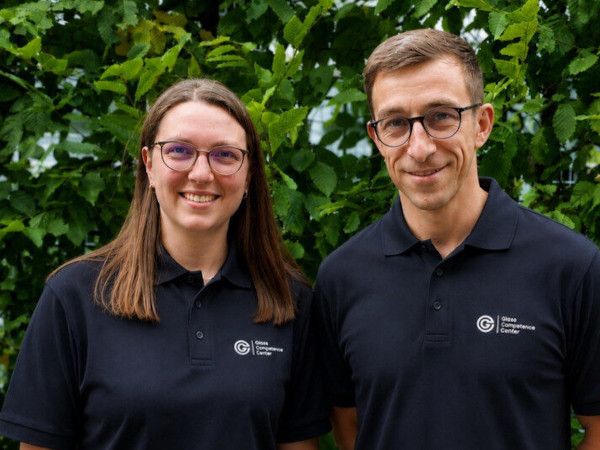
The performance of glass is constantly improving. At the same time, there is a renewed call for simple construction. A contradiction? Not really, according to Miriam Schuster and Matthias Seel from the Glass Competence Centre (GCC) at the Technical University of Darmstadt. Their research topics include thin glass and thick glass, vacuum insulating glass and ‘curved’ glass. The focus is shifting from recycling to reuse.
Thin glass is and remains one of your areas of focus at the GCC. You are now working with thicknesses of less than 1 mm. What advantages and applications does this offer?
Matthias Seel: Thin glass is light and flexible. Using thin glass allows for significant reductions not only in weight but also in the space required. This is particularly interesting when it serves solely as a barrier layer, such as the middle pane in triple-glazed insulating glass. Thin glass can also be used to create kinetic – deformable – facade applications, such as ‘bendable’ glazing. Thin glass offers significant potential for resource-efficient construction and enables genuine innovations in window and facade construction, for example when combined with structural optimisation.
Together with industry partners, you are researching the cutting of thin glass. What are the challenges and potential applications?
Matthias Seel: Handling thin glass in general, right through to the cutting stage, is a challenging process. The cutting support used for cutting thin glass must be stiffer than that used for thick glass, and cutting parameters such as cutting force and the cutting wheel must be individually adjusted. On the other hand, thin glass is very well suited for use as the middle pane in triple-glazed units. This allows the overall weight and thickness to be significantly reduced. Thin glass enables the creation of thin laminated safety-glass constructions. Thin glass is also suitable for building-integrated photovoltaics (BIPV) in combination with perovskite technology. This enables the production of very thin, flexible PV modules. And, of course, its functionality is enhanced when reclaimed glass that has not been remelted is laminated with coated thin glass to form laminated glass.
In stark contrast to this is thick glass. We’re talking about giant panes up to 60 mm thick with a high self-weight, which allow for unusual colours, surfaces and even inclusions. Who can afford this, and what are the benefits?
Matthias Seel: This thick glass is primarily used in high-end architectural applications, in interior applications and for iconic facades. Surface textures with significant variations in thickness, as well as translucent structures, can be easily created using it. This makes it possible to produce highly aesthetic and colourful glass surfaces.
You tend to find flat glass rather boring. So naturally we’re now also interested in your view of 'curved' glass.
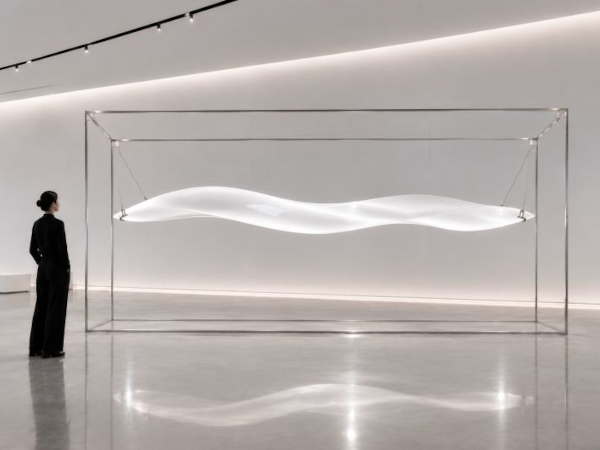
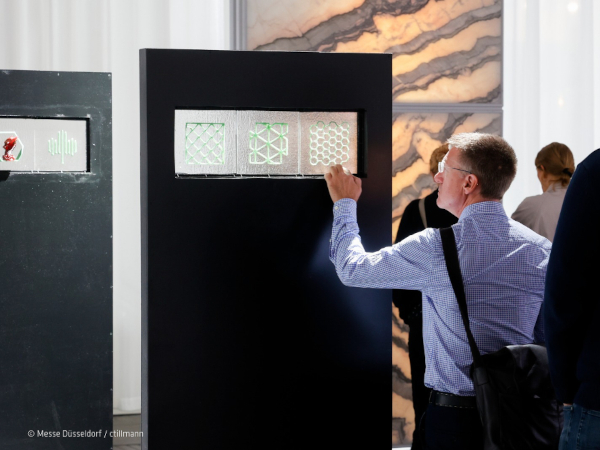
Matthias Seel: 'Curved' glass structures are 'non-flat glass structures'. In other words, flat glass is reshaped locally, or a three-dimensional structure is permanently applied to flat glass using 3D glass printing. These processes open up new possibilities for us to use glass in ways that make lighter, higher-performance and more versatile use of glass. Through targeted curvatures, folds or localised reinforcements, stiffness can be significantly increased, making thinner and lighter panes possible. In laser-induced glass bending, even small localised indentations can have a major effect. For example, a profiled 4-mm pane can achieve the stiffness of a flat 6-mm pane – with around 50 per cent less glass mass. Additive manufacturing on flat glass enables complex and customised glass structures that would be virtually impossible to achieve using conventional methods. In this way, geometry becomes a design tool that combines technical efficiency with architectural freedom. We're also demonstrating this at our stand in the special show at glass technology live.
Together with industry partners, you have been conducting research into vacuum insulating glass for many years. The manufacturing techniques are becoming increasingly sophisticated. Pane sizes of 4.2 m x 2.4 m are now possible. Where do you see the current challenges and potential applications?
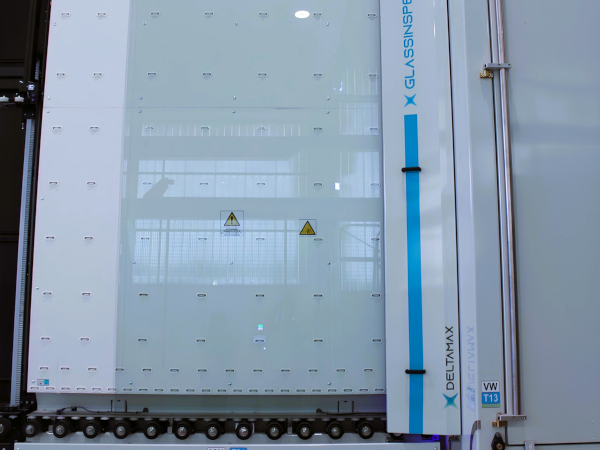
Miriam Schuster: Large formats are now in fact also available for use in facades. And vacuum-insulated glazing is already being used in projects across Europe and here in Germany. We currently see potential applications in the energy-efficient refurbishment of existing windows and facades, as vacuum-insulated glass (VIG), with a thickness of just 6 to 16 mm, provides excellent thermal insulation whilst being lightweight. Due to the low total glass thickness of 6 to 8 mm for window sizes, VIG is particularly interesting for the refurbishment of older buildings where thick and heavy triple-glazed units can no longer be used. However, the relevant standards for structural design are still lacking. Another challenge is the comparatively high cost.
Sustainability remains an important topic. However, the focus is shifting from recycling to reuse. What does this mean for your work, and what can we expect to see at the special exhibition?
Miriam Schuster: When it comes to sustainability and the circular economy, we simply have to consider the full range of options. Recycling, reuse and reprocessing are three of them. With the latter two, we avoid having to remelt the glass – a process that is very energy-intensive. From an environmental perspective, that would be preferable, at least initially. However, we end up with products whose properties are not clearly known.
The technical challenge lies in assessing the properties of the dismantled product quickly and efficiently, and then deciding what can be done with it. That is what we are researching. For example, we examine the visual condition of the recovered glass. Are there any scratches, and if so, how many and where? In the case of laminated glass, we check for delamination, and for insulating glass, we check whether gas is present in the cavity between the panes. We dismantle the products into individual panes, carry out strength tests, manufacture new insulating glass and laminated glass from the dismantled panes, and compare their performance with that of new products. In doing so, we generate fundamental knowledge – for example, regarding properties that change with ageing. At the same time, our work remains closely aligned with industry when we produce 're-use' glass products from dismantled panes using standard processing methods such as lamination.
At the special exhibition, we are displaying insulating glass made from dismantled glass – in direct comparison with a completely new insulating glass unit. We are keen to see whether our visitors can spot the visual differences and guess the CO2 equivalent associated with manufacturing each of the two products.
About Miriam Schuster
Miriam Schuster is a civil engineer and, since 2022, has been co-head of the Glass and Polymers Group at the Institute for Structural Analysis and Design (ISM+D) at TU Darmstadt. She also works as a postdoctoral researcher on sustainability and the circular economy of glass in construction, focusing on the assessment of its potential for reuse and reconditioning. She has been working part-time for CSZ Ingenieurconsult since 2025. Miriam Schuster is an active member of the 'Glass in Construction' standardisation committee and represents ISM+D in the Fachverband Konstruktiver Glasbau (FKG).
About Matthias Seel
Matthias Seel studied civil engineering at the University of the German Armed Forces in Munich and completed his PhD on the structural analysis of point-supported glass panes. From 2015 to 2022, he worked as a postdoctoral researcher at the Centre for Building Materials (MPA-IfW) at TU Darmstadt. Since 2022, he has headed research and the laboratory at the Glass Competence Centre at TU Darmstadt. His areas of specialisation include additive manufacturing and the processing of glass. Matthias Seel is actively involved in national and European standardisation bodies and chairs the European working group on 'prEN 1288-6 – Flexural strength of glass – Testing of edge strength', as well as the working group on 'Edge strength and thermal fracture' within the Fachverband Konstruktiver Glasbau (FKG).
 600450

Add new comment