
Date: 15 October 2026
The evguard® interlayer system is documented in five performance areas: impact behaviour at low temperatures, impact resistance of thin-glass laminates, residual load-bearing capacity in barrier glazing, reaction to fire and high-temperature stability, and national and international approvals. The system combines the cross-linked EVA film evguard® with evguard® MPE, a multi-layer modified co-polyester film.
All values below are taken from the evguard® certification overview (Version 6, 2026) and the underlying test reports. Build-ups use the usual laminated-glass notation (e.g.44.2 = two 4mm panes with a two-ply interlayer); "MPE(x)" marks an additional evguard® MPE layer of the stated type.
1. Impact behaviour at low temperatures
Laminated glass in façades, balustrades and canopies is often loaded at sub-zero temperatures. Interlayers stiffen in the cold, so impact resistance at room temperature does not automatically carry over.
evguard® laminates were therefore tested in the ball drop test to DIN 52338 at 0 °C, −20 °C and −40 °C:
• 44.2 (evguard®): 4.5 m fall height – no break-through, no penetration at all three temperatures.
• 44.2.MPE(200): 6 m fall height – no break-through, no penetration at all three temperatures.
The tests were carried out in-house in cooperation with TU Dresden (Friedrich Siemens Laboratory).
Long-term cold exposure was assessed separately: a 66.2 build-up passed the frost resistance test to GOST 30826-2014 (−70 °C, 14 days).
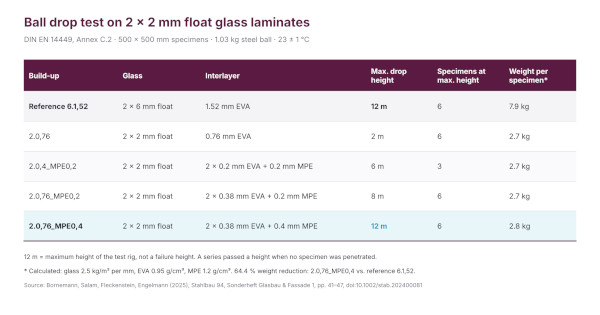
2. Thin glass: 12 m ball drop with 2 × 2 mm float glass
Thinner glass reduces weight, but shifts more of the impact load onto the interlayer. A joint study by Folienwerk Wolfen and TU Dresden (Institut für Baukonstruktion) quantified this with ball drop tests to DIN EN 14449, Annex C.2.
Test set-up: 500 × 500 mm specimens, 1.03 kg steel ball, room temperature (23 ± 1 °C). Drop height was increased in 1 m steps; the maximum height of the rig is 12 m. A series passed a height when no specimen was penetrated.
Key results:
• With 2 × 2 mm glass and 0.76 mm EVA, adding 0.4 mm MPE raises the drop height from 2 m to 12 m.
• The 2 × 2 mm build-up with MPE reaches the same 12 m as the 2 × 6 mm reference – at 64.4 % less weight.
• 12 m is the limit of the test rig, not a failure height.
• Thin-glass specimens released only small fragments (< 1 cm) on the impact-facing side; no visible delamination between EVA and glass. By comparison, 2 × 12 mm glass released fragments of up to 9 cm.
The tests were carried out at room temperature; the low temperature results in section 1 come from a separate test series.
3. Residual load-bearing capacity and barrier glazing
For free-standing barriers and glass railings, the decisive question is how the laminate behaves after the glass has broken.
• Free-standing barrier glass / glass railings: build-ups 66.4.MPE(600), 88.2, 88.2.MPE(200) and 1010.2 approved to BS 6180, DIN 18008-3 (category B, residual load-bearing capacity) and AS/NZS 1170.1. Independent evaluation by J. B. Colvin.
• Glass railings, category B: 88.1, 88.2, 88.2.MPE(200), 88.2.MPE(400) and 88.2.MPE(600) passed to DIN EN 1990/1991/1993/1999, DIN 18008-1 to -4 (Germany), UNI 11678:2017 and NTC 2018 (Italy).
• Deflection and pendulum impact: 88.2.MPE(600) and 88.4.MPE(600) approved to AS/NZS 1170.1.
4. Reaction to fire and high-temperature behaviour
evguard® is cross-linked during lamination (gel content > 80 % to DIN EN 62788-1-6). This determines its behaviour at elevated temperatures.
• Reaction to fire: classification B-s1,d0 to DIN EN 13501-1 (build-up 44.2), based on DIN EN ISO 11925-2 (no ignition) and DIN EN 13823 SBI (no afterburning).
• Ignition temperatures (ASTM D1929, Miami-Dade): self-ignition 377 °C (22.2.MPE(200)); ignition 440 °C (33.1). Rate of burn to ASTM D635: classes C1 and CC1.
• Bake test: DIN EN ISO 12543-4, build-up 44.1 – no delamination up to 240 °C.
• Shear modulus: measured by Friedmann & Kirchner (2017) to EN 16613, 5 % quantile values, from 25 °C to 60 °C and from 3 s to 1 h load duration. For 44.1, G ranges from 2.17 MPa (25 °C, 3 s) to 0.45 MPa (60 °C, 1 h). With evguard® MPE, values at 30 °C rise to 2.8–6.0 MPa, depending on build-up and load duration.
The full shear and Young’s modulus tables are available for structural calculation on request.
5. Approvals and safety classifications
• Germany: DIBt general approval (AbZ) for laminated safety glass with evguard®, expert opinion G-70-21-0003.
• Ball drop, DIN EN 356: from P1A (44.2, 44.3, 22.2.MPE(200)) up to P4A (22.2.MPE(800), 44.4.MPE(600)) and P5A (44.8.MPE(600)).
• Pendulum impact, DIN EN 12600: 1(B)1 for 44.1, 2(B)2 for 33.2, 3(B)3 for 33.1.
• USA / Canada: ANSI Z97.1-2009, CPSC 16 CFR 1201 and CAN/CGSB 12.1-M90 approved; listed by SGCC (evguard® and evguard® MPE).
• Miami-Dade: NOA 25-0421.02 (22.2.MPE(200)) and NOA 24-0117.03 (33.1); large missile impact TAS 201-94 and cyclic loading TAS 203-94 at ±120 psf passed with 55.4.MPE(800).
• Blast: ASTM F2912-17 and F1642-17, insulating glass unit – hazard level H4.
• Active shooter: ASTM F3561-22, classification FTD-SA-C6.
• Durability: DIN EN ISO 12543-4 (heat, humidity, UV) approved for 44.1, 44.2 and 44.2.MPE(200); salt spray 3,000 h to ASTM B117 / ISO 9227 approved.
Data basis
Source: evguard® certification overview, Folienwerk Wolfen GmbH, Version 6 (2026), and the test reports referenced there. Thin-glass results: Bornemann, S.; Salam, M. A.; Fleckenstein, E.; Engelmann, M. (2025) Gewichtsreduzierung von VSG durch Dünnglas bei gleichbleibender Stoßfestigkeit. Stahlbau 94, Sonderheft Glasbau & Fassade, Ausgabe 1, pp. 41–47, https://doi.org/10.1002/stab.202400081. Results apply to the build-ups stated; other build-ups require separate verification. Test reports and full data sheets are available from Folienwerk Wolfen GmbH on request.
 600450
























Add new comment