Article Information
- Digital Object Identifier (DOI): 10.47982/cgc.10.765
- Published by Challenging Glass, on behalf of the author(s), at Stichting OpenAccess.
- Published as part of the peer-reviewed Challenging Glass Conference Proceedings, Volume 10, June 2026, 10.47982/cgc.10
- Editors: Christian Louter, Freek Bos & Jan Belis
- This work is licensed under a Creative Commons Attribution 4.0 International (CC BY 4.0) license.
- Copyright © 2026 with the author(s)
Authors: Graham Coult a, Efstratis Volakos b, Valérie Hayez c, Allan Gibson d
a b Eckersley O’Callaghan Ltd, UK
c Dow Performance Silicones
d Kuraray Europe GmbH, Germany

1. Introduction
Structural silicone is a widely used material in the construction of building envelopes and in particular glazed curtain walls. The most visually obtrusive connection in structural glazed systems occurs between the glazed wall and glass fins.
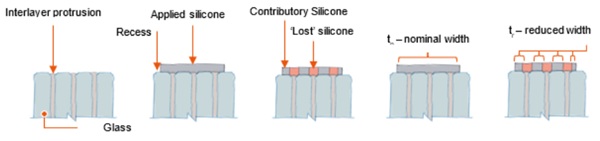
In current engineering practice, the adhesive contribution of silicone/interlayer interface is disregarded as shown in Figure 1. This is primarily due to the lack of standardized testing protocols and certifications verifying the structural compatibility and reliability between silicone sealants and interlayer materials. Consequently, in structural calculations, a reduced effective bite width is assumed in place of the nominal bite. Although, this has been a practical and safe design assumption, it merits re-evaluation given that the additional materials involved lead to increased costs and higher embodied carbon.
If compatibility and performance between silicone and the interlayer substrate were to be formally validated and certified, it would become possible to consider the full nominal bite in design calculations. This could significantly enhance the efficiency of sealant use and enable more optimized structural designs.
1.1. Simple Illustration
To illustrate this, a simplified design example is considered: a generic glass fin supporting the edges of two glass panels under an out-of-plane load, where the connection is fully silicone bonded along the width of the fin, as represented in Figure 1. The glass fin consists of four plies, each 10 mm thick, laminated with 1.52 mm of interlayer, with 1 mm chamfers at the edges and 3 mm recess in both the outer and inner ply. Table 1 below shows how the nominal bite thickness and the reduced one is calculated.
Table 1: Calculation of the nominal and reduced bite width.

In this configuration, the ratio between the nominal and effective bite widths is 1.38. This implies that, if adhesion with the interlayer is structurally effective, the capacity of the silicone joint increases by 38%.
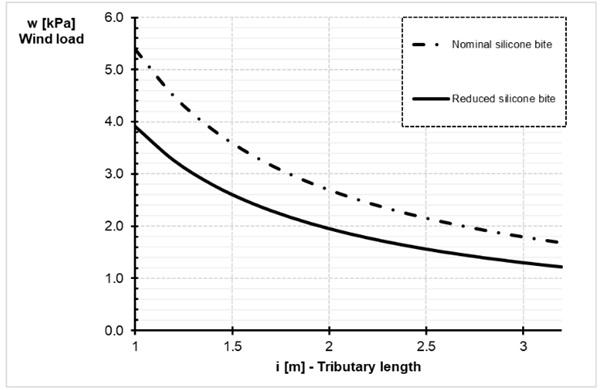
The chart in Figure 2 shows the design wind loads as a function of tributary length, comparing scenarios using the nominal bite versus the effective bite. Notably, using the nominal bite allows the structure to withstand higher loads, while relying on the reduced (effective) bite would necessitate an increase in fin thickness to achieve the same fin spacing.
2. Preliminary qualitative tests
To evaluate the adhesion between silicone and various glass interlayers, Dow Silicones Belgium SRL (Dow) conducted peel adhesion tests in accordance with ASTM C794 (ASTM 2022). This test serves as a reliable and straightforward screening method to assess the bond strength of a sealant to a given substrate. The glass and cured open laminate samples were provided and procured by Kuraray Europe GmbH (Kuraray).
The silicone used for the evaluation was DOWSIL™ 983 Structural glazing sealant (Dow 2025), while three different interlayer materials were tested: SentryGlas® 5000 (Kuraray 2024), SentryGlas® Xtra 6000 (Kuraray 2025), and PVB Trosifol® Xtra Stiff B230 (Kuraray 2025). For each interlayer type, three samples were tested. All open-sandwich laminated specimens featured an exposed interlayer surface laminated by Kuraray following standard procedures, but without a top glass layer. The silicone was applied to the open face of the interlayer at Dow laboratories.
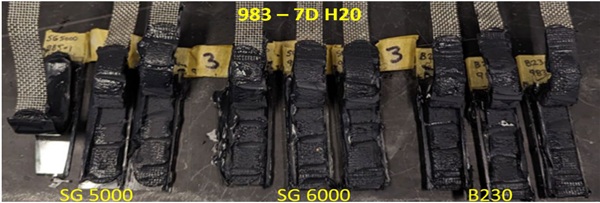
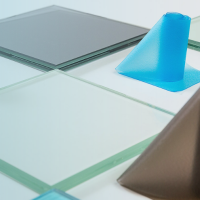
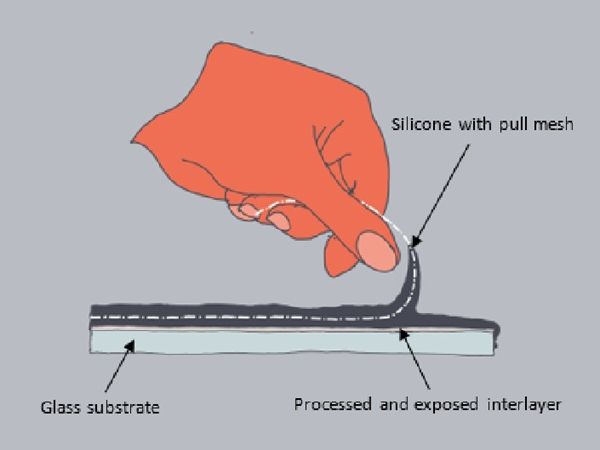
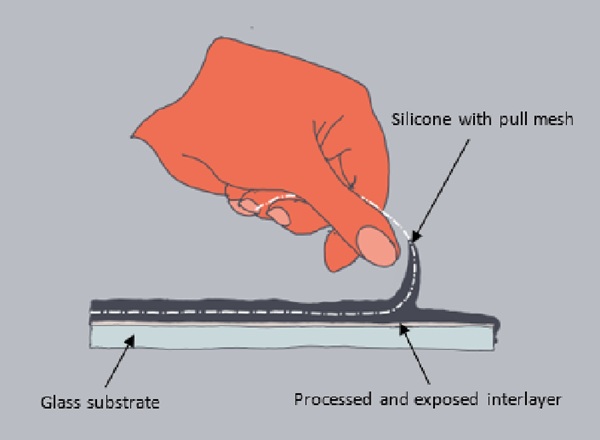
The test procedure is taken from Section 8.1 of ASTM C794. It involves embedding a strip of metal mesh (at least 63.5mm) into a thin layer of sealant applied to the substrate material. The initial silicone smear area is 102mm x 76mm with the final strip width or 25.4mm. After application, the specimens are cured for a specified duration under controlled environmental conditions. Once fully cured, the mesh tails are peeled back from the substrate at a 180° angle to evaluate the adhesive strength of the bond. The peel rate is 50.8mm/min. A schematic representation of the test setup and configuration is provided in Figure 4 and the full range of tested specimens can be seen in Figure 3. This can be a manual process (as applied in Europe) while in the US, the pulling of the mesh is by a machine which allows for the gathering of quantitative strength data and the resulting peel strength level reached satisfying levels. Numerical results are not presented due to the methodology being carried out in Europe.
Cohesive failure is achieved when the sealant tears within itself while remaining fully bonded to the substrate. This mode of failure is required for structural glazing applications, as it indicates that the adhesive bond to the substrate is stronger than the internal cohesive strength of the sealant. As presented, the test results are promising since eight out of nine samples exhibited cohesive failure, with rupture occurring within the silicone material and acceptable strength levels.
Table 2: Type of failure on samples tested according to ASTM C794.

3. Accelerated ageing tests
Lamination interlayers are not approved as substrate for structural glazing according to the European Assessment Document EAD 090010-00-0404 (former ETAG002) (EOTA 2018). The guidelines for structural glazing have been developed specifically for glass and metal substrates and the listed testing procedures for adhesion and accelerated ageing cannot be applied directly to interlayers. To enable the use of these interlayers, an adapted testing protocol should be developed. To collect data for the future application of such an EAD, the OPACIETA test protocol was adopted, as recommended by the Belgian Buildwise Technical Assessment Body (Buildwise 2026). This protocol has previously been developed to evaluate the adhesion of silicone to organic coatings on glass.
3.1. Materials and specimens
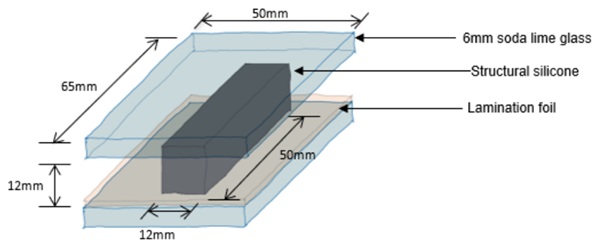
Following the pre-testing of the peel adhesion, Kuraray supplied the selected interlayers, namely SentryGlas® Xtra 6000 and PVB Trosifol® Extra Stiff B230 for further quantitative adhesion testing. DOWSIL™ 993 structural glazing silicone was used for preparing the test pieces. The specimens (Figure 5) comprised 65 × 50 mm glass plies assembled into H-shaped joints (glass–silicone–interlayer) with nominal dimensions of 12 × 12 × 50 mm. Glass surfaces were cleaned with DOWSIL ™ R40 Universal Cleaner. No primer was used.
3.2. Test methods
Initially, the mechanical performance of non-aged (cured at room temperature for 2 weeks) H specimens was evaluated according to ISO 8339 in both tension and shear loading at a strain rate of 5mm/min. (Figure 6)
The ISO 8339 is limited to a tensile test, so the shear test is an adaptation where the H specimen is rotated so that the silicone joint is orientated vertically which is in line with EAD for Bonded glazing kits and bonding sealants (Figure 7)
The resulting tensile and shear capacity and associated failure modes established the reference dataset.
To assess durability under combined environmental actions, an adapted Opacieta protocol, originally developed for organic coatings in SSG, was implemented. This testing protocol combines simultaneous mechanical and climatic loading to reproduce the environment seen in a real façade application. Ultraviolet (UV) exposure, which was originally used in the Opacieta protocol for organic coatings, was deliberately omitted, as direct UV irradiation on interlayers does not reflect typical façade conditions and had already been shown (Glass Processing Days 2025), to induce severe degradation. The specimens were pre-elongated to 12.5% (corresponding to the design deformation for SSG) and under this permanent elongation, subjected to four cycles of 1008 hrs each (Table 3). Each cycle consisted of prolonged exposure at 70°C and relative humidity (RH) above 80% followed by limited exposure at −15 °C. After cycling, the elongation was removed, the samples were allowed to recover (24hours) and then tested in tension and shear.
After the above aging protocol, some specimens, still under elongation, were subsequently immersed in 60 °C water for 24 hrs, allowed for recovery (24hours) and then tested in tension only. Like UV, full water immersion is not likely to occur in a real façade application with such interlayers, which are typically encapsulated between the laminated glass layers. However, this test was maintained to understand failure modes and sensitivity of the interlayers.
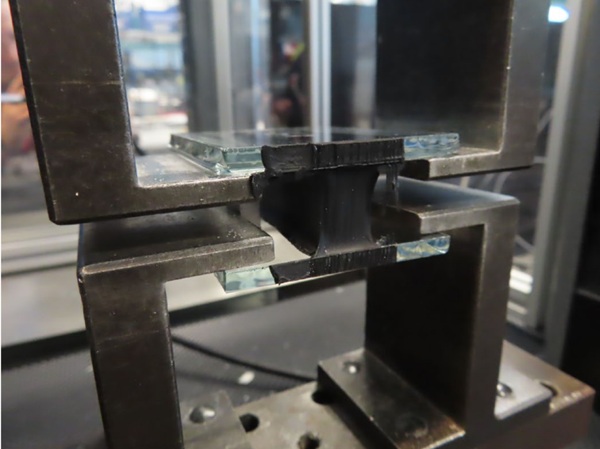
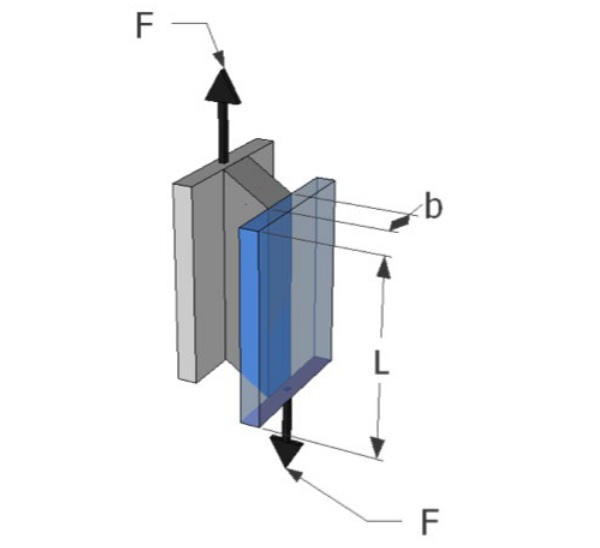
Table 3 Accelerated aging cycle.

4. Results & Discussion
The tables below summarize the experimental results for each interlayer and type of testing.
Table 4: Tensile tests results of PVB specimens.
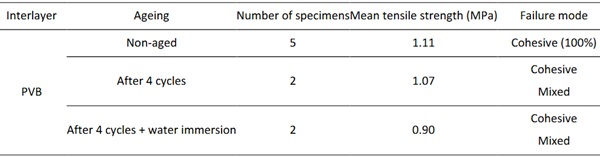
Table 5: Shear tests results of PVB specimens.

Table 6: Tensile tests results of SentryGlas specimens.
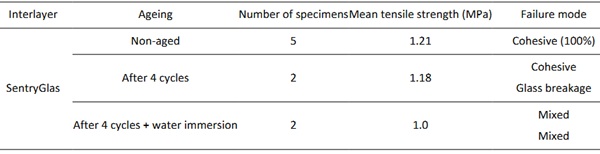
Table 7: Shear tests results of SentryGlas specimens.

4.1. Non-aged specimens
For the non-aged specimens (two-week cure at room temperature), the mean tensile strength was approximately 1.11 MPa for PVB and 1.21 MPa for SentryGlas. In shear, SentryGlas specimens achieved an average strength of 0.73 MPa while PVB specimens reached 0.72 MPa. In all cases, cohesive failure (failure within the silicone) was observed indicating that the adhesion between the silicone and interlayer exceeds the intrinsic strength of the silicone.
4.2. Aged specimens
After the four cycles aging schedule, PVB specimens showed a slight reduction (4%) in mean tensile strength relative to the reference (non-aged) specimens. However, half of these specimens no longer failed purely cohesively; instead, mixed cohesive and interlayer–glass adhesive or material failures were observed. These mixed failures can be disregarded for practical applications as the interlayer in real world projects is fully sandwiched between the glass panes and not exposed as in the specimens tested. SentryGlas specimens in tension exhibited a minor strength reduction of approximately 3% with the reference ones. One of the two specimens tested failed cohesively, while the other specimen exhibited glass failure preventing determination of the actual failure mode.
In shear, both PVB and SentryGlas specimens demonstrated higher strength than the non-aged specimens. PVB specimens showed both cohesive and mixed failure modes, whereas the SentryGlas specimens failed cohesively.
Subsequent immersion in 60 °C water reduced the mean tensile capacity by 19% and 17% for PVB and SentryGlas specimens, respectively. PVB specimens exhibited both cohesive and mixed failure modes, while all SentryGlas specimens displayed mixed failure modes.
t should be noted that, in all cases, limited samples were tested. No comprehensive statistical analysis could be performed, and all results must be taken with caution.
5. Conclusions & Future Research
For façade and glass engineers, a key observation is that, in the short term (non-aged), structural silicones can bond effectively to both SentryGlas and PVB interlayers, providing tensile and shear strengths of similar magnitude to those observed on glass substrates. Accelerated aging tests indicated a slight reduction of the strength capacity. In all cases, failure occurred predominantly within the silicone (cohesive), suggesting that the adhesion between silicone and interlayer exceeds the intrinsic strength of the silicone.
From a purely mechanical perspective, these results imply that the interlayer surface could, in principle, contribute to load transfer in SSG joints in applications such as glass fins, where achieving effective bite without increasing the glass thickness is advantageous. A key requirement to enable this, is to ensure a consistent cohesive failure mode for the silicone-interlayer bond.
Given these promising experimental results, further testing will be undertaken to generate the data required for potential code accreditation employing more representative specimen configurations that eliminate the extreme interlayer exposure to aging factors responsible for the mixed failure modes observed. Additional testing will also be performed on realistic joint details (e.g. glass fin joints) to confirm the suitability of SSG–interlayer connections for real-world applications. Finally, besides changed joint configurations and increased number of samples, the performance testing protocol (including ageing conditions) must be deemed relevant by the certification organism creating the EAD.
References
ASTM International. (2022). ASTM C794-18(2022): Standard test method for adhesion-in-peel of elastomeric joint sealants. ASTM International.
ISO 8339 Building construction — Sealants — Determination of tensile properties
Buildwise, www.buildwise.be (2026)
Dow. (2025). DOWSIL™ 983 Structural Glazing Sealant. , DOWSIL ™ 993 Structural Glazing Sealant, DOWSIL™ R40 Universal cleaner– Product information
EOTA, EAD 090010-00-0404, Bonded Glazing kits and bonding sealants (2018)
International Organization for Standardization. (2012). ISO 8339:2012 – Building construction: Joint sealants – Determination of adhesion/cohesion properties of sealants in combination with substrate. ISO.
Kuraray. (2024). SentryGlas® 5000 structural interlayer for laminated glass.
Kuraray. (2025). SentryGlas® Xtra (SGX) ionoplast interlayer – advanced laminated glass interlayer for improved lamination quality and efficiency
Kuraray. (2025). Trosifol® Extra Stiff B230 PVB interlayer for laminated safety glass. Kuraray – Advanced Interlayer Solutions Division
Mr G Coult, Glass Processing Days (2025) Silicone x Interlayer adhesion