
Date: 26 November 2024
Insulating glass units (IGUs) are a cornerstone of energy-efficient buildings, providing excellent thermal insulation, noise reduction, and comfort. However, a critical factor often overlooked in quality control is the precise fill rate of noble gases, such as argon or krypton, within the IGU cavity. While some manufacturers prioritize the mere presence of gas, Sparklike aims to educate the industry on why the exact argon-filled units’ gas fill rate matters.
Why Gas Fill Rate Matters
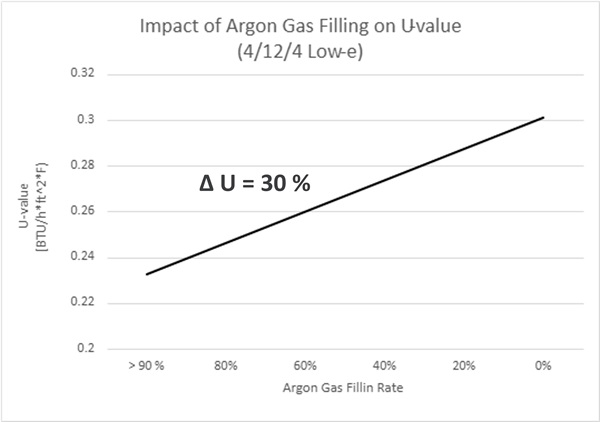
Thermal Performance and Energy Savings: The thermal insulation performance of an IGU is directly tied to its gas fill rate. Low-E argon-filled units outperform air-filled IGUs significantly. Research has shown that increasing the gas fill rate improves the unit’s U-value (a measure of heat transfer), enabling greater energy efficiency. For instance, according to a study, a drop in argon gas levels can increase the Ug-value by approximately 0.07 BTU/(h·ft²·°F), leading to higher energy consumption.
Long-Term Efficiency: Gas loss in sealed IGUs isn’t visible to the naked eye, making ongoing quality assurance essential. As gas levels decline over time, the unit’s thermal insulation deteriorates, raising heating or cooling demands. The AkzoNobel study highlights that even minimal reductions in gas levels can have measurable impacts on energy performance. How to detect Gas Leakage in Insulating Glass Units with Sparklike devices.
Cost vs. Benefit: Filling IGUs with noble gases like argon involves minimal additional cost but yields significant performance benefits. However, maintaining these levels requires robust manufacturing practices, including high-quality sealants and precision measurement tools to minimize gas leakage.
Insights from Studies
Research by AkzoNobel emphasizes the substantial impact of argon fill rates on IGU performance. Units with argon levels above 90% achieve significantly lower U-values compared to those with 60% or less. In other words, without gas the u-value can be 30% lower than the specified u-value. This underscores the importance of precision manufacturing and consistent quality checks during production.
The Role of Quality Control in IGU Manufacturing
Manufacturers must adopt rigorous gas measurement practices to ensure not only the presence of noble gas but also that it meets the optimal percentage required for peak performance. Sparklike devices, for example, enable non-destructive measurement of gas fill rates, empowering manufacturers to guarantee the quality and longevity of their argon-filled units.
Contact Sparklike for more information and support on measuring argon concentration in IGUs.
Contact Sparklike for More Information
Source
D. Lange. 2012. Energy Saving Without Noble Gas Filling? AkzoNobel.
 600450

















Add new comment