Date: 12 May 2026
Running into a glass wall or frameless glass door is not a rare occurrence for them. Read on to discover what the standards prescribe, what solutions look like and why this issue affects the entire industry.
Frameless glass doors, floor-to-ceiling glass walls or glass partition walls in offices are easy to overlook in everyday life. This is a constant risk for persons with impaired vision. According to the European Blind Union (EBU), more than 30 million people are blind or partially sighted in the EU. Statistically, this corresponds to roughly one in 30 people.
However, the problem not only affects those with visual impairments. Transparency as a design principle and discernability as a requirement are often a contradiction in terms.
International specifications of barrier-free building
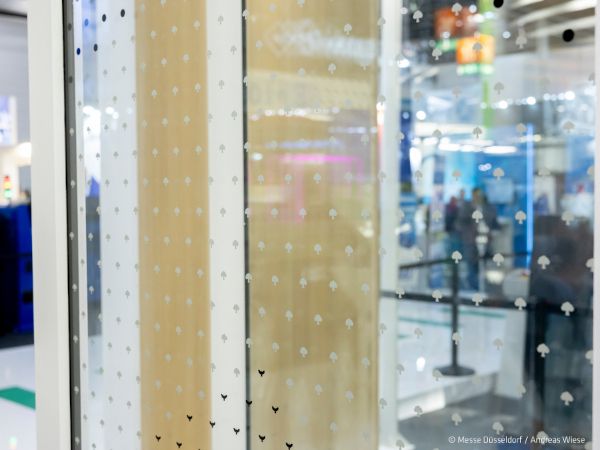
In Germany the DIN 18040 standard specifies the following requirements: large areas of glazing must be clearly recognisable by means of safety markings applied at two heights (40 to 70 cm as well as 120 to 160 cm). In addition, a high-contrast design of the main closing edge is decisive for frameless hinged doors.
Since 2021 DIN EN 17210 has set standards across Europe. As a functional standard, its stated objective is to create an environment that is accessible to everyone in line with the Universal Design principle. The standard demands that strongly reflective surfaces be avoided to prevent optical illusions and that doors be clearly recognisable even when opened. In addition, glass doors must be clearly delimited from adjoining glass walls to make passageways clearly identifiable.
In the USA ICC A117.1 – the relevant standard set in accordance with the Americans with Disabilities Act (ADA) – specifies visual contrasts. Doors and glass areas in public buildings must be designed in such a way that they are clearly recognisable for people with visual impairments.
Screen printing, coatings and soundproofing for accessible glass
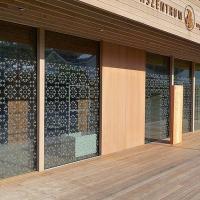
Ceramic screen printing – patterns or graphics stencilled onto glass with high-temperature inks which are then fired – is one of the most common ways to link barrier-free requirements with architectural features. Motifs can be freely designed and there are no specifications for shapes as long as the high-contrast characteristics are complied with. Hotels, office buildings and train stations have long used this as a design feature.
However, barrier-free glass properties are not only restricted to visual recognisability. In interiors with a lot of glazing the acoustic quality also plays a key role especially for those with hearing aids or auditive impairments.
Noise reduction glass with acoustic interlayers reduces outside noise and substantially improves communication conditions in glazed rooms.
Whether ceramic screen printing, innovative coatings or acoustic interlayers, barrier-free building with glass is evolving – from being a mere compliance requirement into an integral design and functional feature of modern architecture.
References
- nullbarriere.de: DIN 18040-1 – Accessible Building Design: Publicly Accessible Buildings
- DIN e. V.: DIN EN 17210 – Accessibility and Usability of the Built Environment: Functional Requirements
- German Federal Institute for Occupational Safety and Health (BAuA): ASR V3a.2 – Accessible Design of Workplaces
- ANSI Blog: ANSI A117.1 and ADA Guidelines for Accessible Design
 600450












Add new comment