Europe has to become more independent, resilient and secure – this could be the credo of a current press review. The need for security is rising noticeably and now KRITIS, the new umbrella act to improve the physical security of critical infrastructure, was adopted on 29 January. The Act requires uniform minimum standards, risk analyses and attack monitoring. Many of the rules relate to the physical resilience of installations and buildings, which also impacts the glass industry and is expected to further fuel the rising demand for toughened glazing. glasstec asked ift Rosenheim and Kuraray as a producer of high-performance interlayers for toughened glass structures about the trends in requirements for toughened glass.
In view of growing threats posed by geopolitical tensions, cyberattacks and natural disasters the reliable protection of critical infrastructures seems as important as ever. These infrastructures include facilities, systems and organisations highly critical to maintaining the fabric of society and whose failure would substantially impact everyday life such as energy supply, information technology and telecommunications, transport and traffic, health, water, food, waste disposal, finance and insurance, state and administration, media and culture. Germany’s federal Länder decide which facilities in Germany are governed by the KRITIS Umbrella Act on the basis of quantitative and qualitative criteria. If a facility is critical for serving a total of 500,000 people, for example, it is rated as critical infrastructure. Mutual dependencies also have to be considered – energy, water and operational transport routes, for instance, are also instrumental to all other critical sectors.
Vandalism and physical attacks
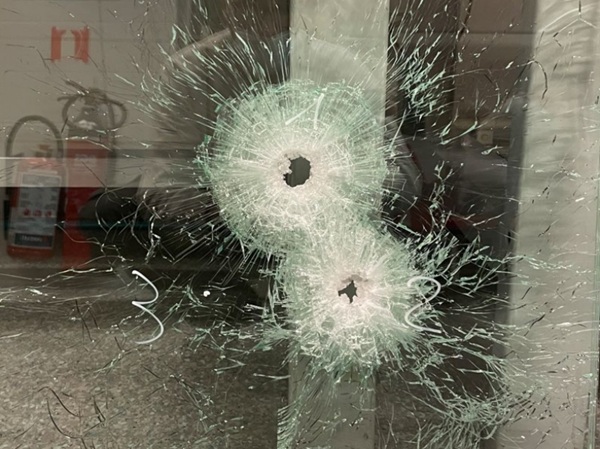
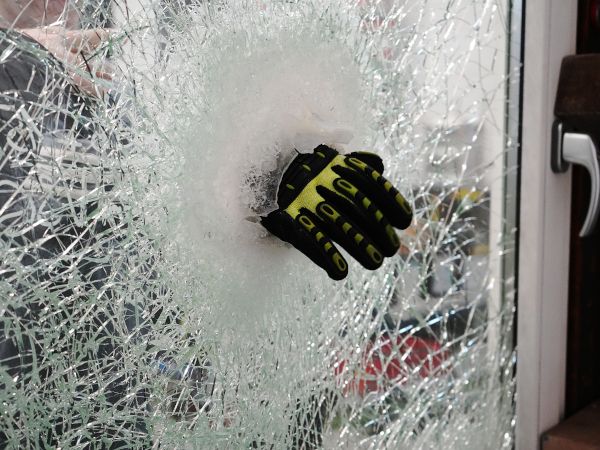
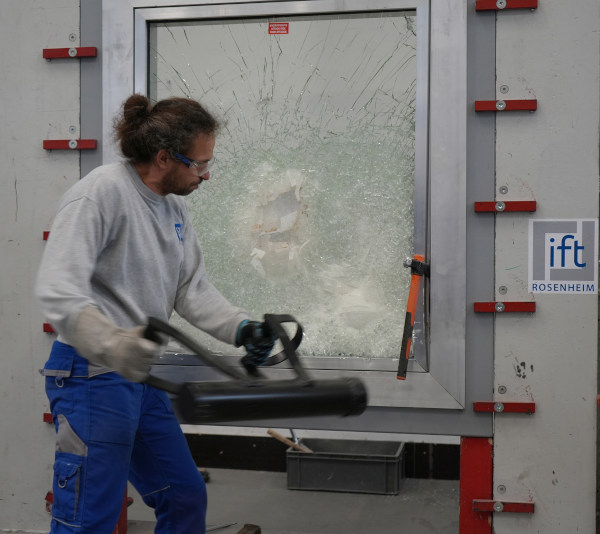
According to estimates by ift Rosenheim, vandalism – though increasingly also sabotage – poses a high risk to public buildings, transport infrastructure or administrative buildings. In acts of vandalism perpetrator behaviour is completely different that seen in acts of burglary, as Dipl.-Ing. Jürgen Benitz-Wildenburg, Head of PR and Technical Communication at ift Rosenheim, explains: “Here, perpetrators act openly, mostly on impulse, using improvised tools ranging from paving stones and street signs to manhole covers as their ramming implements. This means endangered building elements and glazing have to resist direct violent attacks as well as concealed manipulation by burglars. Burglar-resistant components are therefore only suitable to a limited extent.” This is why ift Rosenheim has elaborated the ift Guideline El-06/1 “Vandalismushemmende Bauelemente und Einrichtungen” (Vandalism-Resistant Building Elements and Facilities) with a circle of experts; this guideline defines the typical procedure, tools, reproducible sequences of events as well as possible classifications. These are determined by deploying an array of implements to manually test a functioning installed element (with fixtures, frame, door leaf, lock, glazing etc.) to gauge its resistance to vandalism – where resistance time also counts. Also important is the added “LS (Liquid Safe)” protection requirement, where the test team attempts to create an opening in the test specimen, which is large enough to insert a bottle (Molotov cocktail). The aim is to protect buildings and people better against deliberate destruction and violence in public areas as well as highly frequented and vulnerable locations.

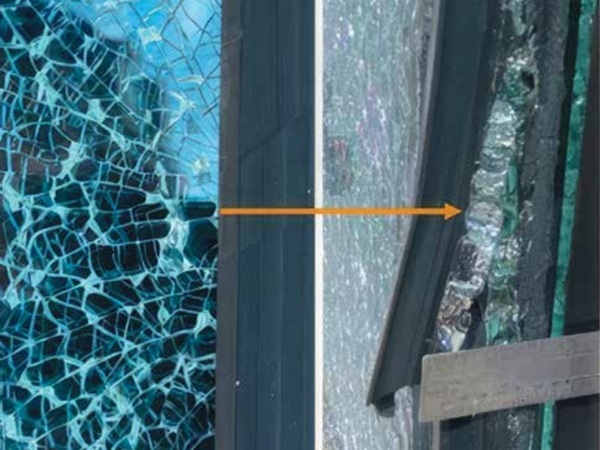
The market is also displaying a trend towards higher protection classes, as Jochen Regenauer, Head of Strategic Projects & Business Development EMEA at Kuraray Europe, observes: “Security is an area experiencing global growth and one witnessing a massive increase over the last few years. In Germany, for public spaces originally subject to medium requirements, protection class P4A for glazing is already the rule today. Often in demand here are glass structures with increased resistance to projectiles, break-in/forced entry, baseball clubs and massive use of force. In the US Kuraray is already operating on the market with a tested solution involving SentryGlas, thereby complying with the ASTM F1233 standard. Beyond this, bullet-proof glazing complying with protection classes BR4-NS to BR6-NS is also increasingly in demand – for public buildings such as train stations, bank buildings and glazed entrance concourses, even in IGU applications for store fronts or foyers.”
Rising requirements through extreme weather conditions
The KRITIS Act focuses not only on security risks but also on risks from ever more frequent extreme weather conditions such as heavy rains and floodings that no longer just affect buildings near rivers. Benitz-Wildenburg explains: “During heavy and prolonged rainfall normal windows and doors are often no longer sufficient to protect against water ingress. Here suitable structures including sealed connections to the building fabric are needed, which in turn require correspondingly sized laminated toughened glass units.” ift Rosenheim therefore tests these components according to the ift Guideline FE-07 “Hochwasserbeständige Fenster und Türen” (Flood-Resistant Windows and Doors). The test results and classifications form the basis for planning and tenders for flood-barrier building elements.”
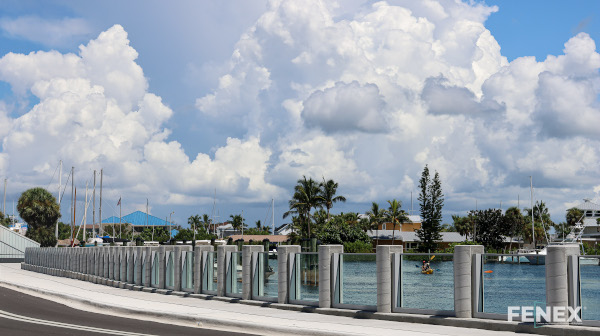

Photo: Kuraray Europe GmbH
Regenauer sees similar developments: “A lot has already been done in flood protection in the last few years; but since it is a local authority responsibility, measures still have room for improvement due to budgetary restraints. The KRITIS Umbrella Act will definitely inject impetus here.” More frequent storms, hurricanes and typhoons – depending on the geographical situation – are also generating growing demand for relevant protective glazing, as Regenauer reports: “Storm-proof glazing is now necessary for a large part of the American East Coast because hurricanes hit more and more often and earlier in the year. The same applies to parts of Asia with more frequent typhoons – these are similar to hurricanes but come with more water. Kuraray supplies various solutions for this – highly secure glass structure with SentryGlas interlayers to further increase energy absorption and penetration resistance in the glazing.” ift Rosenheim also offers corresponding testing for this purpose according to American standards at its Rosenheim site.
Building skin as part of cyber security
The KRITIS Umbrella Act is strongly oriented towards the requirements of NIS2, the EU Directive that already defines minimum standards for cyber and information security. Through the KRITIS Umbrella Act this Directive is transposed into German law and complemented for all relevant areas of infrastructure at the same time. This means, the understanding of security is broadened from purely digital defence to physical protection measures. One growing risk in terrorism or espionage is electromagnetic attacks, for example, where radio or radiation signals are used to tap or hack into networks.
Special shielding glass produces a partial Faraday’s cage effect thereby blocking the majority of electro-magnetic signals. This allows for secured and shielded rooms to be built for sensitive IT departments, authorities or data centres where radio signal can neither enter nor exit. These signals include Wi-Fi signals or electromagnetic radiation from screens and keyboards (war-driving or remote tapping). This type of glass is also used in labs and hospitals where sensitive medical equipment needs protecting from radio interference or in security areas such as conference rooms where confidentiality is key. These solutions complement classic IT security measures and follow the Defence-in-Depth principle where physical and digital protection levels are combined.
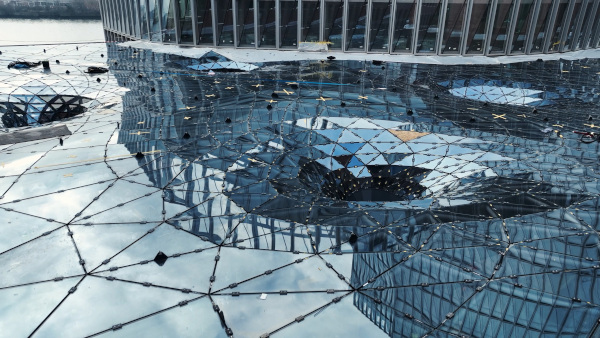
Photo: ©Darren Arpe / Roschmann Group
Demand for exclusive applications is rising
There is growing demand for toughened glass in many other areas especially in exclusive applications, says Regenauer: “Toughened glass for the armoured vehicle market is a hot ticket especially in South Africa and South America – designed predominantly to protect against kidnapping. In the narrow streets of the City of London (London’s financial district) blast resistance is called for and comparatively thin LTG is used since it can react more flexibly to quick, massive pressure. Most lounges and VIP areas are equipped with bullet-proof glass and balustrades achieve a particularly high residual load bearing capacity thanks to SentryGlas interlayers. There is also rising demand for glass sky pools for hotels and private villas that have to constantly withstand very high water pressure. And, last but not least, more and more vessels and yachts are being registered with glass structure specs needing to withstand the high dynamic impact loads from waves. These applications mostly involve structural SentryGlas interlayers for reducing the glazing thickness, or LTG with up to eightfold lamination often containing chemically toughened sheets for flawless looks.”
glasstec 2026 in Düsseldorf from 20 to 23 October 2026 will once again be the pivotal and leading pace-setting trade fair for exchanging ideas on the future of the glass industry featuring Artificial Intelligence & Digital Technologies, Decarbonisation and Circularity as Hot Topics. But it will also show that glass products for building skins are no longer planned solely with an eye on energy-efficiency and design quality but also increasingly with security in mind. At glasstec 2026 the trade fair company and ift Rosenheim as a cooperation partner will organise the first special show “secure – innovative – sustainable”, which will place resilient and security-critical glass solutions for protected rooms and critical infrastructures centrestage.
For more information go to: www.glasstec-online.com
About the Author:

Marc Everling studied Media Education (Technical University Brunswick) and has been a communications and marketing specialist in the glass industry for more than 20 years. In 2021 he founded his networking agency specialising in communications consulting and press liaison for companies and associations that work and produce sustainably in the interests of ecological transformation in the construction sector.