Date: 13 October 2026
Prof. Stefan Behling of Foster + Partners is one of the keynote speakers at the architecture forum at glasstec 2026. His presentation will explore experimentation, climate and human health, and how these factors are changing the requirements placed on glass and façades. Ahead of the event, he discusses technological developments, the use of AI in design, adaptive building envelopes and the role daylight could play in the future of architecture.
You are a keynote speaker at the architecture forum at glasstec 2026. What can attendees look forward to in your presentation?
Prof. Stefan Behling: My presentation traces three core themes – experimentation, climate and human health – through time, exploring how early experiments evolved into real-world architectural applications.
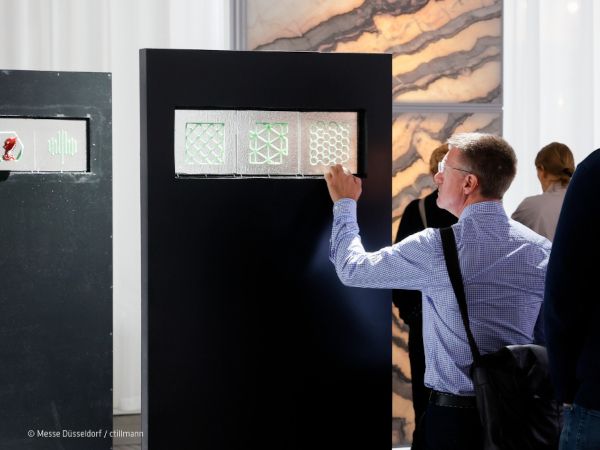
Three decades ago at glasstec, together with my team at the University of Stuttgart, I initiated and developed glass technology live – a platform where architects, engineers, universities and industry partners could test new and innovative ideas. We explored self-supporting glass structures, structural domes and pavilions with minimal connections, vacuum glazing, glass honeycomb systems, advanced coatings and new structural applications. Some of these remained as experiments, others have become the basis for new technologies which are now in use. This culture of experimentation also shaped Foster + Partners’ later work with pioneering clients such as Apple, where the ambition to reduce structure and increase transparency pushed the boundaries of structural glass even further.
I end my lecture by asking how glass can respond to the key challenges of climate change and human wellbeing in the future.
Which technological development in glass construction currently interests you most?
Prof. Stefan Behling: I am particularly interested in coatings and spectral selectivity. It has become easier than ever to control the thermal and optical properties of glass, but I believe in the future, coatings have the potential to become far more sophisticated. Rather than striving for a better U-value or lower G-value, it is increasingly important to ask: which parts of the solar spectrum do we want to admit, or conversely, reflect, and why?
I believe, a window is not simply a thermal boundary; it is an interface between people and the environment. I would like to see glazing systems that manage heat and glare while preserving the qualities of daylight that support human health and wellbeing.
AI and digital technologies are among the key topics of glasstec 2026. Where do you see their greatest benefit for the design of glass façades?
Prof. Stefan Behling: I think AI will help us to achieve and balance levels of complexity that were previously difficult to manage.
I compare it with juggling. A human can only keep a certain number of balls in the air at any one time. AI offers a helping hand – it allows us to work with many more variables simultaneously, effectively managing a far greater number than before.
Instead of optimising one or two parameters, we will increasingly be able to investigate thousands of combinations. In façade design, for example, that could include orientation, solar radiation, future climate scenarios, embodied carbon, operational energy, daylight, glare, thermal comfort, structure, material use and cost efficiency.
The key point is that AI should be used not to create more complicated buildings, but to help us deliver better-performing buildings that use less material and less energy.
You describe climate change not as a trend, but as a transformational force for glass construction. What does that mean specifically for façades?
Prof. Stefan Behling: Not a trend, but a transformational force – climate change will have the greatest impact in the coming years and decades. We must now design for resilience, adaptation and carbon reduction.
For instance, retrofitting the existing building stock will become one of the biggest construction challenges of the coming decades. Updating an existing glass building to adapt to a changing climate will be vital – how can we add shading, change the glazing, introduce ventilation or improve insulation without demolishing it, will be key questions that designers will need to grapple with.
A genuinely sustainable façade should be responsive rather than static. I often describe this responsiveness through the sailboat principle. A sailor adjusts the boat’s sail to efficiently harness the wind’s power; a building should respond to changing environmental conditions in the same way.
If there is strong sun, I want shading. If it is cold, I want insulation and useful solar gain. If conditions are mild, I may want natural ventilation. If the outside temperature is extremely hot, I need to prevent heat from entering.
Future façades need to be more adaptive, climate-specific, repairable and upgradable, because the climate itself will continue to change throughout a building’s lifecycle.
Alongside climate protection, you also focus on the impact of daylight on people. What role will health play in the future when designing with glass?
Prof. Stefan Behling: The second major area of change is health. Over millennia, human physiology has evolved in close relationship with daylight and the natural environment. However, as people spend most of their lives indoors, the challenge of the future is finding the right balance between carbon, climate resilience, comfort and human health in our built environments.
Today we understand much more about how the intensity, timing and spectral composition of light influence human physiology. Glass is so important precisely because it is the interface between people and their natural environment. Therefore, I believe that we will see greater collaboration between architects, engineers, physicists, doctors and neuroscientists to deliver buildings that not only respond effectively to their climate but actively enhance the health of their users.
The question will increasingly be: what kind of daylight do human beings need, and how can glazing provide it while also controlling heat, glare and energy use.
Prof. Stefan Behling at the architecture forum at glasstec 2026
Prof. Stefan Behling is a keynote speaker at the architecture forum at glasstec 2026.
 600450













Add new comment