Authors: Daniel R. Neuville¹ and Laurent Cormier²
¹Geomat Lab, IPGP-CNRS, Université de Paris, 75005 Paris, France
²Sorbonne Université, Muséum National d’Histoire Naturelle, UMR CNRS 7590, Institut de Minéralogie, de Physique des Matériaux et de Cosmochimie, IMPMC, 75005 Paris, France
Source: Glass Europe Vol. 4 (2026) 85-86
https://doi.org/10.52825/glass-europe.v4i.3506
© Authors. This work is licensed under a Creative Commons Attribution 4.0 International License
Published: 30. Jun. 2026
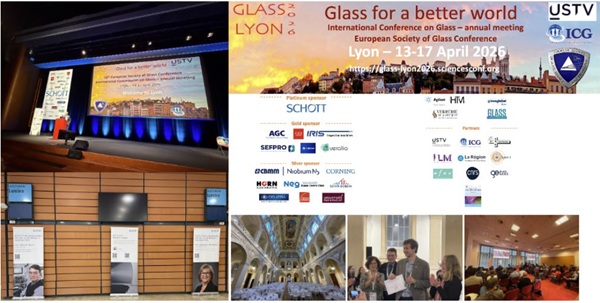
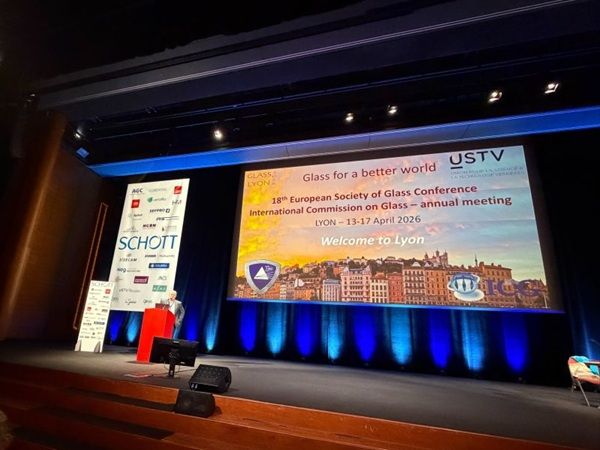
This special issue brings together a selection of contributions presented at Glass Lyon 2026, the joint European Society of Glass Conference and International Commission on Glass Annual Meeting (ICG 2026) held in Lyon, France, under the theme Glass for a better word. Organized by the French Glass Society, USTV, the conference welcome more than 500 scientists from academic and industrial laboratories across 32 countries, providing a vibrant forum for the exchange of ideas and recent advances in glass science and technology. Additional information about the event remains available on the conference website: https://glass-lyon2026.sciencesconf.org/?lang=en.
The scientific program was structured around ten thematic sessions, covering simulation, modeling and machine learning; glass formation and glass transition; structure-property relationships; optical and photonic properties; glass surfaces and coatings; crystallization and glass-ceramics; advanced manufacturing processes; environmental and sustainable glass technologies; healthcare applications; and archaeometry and the historical study of glass. Together they illustrated both the diversity of current research directions and the increasing integration of experimental theoretical and data-driven approaches in the field.
The program featured seven plenary lectures delivered by leading international experts: Delia Brauer (University of Jena), Heike Ebendorff-Heidepriem (Optofab Adelaide Hub, Australian National Fabrication Facility), Liping Huang (Rensselaer Polytechnic Institute, Troy, New York), Thibault Charpentier (CEA Saclay), Shinji Kohara (National Institute for Materials Science, Tsukuba), Pierre Lucas (University of Arizona), and Erik Muijsenberg (Glass Service). In addition, 41 invited talks further enriched the scientific program ensuring strong coverage of both fundamental and applied topics. Overall, the meeting included 301 oral presentations and two poster sessions showcasing 90 posters.
In parallel with the scientific session, a glass art exhibition was organized fostering a fruitful dialogue between artists and researchers. The exhibition featured works by Thomas Arnal, Céline Bachelot, Claude Baillon, Théo Beaumont, Wilfried Becret, Yves Braun, Atelier Faucher (M. Monel, J.-J. Fanjat and M. Faucher), Sylvie Freycenon, Allain & Claudine Guillot, Frédéric Guillot, Corinne Joachim, Lycée Jean Monnet – École Française du Verre (Yzeure), Fabienne Picaud, Horizon Verre, Olivier Mallemouche, Véronique Monod, Simon Rio, and Georges Stahl.
Several prestigious awards were presented during the conference, recognizing outstanding contributions to glass science and technology:
- The Otto Schott Research Awards 2026 were conferred upon Kathleen Richardson (University of Central Florida) and Steve Martin (Iowa State University), in recognition of their exceptional contributions to glass science.
- The Turner Award, granted by the International Commission on Glass (ICG) was presented to Dr Shibin Jiang (AdValue Photonics).
- The Gottardi Award 2026, presented by the ICG, was awarded to Prof. N. M. Anoop Krishnan (IIT Delhi).
- The N. F. Mott Award 2026, delivered by the Journal of Non-Crystalline Solids, was awarded to Prof. Yuanzheng Yue (Aalborg University, Denmark).
- The USTV Best PhD Award 2025 was awarded to Nadezhda Shchedrina (Université Paris-Saclay) for her thesis entitled “Study of the mechanisms of silica densification under irradiation”, highlighting important advances in understanding radiation effects in glassy systems.
Finally, Best Poster Prizes were awarded to students in recognition of outstanding contributions to the poster sessions. The first prize was awarded to John Bussey (Washington State University, IPGP) for ‘Impact of fluorine on silicate glass structure and diffusivity’. The second prize was awarded to Antonio Familiari (Université de Strasbourg, Università degli Studi di Modena e Reggio Emilia) for ‘Insights into the chemical bonding, electronic structure and local environments of Na-V-P-O glasses for cathode materials by first-principles and machine learning simulation’. The third prize was awarded to Leyla Buyukfirat (Rutgers University) for ‘Feasibility of albite and sanidine as environmental barrier coatings for CMAS corrosion prevention’.
We would like to sincerely thank all the invited authors whose contributions are included in this special issue dedicated to Glass Lyon 2026. Their valuable contributions reflect the richness and vitality of current research in glass science and technology.