Date: 18 September 2026
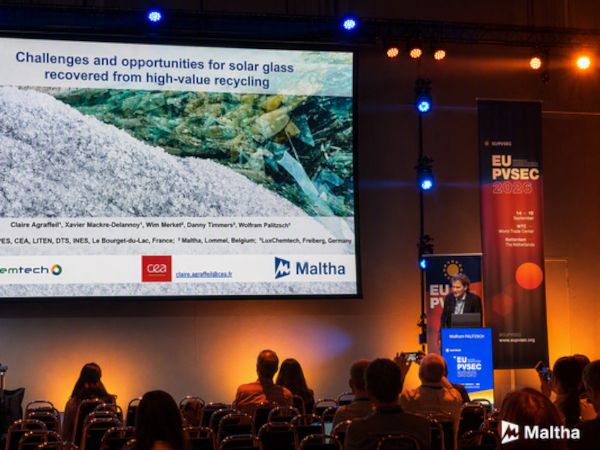
Solar panels are essential to the energy transition. But what happens when they reach the end of their service life? That was the central theme of the presentation delivered by the European PHOTORAMA project at the EU PVSEC - 43rd European Photovoltaic Solar Energy Conference and Exhibition in Rotterdam. Together with research and industry partners, Maltha presented the latest developments in high-value solar panel recycling and the recovery of solar panel glass.
Why Solar Panel Recycling Is Becoming Increasingly Important
The volume of end-of-life solar panels is expected to grow rapidly over the coming decades. Global PV waste is projected to exceed 210 million tonnes by 2050. Since glass accounts for 70 to 95 percent of a solar panel’s total weight, glass recycling plays a crucial role in creating a circular solar industry.
High-value solar panel glass recycling offers several important benefits:
- Reduced demand for virgin raw materials
- Lower CO₂ emissions from glass production
- Less waste sent to landfill or incineration
- Greater circularity within the solar energy value chain
How Does Solar Panel Glass Recycling Work?
Within the PHOTORAMA project, innovative technologies have been developed to recycle solar panels at a much higher value. Instead of crushing panels into low-grade materials, advanced delamination techniques separate glass, metals and polymers while preserving material quality. This creates a clean glass stream suitable for high-value reuse.
Maltha contributed through:
- Analysing the quality of recovered solar panel glass
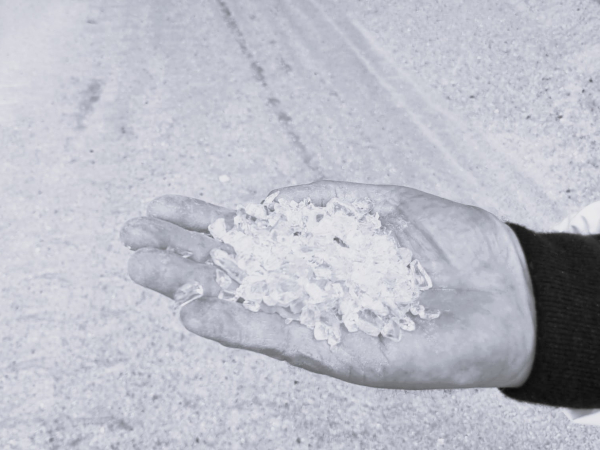
- Producing high-quality cullet for industrial applications
- Conducting industrial trials with recycled PV glass
- Investigating new circular applications for solar panel glass
The results confirmed that the recovered glass has a high level of purity and is suitable for reuse in demanding glass manufacturing applications.
View the full presentation on high-value solar panel glass recycling (PDF).
First Successful Application in Flat Glass Production
One of the project’s key achievements was the successful use of recycled solar panel glass in an industrial flat glass manufacturing facility. Maltha produced high-quality cullet from end-of-life solar panels, after which 75 tonnes of recycled solar panel glass were successfully incorporated into the production of new flat glass. This demonstrates that solar panel glass can be reused as a valuable raw material for new glass products.
Can Recycled Solar Glass Be Used in New Solar Panels?
Beyond glass remelting, PHOTORAMA explored an even more ambitious route: the direct reuse of recovered glass in new photovoltaic modules.
The results are highly promising. Solar panels manufactured with recovered glass performed comparably to modules made with virgin glass. Mechanical and reliability testing was also successfully completed.
These findings suggest that solar panel glass could potentially go through multiple life cycles without significant loss of quality.
What Challenges Still Need to Be Solved?
Although the results are encouraging, several challenges remain before large-scale implementation becomes possible.
- The presence of antimony (Sb) in certain types of solar panel glass
- Further scaling of recycling technologies
- Clear European regulations for the reuse of recycled PV glass
- Market acceptance of recycled materials in high-value applications
Building a Circular Solar Industry
The results of PHOTORAMA demonstrate that high-value solar panel recycling is technically feasible. Recovered solar glass can already be used in new glass products and has the potential to be reused in new solar panels. This brings the industry one step closer to a fully circular solar value chain.
 600450







Add new comment