
Date: 2 October 2026
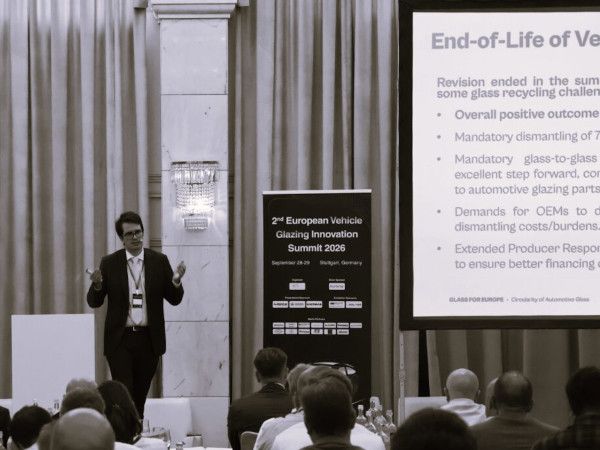
On 28 and 29 September, more than a hundred actors of the automotive glass value chain met in Stuttgart for the second European Vehicle Glazing Innovation Summit: two days of presentations and discussions on the latest innovations, research, and trends in automotive glazing.
Justin Loup, who oversees automotive product policy issues at Glass for Europe, presented on automotive glass circularity and its interlinked opportunities and challenges. It was a chance to explain the current state of automotive glazing recycling in Europe and exchange with stakeholders on how to prepare for the future.
Today’s situation, where automotive glass is very rarely recycled, is a missed opportunity to reduce raw material use, energy consumption and CO2 emissions from production. Beyond the obvious environmental benefits of such measures, it would also positively impact production costs. On the other hand, systematic dismantling and recycling of automotive glass comes with its own challenges and costs, which currently hinder further recycling.
That is where regulation has a role to play, and the recently published End-of-Life Vehicles Regulation (ELVR) represents, in this respect, an important step forward. Indeed, the ELVR will very soon render the dismantling of most automotive glazing (70% of all glass from vehicles) and its recycling into glass mandatory. In addition, the text plans Extended Producer Responsibility schemes for vehicles to finance its growing demands for end-of-life treatment.
Glass for Europe now takes it as its role to support a good implementation of the ELVR rules so that the text permits positive results for glass recycling!
Beyond these positive regulatory aspects, the future of automotive glass recycling also lies in how new products are designed with circularity in mind. Indeed, as automotive glazing becomes more integrated into vehicle systems, a whole range of products (cameras, sensors, innovative interlayers, solar cells, etc.) are now part of the automotive glazing components, and these will also need to be treated adequately at end of life. Crucially, these components will also need to be dismantlable from the glass to enable its recycling.
Considering the joint efforts and the coordination needed to increase automotive glazing circularity, presenting and exchanging with all stakeholders of the value chains, from suppliers to clients of automotive glazing manufacturers, was very insightful for grasping possible challenges and opportunities from a regulatory perspective.
 600450












Add new comment