Date: 20 July 2026
Glass for Europe, the trade association representing Europe’s flat glass sector, considers reform of the EU Emissions Trading System (EU ETS) beyond 2030 both necessary and long overdue to restore a credible business case for industrial decarbonisation in Europe’s flat glass manufacturing sector.
Glass for Europe recognises the European Commission’s objective of accelerating emissions reductions in industries that manufacture the materials underpinning Europe’s economy. Flat glass is an essential material for energy-efficient buildings, clean mobility and renewable energy generation. Its continued production in Europe is therefore a strategic matter for Europe’s decarbonisation pathway and its future economic resilience.
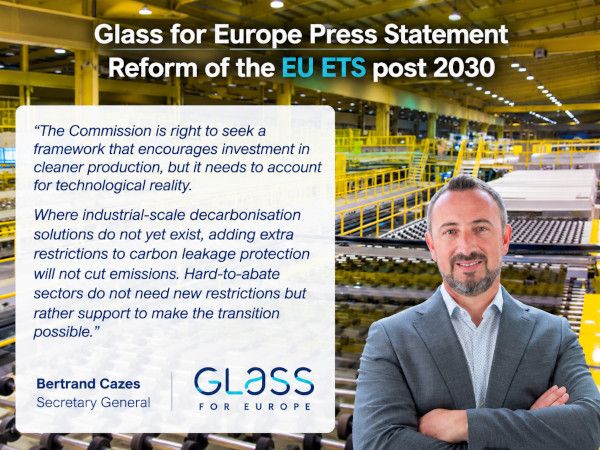
Commenting on the proposal, Bertrand Cazes, Secretary General of Glass for Europe, said: “The Commission is right to seek a framework that encourages investment in cleaner production, but it needs to account for technological reality. Where industrial-scale decarbonisation solutions do not yet exist, adding extra restrictions to carbon leakage protection will not cut emissions. Hard-to-abate sectors do not need new restrictions but rather support to make the transition possible.”
Glass for Europe will now undertake a detailed assessment of the legislative proposal against its stated objective of supporting investment in decarbonisation while preserving industrial activity in Europe. In particular, the association will analyse whether the proposed changes to free allocation effectively support decarbonisation investment or risk undermining the competitiveness of sectors facing structural technological constraints.
Glass for Europe calls on EU co-legislators to introduce a dedicated provision conditioning any reduction in free allocation for industries on the availability of decarbonisation technologies deployable at commercial scale.
The same rationale should apply to the Electrification Action Plan unveiled today by the European Commission. The defossilisation agenda should not become synonymous with mandatory full electrification. Where fossil fuels remain indispensable to maintain glass quality, product performance and manufacturing integrity, their continued use should not be treated as a policy failure, but as a reflection of current technological constraints. The priority should be to accelerate the development and deployment of breakthrough low-carbon solutions, including through greater use of electricity, rather than to force a full-electrification technology that does not yet exist.
The association stands ready to engage constructively with the European Commission, the European Parliament and Member States throughout the legislative process to ensure that both the revised post-2030 EU ETS and the Electrification Action Plan work hand in hand to deliver climate progress and industrial resilience.
Background
The European flat glass sector has consistently invested in the best available technologies and in the development and trialling of breakthrough solutions such as hybrid and hydrogen-fired furnaces. However, no technology is currently available at industrial scale that would allow the sector to achieve the level of emissions reductions envisaged for 2040 while maintaining competitive production in Europe. These constraints have been repeatedly highlighted by Glass for Europe in its advocacy towards the EU institutions.
Against this backdrop, Glass for Europe remains concerned that additional restrictions, conditions or penalties attached to free allocation could prove counterproductive if they reflect theoretical decarbonisation pathways rather than technologies actually available to industry.
For sectors where emissions reductions are currently constrained by technological limitations, the ETS reform should provide a pragmatic safeguard ensuring that the level of free allocation remains aligned with realistically achievable decarbonisation trajectories. Such an approach would preserve investment capacity while supporting the development and deployment of breakthrough technologies.
For more information: https://glassforeurope.com/the-eu-ets-reform-must-restore-a-business-case-for-sustainable-flat-glass-manufacturing-in-europe/
 600450






Add new comment