
Date: 10 July 2026
How can the energy-intensive glass industry, so far heavily dependent on natural gas, become CO2-neutral by 2045? This issue is examined by the “Bundesverband Glasindustrie e.V.” (Federal Association of the Glass Industry (BV Glas)) jointly with the “Institut für Energiewirtschaft und Rationelle Energieanwendung” (Institute for Energy Economics and Rational Energy Use (IER)) of Stuttgart University: at glasstec 2026 the study “Glass 2045 – Roadmap for the Decarbonisation of the German Glass Industry” will be tabled. In an interview Prof. Dr. Peter Radgen, Head of the Chair for Energy Efficiency at IER, already shared some insights with Messe Düsseldorf upfront.
glasstec – Prof. Dr. Radgen, we are delighted you are able to give us a preview of the “Glass 2045” study to be presented by BV Glas and IER at glasstec 2026 in October. What are the key insights compared to the 2022 study?
Prof. Dr. Peter Radgen – Positive to note upfront is that the extensive decarbonisation of the German glass industry is technically feasible by 2045. However, due to the differing requirements on the part of flat glass, container glass and special glass industries there is no uniform transformation pathway but instead a mixture of electrification, green hydrogen, hybrid solutions, circularity as well as complementary carbon management.
glasstec – What will decide whether transformation is successful?
Prof. Dr. Peter Radgen – The glass industry is currently forced to undergo transformation under extremely difficult conditions. Decisive for success would be internationally competitive energy prices, the accelerated expansion of regenerative energies and power grids and a hydrogen infrastructure as well as an evidence-based and long-term, reliable political framework.
glasstec – Does transformation differ by region?
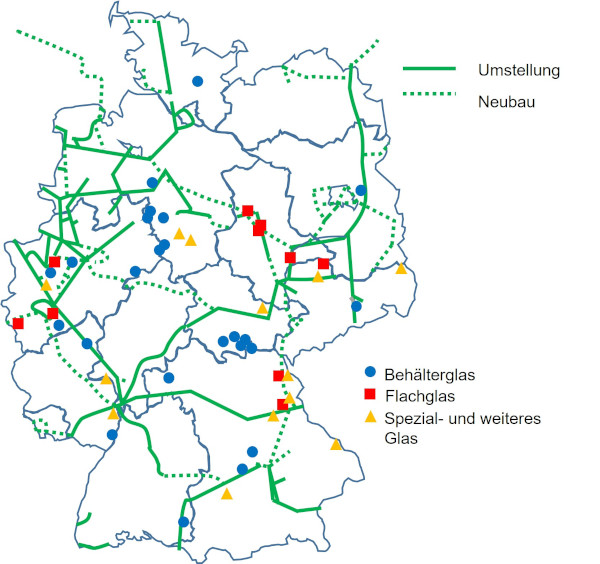
Prof. Dr. Peter Radgen – In general, insecurities make planning more difficult across the board. But there are also individual, regional sticking points that complicate transformation. The probability of success depends on the regional availability of regenerative electricity, power grids, electricity storage facilities and a hydrogen infrastructure. Those who do not operate their glass melting facilities near the anticipated hydrogen core network face greater hurdles to successfully pursuing this transformation pathway. Whether they then transport hydrogen over a distance or opt for a change of energy source ultimately also depends on the costs.
glasstec – In that case, many will bank on electricity rather than on hydrogen?
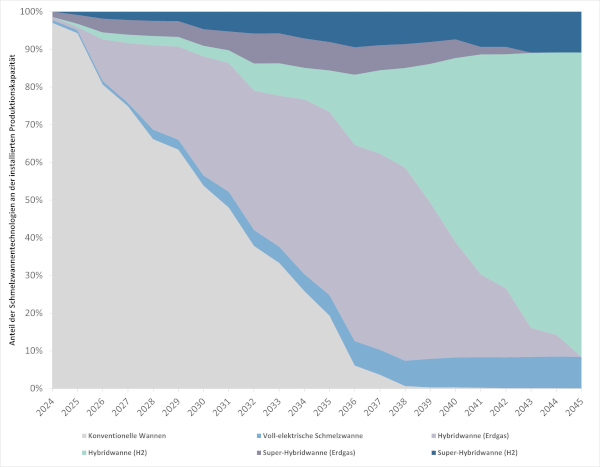
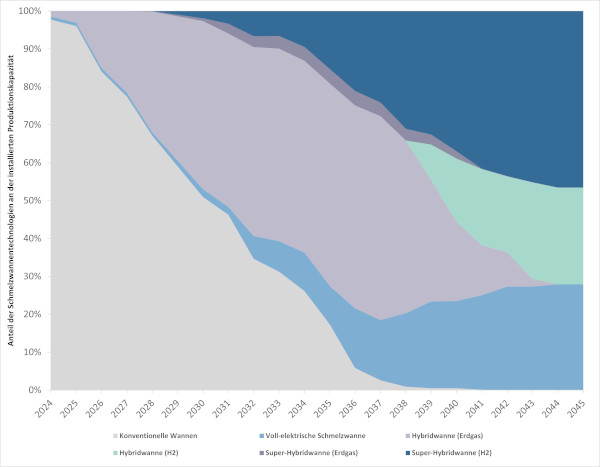
Prof. Dr. Peter Radgen – Using hydrogen would, in principle, be easier because this would allow us to stick with the existing melting unit technology. A lively debate has arisen around this issue, and everyone is now waiting for the future hydrogen core network. At the end of the day, however, costs will decide and hydrogen is not cost-efficient yet – it is currently five times more expensive than natural gas – which is why no progress has been made as yet. What’s more, electricity prices are easier to budget. The industry is therefore embracing electrification, in particular, and is trying to be flexible with electricity prices by using electric boosting to a greater or lesser extent during the melting process. In addition, electrification is a key driver for research and development in new melting unit concepts.
glasstec – Are hybrid melting concepts only an “interim solution” or will they remain an integral part of glass production?
Prof. Dr. Peter Radgen – I assume they will be a “lasting interim solution”. Hybrid concepts work well to buffer insecurities and operate flexibly – also with hydrogen instead of natural gas. This also means the location will decide on what is feasible. Those unable to obtain hydrogen – be it by pipeline or by economically viable transportation, will have to find solutions for running the units on electricity only.
glasstec – How has the situation changed in general?
Prof. Dr. Peter Radgen – In the last study we expected glass production to stagnate or only increase slightly. Today, we have unfortunately observed a slight decline in production instead because some producers are probably delaying the cold repair of their melting units as long as they are uncertain about the best transformation option. This is a sensitive issue, as missing the window for a cold repair during a technology change could mean being locked into the current system for a further ten to twenty years – or that some units might by decommissioned for good. Things get difficult where sites only run on one melting unit. If this unit is lost the future of the entire infrastructure is impacted.
glasstec – What about carbon management? Any developments there?
Prof. Dr. Peter Radgen – Carbon capture and storage (CCS) and also use (CCU) are viewed much more favourably than four years ago. Back then, there was no legal framework in place yet for CO2 transport and storage in Germany. Since November 2025 this has been generally possible, which is why we included this option for process and residual emissions in our study. These are greenhouse gas emissions that cannot be eliminated even after consistent implementation of all reduction measures that make both technical and economic sense, such as CO₂ from the deacidification of carbonate-containing raw materials. By comparison, the emissions from specialty chemicals, from unavoidable transport or also from the production of refractory materials for furnaces are Scope 3 emissions. These were not considered in our study. If these are to be avoided too and net zero is to be achieved across all 3 Scopes, permanent CO₂-removal (Carbon Dioxide Removal, CDR) is needed, in addition.
glasstec – What role could CO2 use play in future?
Prof. Dr. Peter Radgen – In general, its use makes a lot of sense if the captured CO2 is incorporated into durable products. Other alternatives would be other chemicals such as Sustainable Aviation Fuels, for example, to decarbonise air traffic. Or direct use in greenhouses which is very popular in the Netherlands. Unfortunately, this use only requires CO2 in the spring and summer months, the plants’ growth phase. However, the total amount of CO2 emitted is far too high and there are still too few possibilities to use it.
glasstec – What infrastructure measures should be supported by policymakers and implemented as a priority over the next five to ten years?
Prof. Dr. Peter Radgen – The expansion of regenerative energies, of the power grid and grid connections for businesses. If the requirement for underground power lines is removed, things might move faster. Ultimately, the pace of the transition depends on the infrastructure – glass-manufacturing companies have no control over whether hydrogen supplies or grid connection materialise. Furthermore, it is difficult to plan when, for example, compensation for electricity price increases is limited to just three years. Companies need long-term predictability.
glasstec – If you could pass on some messages from the Roadmap to politicians – what would these be?
Prof. Dr. Peter Radgen – Take a more individualised approach to the different sectors, whilst at the same time looking at them more broadly, as the current narrow focus on cement, steel and chemicals has not been helpful so far. Value chains must be viewed holistically and strengthened. We need evidence-based and reliable policy: infrastructure development, renewable electricity, gas, CO₂ – the government must set a clear direction and support the process.
glasstec – And what are your messages to the glass industry?
Build up your own renewable energy supply – through photovoltaics, wind turbines, heat pumps or biomass. And tap into efficiency potential even more systematically, for example through batch and cullet preheating, and make use of funding schemes. CO₂ capture is also an ongoing challenge – the glass industry must prepare for this and invest more heavily in research and development. We are happy to support the sector in this regard by providing scientific support for pilot projects.
glasstec – When there’s a release date for the study, will you let us know?
Prof. Dr. Peter Radgen – I’m sure “BV Glas” will already have scheduled the release. I at least have a conference slot at glasstec and look forward to exchanging ideas with the industry.
glasstec – Thank you very much for the interesting interview!
glasstec from 20 to 23 October 2026 in Düsseldorf will once again be the pivotal and pace-setting trade fair for exchanging ideas on the future of the glass industry. For more information go to: www.glasstec.de.

Marc Everling studied media education (Technical University Brunswick) and has been a communications and marketing specialist in the glass industry for more than 20 years. In 2021 he founded his networking agency specialising in communications consulting and press liaison for companies and associations that work and produce sustainably in the interests of the ecological transformation of the construction sector
 600450



Add new comment