
Date: 28 April 2026
Energy efficiency in buildings increasingly depends on the performance of insulating glass units (IGUs). Modern construction standards require exterior windows to reduce heat loss, improve comfort, and support sustainability goals. Yet one critical factor often remains overlooked: the real inert-gas content inside insulated glass and how it changes over time.
A 2022 independent study conducted by the Beijing Building Materials Testing Academy provides rare, detailed data on gas content trends, compliance rates, and long-term performance of inflatable IGUs. The results highlight an industry-wide issue that has direct implications for IGU manufacturers, window producers, façade engineers, and building owners.
Below, we break down the main findings and what they mean for ensuring reliable, high-performance IGUs.
Why Inert Gas Matters More Than Ever
Modern energy-saving windows rely on inert gases such as argon or krypton to reduce heat transfer between glass panes. When the gas content is correct, IGUs deliver better insulation and help meet global standards such as:
- EN 1279 (Europe)
- GB/T 11944 (China)
- ASTM E2190 (United States)
However, inert gas is invisible and odorless. Without testing, it is impossible to know whether IGUs have been filled correctly or whether they still contain their original gas content after storage, transport, or installation.
The study confirms what many manufacturers already suspect:
initial fill rates vary widely, and gas leakage during use is common.
Key Findings from the Study
Low Initial Compliance Rates
A total of 128 IGU samples from the construction market were tested. The qualification rate for correct initial gas content was:
- 33% for engineering samples
- 45% for certification samples
- 36% for R&D samples
- 98% for sampled inspection products (only when tightly controlled)
Overall compliance rate: 34%
This means two out of three IGUs did not reach the required gas content at delivery.
Gas Leakage Over Time
Long-term monitoring revealed measurable gas loss:
- Samples starting at 85–90% argon fell to 79% after 6 months
- After 9 months, gas content dropped to 69–80%, depending on sealant quality and exposure conditions
- Outdoor exposure accelerated leakage, especially under rain, UV radiation and temperature cycles
In other words, even IGUs that start with a good gas fill may lose performance if a small sealant defect widens during storage, transport, or the first months after installation.
Impact on Energy Performance
Gas loss directly affects thermal performance. The study showed that:
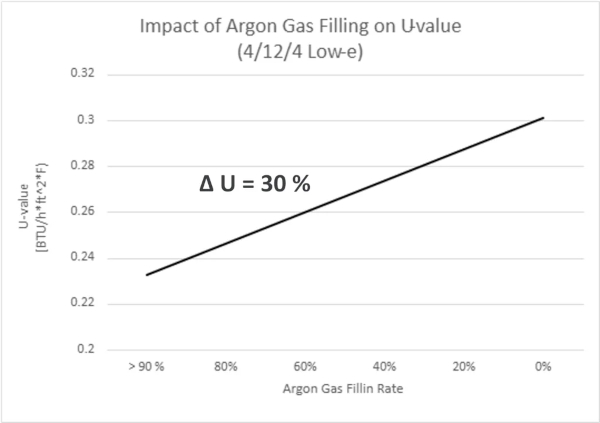
- For every 20% decrease in argon, the U-value increases by ~0.06 W/(m²·K)
- When gas content falls below 50%, U-value deviations of 0.05–0.1 W/(m²·K) occur compared to design values
- Certain IGU configurations fail the ≤0.8 W/(m²·K)** energy requirement once argon drops below 60%
This means an IGU that was designed to be “high-performance” may no longer meet building code requirements if gas leakage goes undetected.
Read Argon-Filled Units: Why Fill Rate Matters for Reliable Insulation Performance
What These Results Mean for the Industry
A hidden risk in IGU production
Manufacturers often assume that filling equipment and sealing processes deliver consistent results. The study confirms the opposite: gas content varies significantly across production batches, suppliers, and even different IGUs within the same window system. Also, Visual Defect Inspection for Insulating Glass Units Alone Is Not Enough and there is a need for argon fill tests.
A challenge for installers and façade contractors
If gas leakage occurs during transport or on-site storage, installers may unknowingly deliver underperforming windows.
A long-term cost for building owners
Lower gas levels mean poorer insulation, higher heating/cooling demand, and reduced comfort often without any visible signs.
A compliance issue for energy certifications
If real-life U-values drift from verified performance, it can affect building energy ratings and contractual obligations.
The Practical Way Forward: Measuring Inert Gas Content
Traditional gas testing methods (e.g., gas chromatography) are destructive and unsuitable for production lines or on-site installations.
This is where non-invasive gas measurement becomes strategically important. Read Why Break the Insulating Glass Unit for Gas Analysis If You Don’t Have To?
Why testing matters:
- Ensures quality control at the production line
- Verifies storage and transport conditions
- Confirms compliance at installation
- Supports transparent documentation for customers
- Reduces risks of complaints, warranty claims, or energy-performance disputes
By integrating measurement into standard processes, manufacturers can move from assumption to verification, a key step towards consistent IGU quality.
Sparklike devices:
- Sparklike Handheld™ – for double glazed insulating glass units
- Sparklike Laser Portable™ – for double and triple glazed insulating glass units with coatings and lamination
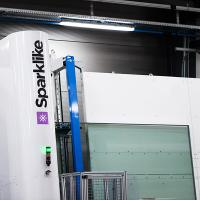
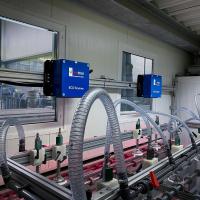
- Sparklike Laser Integrated™ – insulating gas measurement station integrated to the IG-line – for double and triple glazed insulating glass units with coatings and lamination.
Best Practices for IGU Gas-Fill Quality Control
Based on study insights and industry standards, the following measures are recommended:
- Measure gas content immediately after production
- Ensures that filling equipment and sealing procedures deliver the intended fill rate.
- Re-check gas content after storage or long-distance transport
- Prevents accidental degradation before installation.
- Test IGUs on-site during installation for critical projects
- Especially important for large façades or energy-certified buildings.
- Maintain documentation for traceability
- Supports customer confidence and reduces risk in case of performance disputes.
- Use non-destructive tools for continuous quality assurance
- This ensures regular testing does not damage products or slow down production.
Customer Case: A Manufacturer’s Perspective on Evolving Gas Fill Verification Needs
For many IGU manufacturers, verifying gas fill levels is not just a technical step but a part of protecting their reputation for quality. This was true for Huadong Coating Technology, a long-standing Low-E and insulating glass producer in Suzhou.
Their quality team had already been using Sparklike Handheld™ for years. It worked reliably for double glazing, and it became a natural part of their routine quality checks. But as their product portfolio expanded and triple and multi-cavity IGUs became more common, the Handheld could no longer cover everything they produced.
They told us that this created a gap: they could measure some units, but not the most advanced, high-performance structures which their international customers cared about the most.
To close that gap, Huadong Coating decided to adopt Sparklike Laser Portable™, which allowed them to verify gas fill levels in triple glazing, laminated IGUs, and units with multiple Low-E coatings without breaking the seal.
The immediate impact was clear:
- they could finally test the entire product range, not just double panes
- they gained confidence that multi-cavity IGUs met gas specifications
- QC became more transparent across different production stages
- customers appreciated the added proof of performance
Their experience shows how non-invasive measurement evolves alongside modern IGU production and helps manufacturers stay ahead of rising energy-efficiency expectations.
Read the full customer case from Huadong Coating Technology:
Conclusion: Consistent Gas Quality Is Key to Reliable IGU Performance
The 2022 study highlights an industry-wide truth:inert-gas content cannot be assumed but it must be measured.
With low initial compliance rates and measurable gas leakage over time, IGU performance depends heavily on effective filling, sealing, storage, and verification. As energy standards tighten globally, ensuring correct gas content is not only a quality issue but also a business advantage.
Manufacturers, installers, and building owners who invest in consistent gas measurement are better positioned to deliver real performance, meet regulatory expectations, and maintain trust in high-performance window solutions.
More information on Sparklike’s solutions and their applications in IGU quality control.
Contact Sales to Talk About Sparklike Solutions
Source:
Wang, D., Gao, W., Wang, Y., & Wang, L. (2022). 充气中空玻璃惰性气体含量相关研究. 《玻璃》, (5).
Wan, C. (2025, March 10). 128组样品、10个月监测,中空玻璃 Ar 泄露真相大白! Weixin. https://mp.weixin.qq.com/s/UexH5naKTXhGxv1S3Tl4CA
 600450










Add new comment