

Date: 2 July 2021
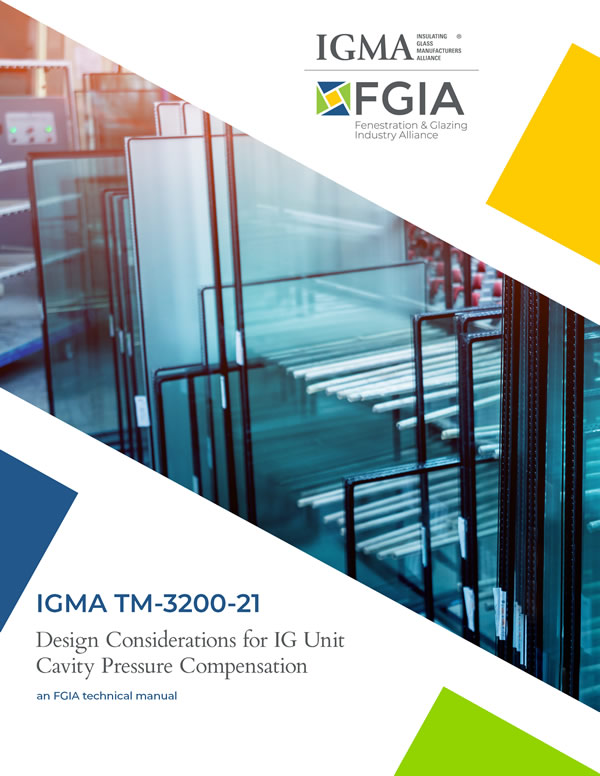
The Fenestration and Glazing Industry Alliance (FGIA) has released new technical manual providing generic design considerations for cavity compensation for insulating glass (IG) units and determining conditions which impact the pressure in the IG unit cavity. IGMA TM 3200-21, Design Considerations for IG Unit Cavity Pressure Compensation, is FGIA's newest technical manual.
"The TM-3200 document is helpful for anyone who is interested in or involved with the installation of IGUs at an elevation that differs from the elevation at which they were built," said Dan Haglin (FDR Design), chair of the FGIA Design Considerations for IG Cavity Compensation Task Group. "The committee has done an excellent job listing and explaining the different ways that are known for altering the internal cavity pressure in an IGU. Thanks to all who were involved in making this comprehensive and thorough document."
Insulating Glass Units (IG, IGU or IG units) are dynamic assemblies in which the cavity can change dimensionally based on environmental factors (temperature and barometric pressure), dynamic load factors (wind load) and location (elevation). Since the cavity of a standard IG unit contains air, a fill gas or a mixture, the pressure and volume within the cavity are subject to these factors. As the IG unit temperature increases, or the elevation is higher than point of manufacture, or lower barometric pressures, the volume of gas inside the IG unit increases relative to its original volume, causing outward deflection of the glass panes.
Similarly, if the temperature decreases, or the elevation is lower than point of manufacture, or higher barometric pressures, the volume of gas inside the IG unit decreases relative to the conditions external to the IG unit, causing inward deflection of the glass panes. The amount of deflection is dependent upon the IG unit dimensional geometry, glass thickness, edge seal design and materials, glazing or framing design and materials and other factors.
IGMA TM-3200-21, as well as other IGMA documents available from FGIA, may be purchased from the online store at the discounted member rate of $125 or the non-member price of $250.
More information about FGIA and its activities can be found at FGIAonline.org.
 600450













Add new comment