
Date: 12 February 2026
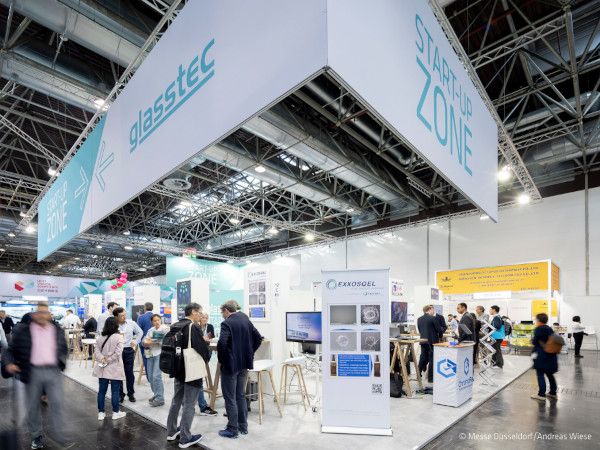
EXXOSQEL GmbH from Gössenheim, Germany, specialises in innovative surface treatments for glass. In 2024 the company presented its technology for repairing mechanically damaged glass surfaces in the Start-Up Zone of glasstec. In this interview Managing Director Thomas Claude Sauer explains how increasing the strength of lightweight construction can become a central lever for decarbonising the glass industry.
Looking at the decarbonisation of the glass industry as a whole where do we stand currently and what do you consider the two most important adjustments for the next years?
Thomas Claude Sauer: The most important adjustment for decarbonisation is a combination of saving energy and electrifying the melting technology as far as possible – and in conjunction with renewable energy supply concepts including energy storage. The first projects to increase electrification on an industrial scale have already been implemented.
An example of this is the ”NextGen Furnace“ project by Ardagh Glass Packaging in Obernkirchen which succeeded in massively increasing the share of electrical heating. This is a basic requirement for decarbonisation since electrical power can be generated from renewable sources. It is hard to predict how quickly the glass industry can achieve this transition. Due to the relatively long lifecycles of glass melting furnaces this will take several more years even in the best case scenario.
I view the efforts to use hydrogen for melting with scepticism: hydrogen will play a role for specific processes but for furnace heating it is too costly and inefficient to produce and supply.
Alongside operational process optimisations in the transition to lightweight glass, an increase in its strength is another crucial adjustment for saving energy. This comes with not just one but two benefits: firstly, the reduced energy consumption per unit produced – square metre or sheet – and secondly, the possibility of using a higher share of electrical heating for the same melting furnace size. Another positive knock-on effect is the reduced requirements for supporting structures. In construction the reduced weight of glass could markedly reduce the structural requirements and, hence, the concrete and steel volumes needed.
Your approach to lightweight glass is a surface treatment. Which glass properties do you “shift” by using this practice and what roughly happens on a physical or chemical level to make the material more resilient?
Thomas Claude Sauer: With our technology surface defects can partly be healed. An approach that results in a marked increase in strength. At a molecular level we produce covalent cross-links in the micro-cracks formed by cooling and hot forming. This substantially increases the energy required for breakage. In addition, this forms a barrier against environmental influences. Glass brilliance and touch are also improved and the material becomes slightly more ductile.
The impact of micro-cracks on glass strength
Cooling and hot forming of glass can give rise to near-surface micro-cracks and defects. These impact the energy required to break the glass, because most fractures occur in the “critical” crack tip where the stress energy meets with the least resistance. Processes that stabilise or bridge these defects increase the energy required for fracture and improve the structural load-bearing capacity of the material.
What would have to change over the next few years to really make lightweight a standard for glass and how can your methods contribute to this?
Thomas Claude Sauer: The relevant standards and requirements in the glass, construction, automotive and pharmaceutical sectors must to a certain extent be amended. This is a major task we are actively committed to. But at the end of the day, costs, customer benefit and the willingness to change will decide on the widespread adoption of this new technology. We see ourselves well positioned here as our solution is efficient on an industrial scale and comparatively easy to retrofit.
After years of preparatory work we are currently delighted at the clearly risen interest shown by both the glass industry and users. This trend makes me feel very confident because I assume that “lightweight” functionalities in glass will now see a breakthrough, going from being a niche topic to becoming state of the art for more sustainable glass production.
Decarbonisation will also be one of the central Hot Topics at glasstec 2026 again this year.
 600450



Add new comment