HORN’s E-Fusion Power Boosting System Drives Sustainable Glass Melting

HORN’s E-Fusion Power Boosting System Drives Sustainable Glass Melting
Photo source
HORN Glass Industries

Date: 21 May 2026

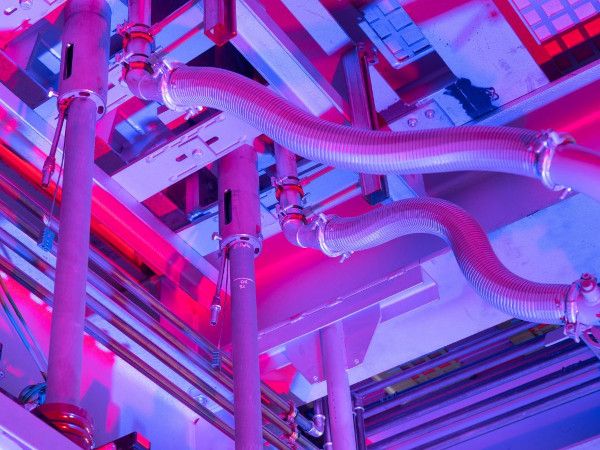
HORN continues to advance sustainable glass production with its innovative E-Fusion Power Boosting System, designed to increase melting efficiency, improve glass quality and support manufacturers in reducing CO₂ emissions.

As one of the world's leading supplier of sustainable glass production technologies, HORN stands for state-of-the-art technologies, innovative spirit and technological leadership. Driven by these values, the glass manufacturing process is continuously optimised energetically, technically and technologically.

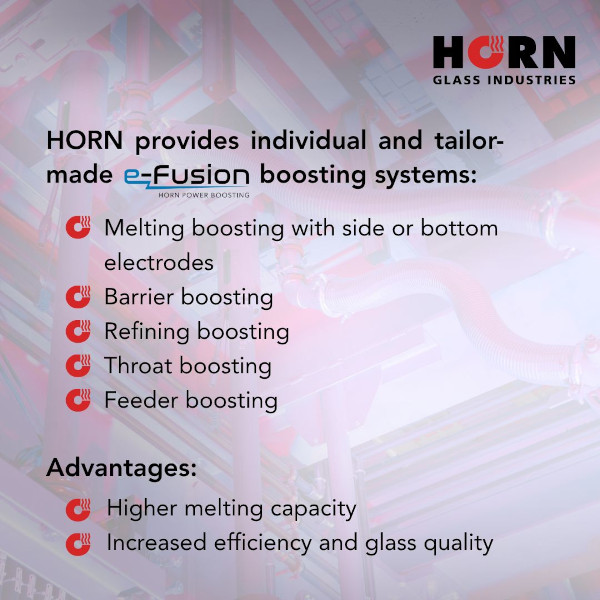
HORN´s in-house developed e-Fusion Power Boosting System enhances the glass melting process, increases throughput, improves glass quality and reduces CO₂ emissions. This technology uses electricity directly as a source of melting energy and is crucial for glass manufacturers to acheive their carbon neutrality goals in the near future since substituting fossil energy with electricity reduces CO₂ emissions.

With this tailor-made technology, additional electric energy is directly inserted to the glass bath. While small and medium-sized furnaces are usually fitted with a single electrical booster, larger installations benefit from splitting the installed electrical energy between two or more separate systems. This has the greatest impact on the convection currents and high specific melting capacities can be acheived.
HORN’s E-Fusion Power Boosting System Drives Sustainable Glass Melting

600450 HORN’s E-Fusion Power Boosting System Drives Sustainable Glass Melting glassonweb.com

See more news about:

Others also read

How can the energy-intensive glass industry, so far heavily dependent on natural gas, become CO2-neutral by 2045?
Saint-Gobain and AGC are joining forces to deploy a world-first, large-scale hybrid electric furnace at Saint-Gobain's Avilés plant in Spain, set to cut CO₂ emissions from flat glass production by around 50%.
Saint-Gobain is strengthening its AI leadership by partnering with Microsoft to accelerate sustainable construction, boost productivity, and support the next generation of low-carbon data centers.
In Düsseldorf international decision-makers will encounter innovations, knowledge and concrete solutions for the glass sector
On 17 July, the European Commission adopted its proposal for the ETS reform. Glass for Europe is currently conducted a detailed assessment of the legislative proposal. The text below is the press release which was sent following the adoption.
A new roadmap explores how Germany's glass industry can achieve CO₂ neutrality by 2045, outlining the technologies and strategies needed to drive decarbonisation.

Add new comment

From industry

NEWS RELATED PRODUCTS

Kuraray Europe GmbH
Horn Glass Industries