
Date: 31 July 2026
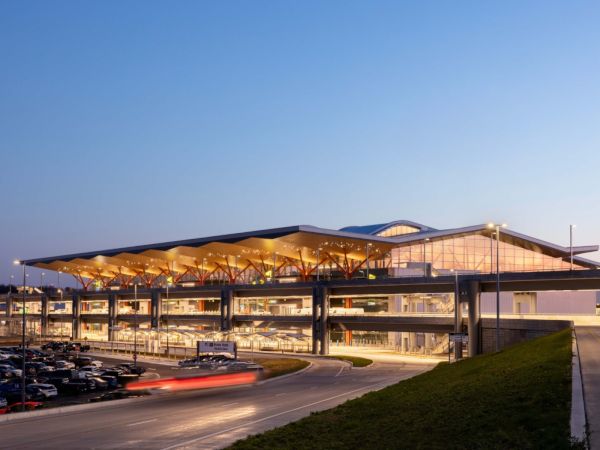
Featuring an undulating mass timber roof, steel beams mimicking tree trunks and branches, and expansive clerestory windows, Pittsburgh International Airport’s new 811,000-square-foot terminal, which officially opened in November 2025, presents a new gateway to the city.
Designed by Gensler, outdoor terraces incorporate native plants, walkways and benches, and the wavy wood ceiling references the rolling hills of the Allegheny Mountains.
“The undulating roof design is intended to evoke impressions of being under a tree canopy. The shifting light from the clerestories is like dappled sunlight that filters down through the leaves,” said Carolyn Sponza, project director, Gensler, Pittsburgh.
A total of 38 unique, architecturally exposed structural steel (AESS) hollow beams filled with concrete cast a copper hue, creating the look of sunlight filtering through the canopy.
For the clerestory windows, which weave above and below the dropped timber ceiling, the design team wanted clear glass but also required solar control.
Initially, a glass product offering Visible Light Transmittance (VLT) of 70% was considered. However, the Solar Heat Gain Coefficient (SHGC) was just 0.38, which meant that more than a third of the solar heat would be allowed into the terminal.
“Our overall strategy was to find a glass that could be as close to clear as possible but would provide balance with our mechanical system so as not to add load thereby increasing unit size and operational costs,” explained Sponza.
The design team prioritized a highly transparent glazing solution that would maximize clarity and daylight while working in harmony with the building’s mechanical systems. By balancing aesthetic and performance goals, the selected glass helped minimize energy demands, avoid increased HVAC loads and support long-term operational efficiency.
Ultimately, Solarban® 72 Starphire® glass from Vitro Architectural Glass was specified, which delivers a VLT of 68% and SHGC of 0.28.
To verify these values and compliance with ASHRAE Energy Sim Standard, the Buro Happold engineering team used Integrated Environmental Solutions’ modeling software.
“This helped us validate the performance of the glass within the overall strategy,” added Sponza.
In addition to performance and aesthetics, the daylight from the glazing and clerestory windows helps direct passengers from the curb to the security checkpoint within the terminal. A stark change from the windowless original terminal, the new design enhances flow, decreases wait times, speeds up the security and check-in, presents a welcoming civic space and celebrates Pittsburgh’s evolving identity from the Steel City to a major hub of higher education, integrated tech and medicine.
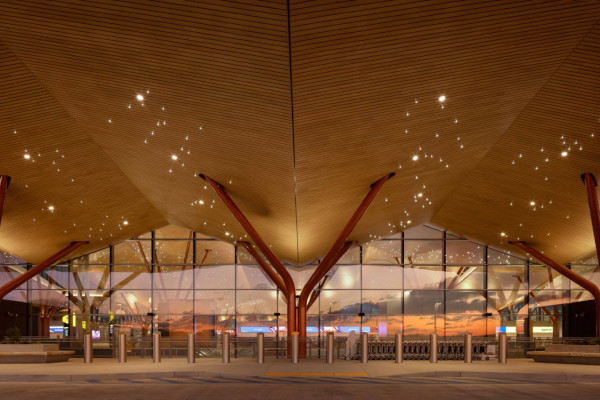
Featuring an undulating mass timber roof, steel beams mimicking tree trunks and branches, and expansive clerestory windows, Pittsburgh International Airport’s new 811,000-square-foot terminal, which officially opened in November 2025, presents a new gateway to the city.
Designed by Gensler, outdoor terraces incorporate native plants, walkways and benches, and the wavy wood ceiling references the rolling hills of the Allegheny Mountains.
“The undulating roof design is intended to evoke impressions of being under a tree canopy. The shifting light from the clerestories is like dappled sunlight that filters down through the leaves,” said Carolyn Sponza, project director, Gensler, Pittsburgh.
A total of 38 unique, architecturally exposed structural steel (AESS) hollow beams filled with concrete cast a copper hue, creating the look of sunlight filtering through the canopy.
For the clerestory windows, which weave above and below the dropped timber ceiling, the design team wanted clear glass but also required solar control.
Initially, a glass product offering Visible Light Transmittance (VLT) of 70% was considered. However, the Solar Heat Gain Coefficient (SHGC) was just 0.38, which meant that more than a third of the solar heat would be allowed into the terminal.
“Our overall strategy was to find a glass that could be as close to clear as possible but would provide balance with our mechanical system so as not to add load thereby increasing unit size and operational costs,” explained Sponza.
The design team prioritized a highly transparent glazing solution that would maximize clarity and daylight while working in harmony with the building’s mechanical systems. By balancing aesthetic and performance goals, the selected glass helped minimize energy demands, avoid increased HVAC loads and support long-term operational efficiency.
Ultimately, Solarban® 72 Starphire® glass from Vitro Architectural Glass was specified, which delivers a VLT of 68% and SHGC of 0.28.
To verify these values and compliance with ASHRAE Energy Sim Standard, the Buro Happold engineering team used Integrated Environmental Solutions’ modeling software.
“This helped us validate the performance of the glass within the overall strategy,” added Sponza.
In addition to performance and aesthetics, the daylight from the glazing and clerestory windows helps direct passengers from the curb to the security checkpoint within the terminal. A stark change from the windowless original terminal, the new design enhances flow, decreases wait times, speeds up the security and check-in, presents a welcoming civic space and celebrates Pittsburgh’s evolving identity from the Steel City to a major hub of higher education, integrated tech and medicine.
 600450







Add new comment