
Date: 23 June 2026
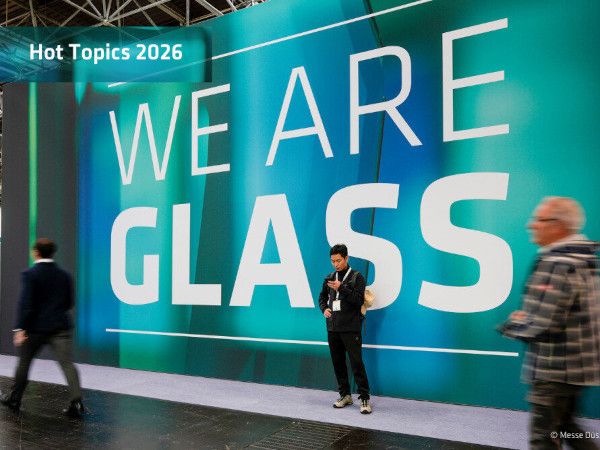
glasstec 2026 presents and discusses solutions to current challenges within the glass sector. The main focus is on the issues “Circular economy”, “AI + Digital Technologies” and “Decarbonisation”. What options for change must the glass industry explore to unearth significant potentials for the future?
AI & Digital Technologies
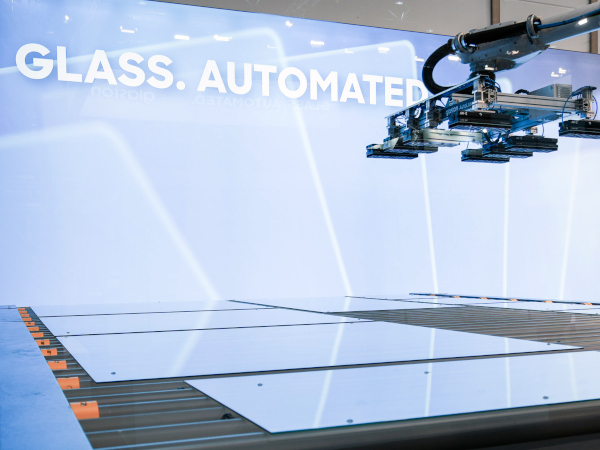
 Digital glass production: between AI and automated glass factories
Digital glass production is a key driver for greater efficiency, quality, and sustainability in the glass industry. The networking of systems, sensors, and data platforms creates transparent processes that can be better controlled, automated, and optimized. The focus is on AI applications specifically tailored to glass manufacturing, as well as the goal of a fully networked glass factory. In this way, digitalization becomes not an end in itself, but the foundation for measurable improvements in production, energy use, and competitiveness.
Companies in the glass industry are facing rising energy costs, increasing competitive pressure and production processes that are becoming increasingly complex. Digital technologies offer the opportunity to tackle these challenges in a structured and data-driven manner.
What does digital glass production mean?
Digital glass production refers to the networked control of key processes in glass manufacturing. Machines, systems, and software exchange data in real time. This enables processes to be monitored, controlled, and optimized with greater precision.
Key features include real-time production monitoring, automated plant control, data-driven optimization of energy and material usage, precise quality control, and transparent performance metrics. This enables companies to reduce scrap, shorten lead times, and leverage efficiency potential in a targeted manner.
AI in glass manufacturing: automation and energy efficiency
AI applications analyze production and plant data and use it to identify specific areas for optimization. This makes potential savings visible and actionable, particularly in energy-intensive areas such as the melting process.
At the same time, AI supports dynamic control of energy usage and predictive maintenance. This lowers consumption, reduces downtime, and helps control costs. As a result, glass production becomes more efficient, sustainable, and competitive.
Technology partners across the value chain
Digital glass production is the result of collaboration among specialized providers. These include plant and furnace manufacturers with digitally controllable systems, automation specialists for integrated control solutions, software providers for production and data management, AI and analytics companies, and specialists in image-based quality control.
Only by combining these technologies can the foundation for a fully connected glass factory be established.
glasstec as a driver of innovation
From AI applications to digital production
glasstec brings together leading suppliers, technologies, and decision-makers in one place. It demonstrates how AI applications, automation solutions, sensor technology, and data platforms interact in glass production. In doing so, the trade show serves as a central platform for guidance, knowledge exchange, and strategic decision-making in the digital transformation of the glass industry.
Exhibitors specialising in AI and digitalisation ❯
More>
Decarbonisation
 The glass industry’s transition to carbon neutrality
Decarbonizing the glass industry is one of the sector’s greatest challenges. As it moves toward climate neutrality, the industry is undergoing a profound technical and economic transformation. At the same time, glass manufacturing is one of the most energy-intensive industrial processes in existence.
Energy-intensive production often relies on fossil fuels such as natural gas. At the same time, CO₂ costs, regulatory pressure and demands for sustainable procedures are constantly rising.
The move towards climate-neutral glass production requires technological innovation, alternative fuels and a systematic improvement in energy efficiency. Decarbonising the glass industry therefore involves not only reducing emissions, but also a structural transformation of plants, processes and energy sources.
Decarbonization in the Glass Industry: Significance and Goals
Decarbonization refers to the gradual reduction of CO₂ emissions with the goal of making the economy and industry climate-neutral. In the glass industry, this primarily means reducing process-related emissions and gradually replacing fossil fuels.
The goal is to make energy-intensive glass production climate-neutral in the long term without jeopardizing supply security and competitiveness. To achieve this, melting tanks, furnace technologies, energy infrastructure, fuel systems, and process control must be specifically further developed.
Technological drivers of decarbonisation
To reduce energy consumption and CO₂ emissions, the glass industry is relying on various technological approaches. These include more efficient processes, better insulation, and heat recovery systems. A higher proportion of recycled glass also makes an important contribution, as cullet can be melted at lower temperatures and thus requires less energy.
Other key levers include the electrification of melting furnaces and the use of green hydrogen as an alternative to natural gas. However, their implementation depends heavily on local conditions: renewable energy or green hydrogen is not yet available everywhere in sufficient quantities and at competitive costs. Combined with a reliable supply, hybrid or fully electric plants can significantly reduce CO₂ emissions.
The economic dimension of decarbonization
The retrofitting of existing facilities, new burner systems, investments in infrastructure, and fluctuating energy prices are forcing companies to make costly decisions. At the same time, decarbonization offers the opportunity to reduce energy demand in a targeted manner, drive innovation, and secure long-term competitiveness.
The key is a transformation path that combines technical feasibility, economic viability, and regulatory requirements. This makes investments more predictable and enables a sustainable reduction in energy consumption and CO₂ emissions.
Technology partner for decarbonisation
Decarbonizing the glass industry requires specialized expertise and close collaboration among various partners.
These include plant and furnace builders, suppliers of hybrid or fully electric melting systems, specialists in hydrogen technology, experts in energy infrastructure, and consulting firms specializing in industrial transformation strategies.
glasstec as a driver of innovation
From energy-efficient melting technologies to carbon-neutral production
glasstec brings together leading suppliers, technologies, and decision-makers in one place. It showcases solutions for decarbonizing the glass industry – not just individually, but in combination. This creates a solid foundation for strategic decisions on the path to more energy-efficient and climate-friendly glass production.
Discover exhibitors specialising in decarbonisation ❯
Circular Economy
 Conserving resources for a sustainable glass industry
Sustainability has been gaining importance in the international glass industry for years. Glass offers ideal conditions for this: the material is durable and almost entirely recyclable. However, a well-functioning circular economy is essential. To achieve this, waste glass must be consistently collected, processed, and returned to the manufacturing process. This helps conserve resources, reduce energy consumption, and stabilize material cycles in the long term.
The efficient use of existing resources and closed-loop material cycles are crucial to ensuring sustainable glass production in the long term and steering the entire glass industry towards a climate-friendly future.
Circular Economy as a Response to Current Challenges in the Glass Industry
The glass industry is one of the most energy-intensive industries. High melting temperatures, continuous processes, and complex material requirements drive energy consumption. At the same time, demands are growing for sustainable manufacturing processes, stable raw material cycles, and the careful use of resources.
This is precisely where the circular economy comes into play: a higher proportion of recycled glass conserves raw materials, lowers energy consumption, and reduces waste. The key lies in the interplay between collection, processing, technology, and industrial implementation.
The glass recycling cycle
A key component of sustainable glass production is the closed-loop recycling system. Waste glass is collected, sorted, cleaned of foreign materials, and then reused as a raw material. After being sorted by color, the glass cullet is melted down and used to replace primary raw materials such as quartz sand, soda ash, and lime.
The more uniformly sorted the cullet is, the more effectively it can be reintroduced into the glass cycle as a high-quality material. This process, also known as glass cullet recycling, reduces energy consumption and CO₂ emissions, conserves resources, and prevents waste. Efficient organization of the entire recycling process is crucial.
Approaches to sustainable glass production
To enhance sustainability, the glass industry is increasingly turning to recycled materials. In particular, reducing the use of quartz sand in favour of cullet and recycled glass lowers raw material consumption and energy requirements in production.
As the melting process accounts for up to 85 per cent of energy consumption, changes to the material mix have a significant impact. Even a ten per cent proportion of cullet reduces melting energy by around three per cent, although suitable solutions vary depending on the production segment. In practice, the appropriate approaches differ depending on the production segment within the glass industry: Container glass, flat glass, and specialty glass each have different requirements regarding cullet quality, sorting, and return to production.
glasstec as a driver of innovation
From glass recycling to resource-efficient production
glasstec brings together companies, technology providers, and research institutions working on solutions for a more sustainable glass industry. As the leading international trade fair, it offers a platform for innovation, collaboration, and strategic dialogue on the circular economy, resource efficiency, and sustainable manufacturing processes.
 600450







Add new comment