
Glass for Europe reacts to the publication of the Industrial Accelerator Act

Industrial Accelerator Act – A constructive first step but more is needed to strengthen flat glass manufacturing in Europe
Photo source
Glass for Europe

Date: 5 March 2026

'The Industrial Accelerator Act represents a constructive first step towards supporting European-made products' declared Bertrand Cazes, Secretary General of Glass for Europe.

The Commission’s proposal recognises the manufacturing, shaping, and processing of flat glass as a strategic sector whose production must be retained and expanded within Europe. Glazing is a critical input for the construction, automotive and solar-energy industries, key sectors addressed by this regulation.

It is logical that our industry should benefit from the provisions on accelerated permitting and be eligible for inclusion within designated Acceleration Areas ensuring a regulatory environment conducive to investment.

Regarding EU-origin requirements in public procurement and support schemes, the current scope covers only a limited range of materials, despite the strategic relevance of others, including flat glass. The criteria for material selection, the thresholds applied, and the proposed extension to eligible third countries should be clearly articulated.

Glass for Europe welcomes that provisions related to the automotive sector cover all vehicle components with a 70% ex-works price threshold. The role of critical components such as automotive glazing may deserve to be better specified to boost the competitiveness of the entire automotive eco-system, as intended by the recent Automotive Strategy.

"While a resilient European flat glass sector is clearly strategic for the construction, automotive and solar energy value chains, further refinement and additional measures will be needed to fully strengthen flat glass and glazing manufacturing in Europe" concluded Bertrand Cazes.
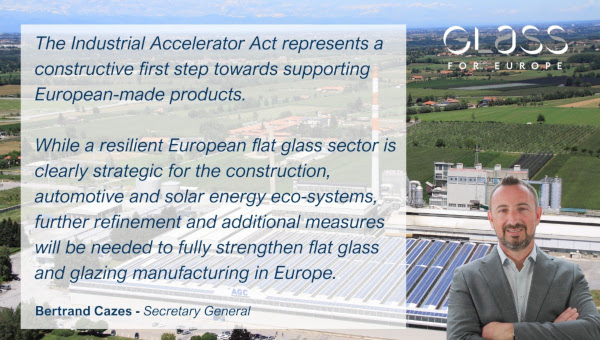
Bertrand Cazes

600450 Glass for Europe reacts to the publication of the Industrial Accelerator Act glassonweb.com

Others also read

The Fenestration and Glazing Industry Alliance (FGIA) has released an updated trio of documents sharing recommend test methods for three different types of movement during seismic-related events.
The challenges facing the glass and glazing industry continue to evolve. From changing regulations and product safety reforms to energy efficiency targets and skills development, businesses are navigating an increasingly complex landscape.
Saint-Gobain and AGC are joining forces to deploy a world-first, large-scale hybrid electric furnace at Saint-Gobain's Avilés plant in Spain, set to cut CO₂ emissions from flat glass production by around 50%.
Glass can be recycled indefinitely, and using glass cullet in production reduces the need for virgin raw materials, energy consumption and greenhouse gas emissions.
The Fenestration and Glazing Industry Alliance (FGIA) has released an updated technical information report describing what sound is, how it is transmitted, how it is measured and how its transmission can be controlled.
Specification will include enamel application standards on all types of glass for quality assessment.

Add new comment

From industry

İçmeler Mah. D-100 Karayolu Cad. No:44A,
34947 Tuzla,/İstanbul
Turkey

NEWS RELATED PRODUCTS