Date: 16 March 2026
Read on to find out what is currently changing in research, associations and mechanical engineering – and the role Artificial Intelligence plays in this.
Returns in container glass are already functioning well in many markets. But flat glass from windows, façades and insulated glass units remain a challenge: coatings and laminations complicate separation, sorting and reclamation – and this is precisely where new solutions kick in.
Practical use cases and research
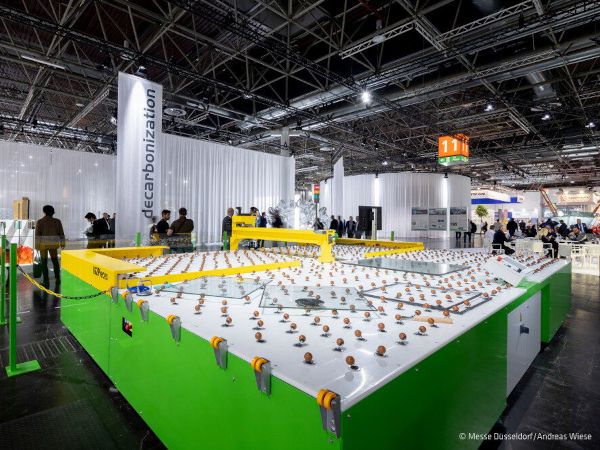
Introducing the IG2Pieces system glasstec exhibitor HEGLA has developed a machine concept that enables the clean-grade separation of insulated glass into individual, undamaged components – to then reuse or recycle them in a downstream process. This concept addressed one of the central bottlenecks in flat glass recycling: the insulated glass unit. At glasstec 2024 this system was one of the exhibits in the Circular Economy area.
Further impetus comes care of research: TU Delft researches the circular use of glass along the three pillars Reduce, Reuse, Recycle. With a view to reducing material consumption the researchers study the structural topology of monolithic, structural glass components – with the aim of achieving maximum stiffness with minimum volume. TU Delft was a partner of the special show glass technology live at glasstec 2024.
Not only enterprises and research institutions are dealing with this topic – change is also driven by associations.
The Bundesverband Flachglas e. V. (BF) (German Flat Glass Manufacturers’ Association) has undertaken a joint analysis with ift Rosenheim and the Fraunhofer Institute for Silicate Research (ISC) of the state of affairs in Flat glass recycling in Germany. The result is sobering: of the approx. 521,000 tons of flat glass cullet available only 19% return to float glass melting tanks as high-quality cullet. The larger share ends up in container glass or in glass wool – a downcycling that does not do justice to the potential this material holds. This analysis shows: the circular economy requires not only new technologies but also changed structures and a new awareness along the entire recycling chain.
How KI changes recycling
longside machine technology Artificial Intelligence is gaining importance in glass recycling – in two key fields of application. Firstly, data-controlled systems analyse operational data and provide plant operators with targeted recommendations to act: for process control, for improving plant efficiency and for planning maintenance jobs. Secondly, AI is increasingly used in sensor-based sorting systems, which scan and analyse all material streams – thereby ensuring a more efficient separation and processing of glass.
Circular Economy as a Hot Topic at glasstec 2026
Circular economy will again feature as one of the three Hot Topics at glasstec 2026 from 20 to 23 October in Düsseldorf – and the aforementioned examples show why: technology, research and associations jointly create the basis for a glass industry that consistently keeps resources in a closed loop.
 600450




Add new comment