Date: 25 June 2026
The former provided an overview of the evolution, engineering and performance of black vinyl frames while the session on certifying security screens gave participants a look at a new FGIA standard: AAMA 1901, Specification for Security Screen Products. Both offered the latest information on these popular residential products.
Black Vinyl’s History and Future
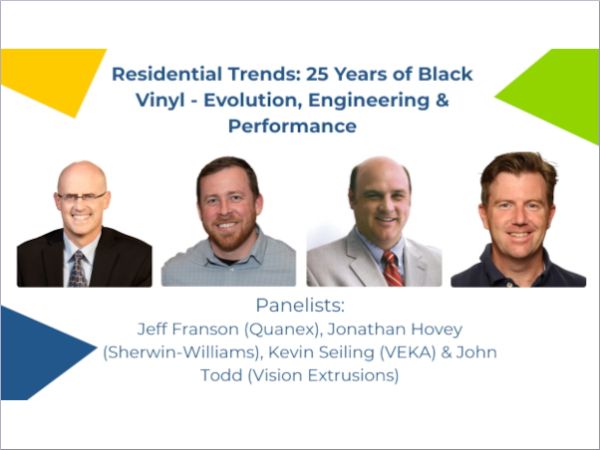
Black framed windows have rapidly emerged as a defining trend in modern design, but achieving both aesthetics and performance requires advanced engineering. In this panel discussion entitled “Residential Trends: 25 Years of Black Vinyl – Evolution, Engineering and Performance,” industry experts traced the historical development of black vinyl window frames, examining how engineering breakthroughs have transformed both durability and performance. Panelists included Jeff Franson (Quanex), Jonathan Hovey (Sherwin-Williams), Kevin Seiling (VEKA) and John Todd (Vision Extrusions).
Panelists highlighted how materials, extrusion technologies and system design have evolved to address the unique challenges of dark-colored vinyl, including heat buildup, weathering and color retention. Mono-extruded and capstock profiles, laminate technologies and advanced coatings are all part of the conversation along with discussion around key standards, test methods and long-term performance considerations.
While black window frames have been around for over two decades, they emerged as a trend about 15 years ago and shifted to a staple in the market in the 2020s. “Black vinyl frame technology has evolved over time,” said Seiling. He noted that, in the late 1980s, white vinyl windows were painted bronze, but the paint was not environmentally friendly. After that, black laminates were developed that met AAMA finishes standards.
“All colors from white to black must meet AAMA 303, Voluntary Specification for Rigid Polyvinyl Chloride (PVC) Exterior Profiles,” said Franson. AAMA 303 tests dimensional stability, impact resistance, weatherability, heat resistance, profile tolerances, heat build-up and lead compound content limit. “Weathering and heat build-up are the biggest challenges for black vinyl, especially in hot climates,” said Franson.
Hovey spoke more about testing, which he described as rigorous. “South Florida weathering takes a while to complete,” said Hovey. He pointed out that, as an industry trend, waterborne paint is the most common. “The easiest way to cure paint is just air,” he said. Using solar reflective pigments that provide low heat build-up and high solar reflectance can aid in meeting industry standards, Hovey explained.
Todd went into more detail about alternate test methods, including using capstocks, or a polymer fed through the extrusion tool at the same time as the vinyl, or laminates. “You can even do a hybrid approach, in which some areas are laminated and some are painted,” he said.
As for what is next in this space, the VMC Black Color Space Study Group is collecting data from a broad population to develop an appropriate L-a-b ellipsoid for black profiles. FGIA members can join this group to have the opportunity to influence the outcome. Additionally, a station showing samples will be on display at the FGIA Fall Conference.
Market Place Opportunities with Security Screens
In a session titled, “Powering Market Place Opportunity with New Security Screen Certification,” presenter Jason Seals, FGIA Certification Services Manager, Fenestration, gave the history of the development of the new AAMA 1901 standard. Based on proven, high-performance benchmarks established by Standards Australia over the course of two decades, AAMA 1901 provides performance standards for installed security screen products.
“Within the security screen market potential, there is opportunity,” said Seals. “Commissioned industry research projects a U.S. retail residential security market value surpassing $2.1 billion. Security remains an emotional purchase that operates independently of typical budgetary constraints, offering wide potential.”
As standard housing turnover slows down, window and door manufacturers can leverage security screens as lucrative aftermarket add-ons. It generates incremental revenue without requiring a spike in base unit sales, said Seals. Plus, overall, the home security market is growing. In 2020, it represented $54B in retail sales.
Within AAMA 1901, there are two types of screens: Type 1, which is small enough to prevent an arm from passing through, and type 2 is small enough to prevent many flying insects. There are three classes of screens:
- Class A Permanent/Fixed: Unit is designed to be permanently attached to the building structure and not be removed for cleaning or maintenance purposes. Panel(s) are non-operable.
- Class B Permanent/Operable: Unit is designed to be permanently attached to the building structure and not be removed for cleaning or maintenance purposes. Panel(s) are operable by either swinging or sliding open and closed. Panel(s) are lockable in the closed position.
- Class C Removable/Operable: Unit is removeable for cleaning or maintenance purposes. Panel(s) are operable by either swinging or sliding open and closed. Panel(s) are lockable in the closed position.
Testing includes several aspects, including impact, a shear test, a knife shear test, a pry test and a pull test. Once AAMA 1901 was completed, its developing task group moved on to developing a certification program for security screens.
“So why certify?” said Seals. “Certification provides an independent, third-party check of your manufacturing processes.”
Licensees are audited twice a year on an unannounced basis. “Any deviations found during inspections are noted as non-conformities,” said Seals. “But you should know, non-conformities are not necessarily a bad thing. It generally costs 10 times more to repair a product in the field than it would to address the issue in the factory. Finding a non-conformity means an issue was identified in the factory, and that the conditions for fixing the non-conformity can be controlled by the manufacturer.”
The certification program procedural guide, AAMA 114, has been completed and approved for publication. The security screen certification program will launch in July 2026.
For more information about FGIA and its events, visit FGIAonline.org/events.
 600450



Add new comment