Date: 7 October 2022
This commitment is based on two pillars:
- Continuous optimization of its production processes and the use of its buildings, to limit energy consumption and CO2 emissions,
- Designing and commercializing solutions that combine both performance and sustainability for energy-efficient building renovation and light construction.
These two pillars are on their own a response to
the energy and climate crisis. The Group's ambition is to be the leader in light and sustainable construction meaning a more frugal, resource-efficient, low-carbon construction industry.
The immediate need for energy savings in Europe, in the face of the risk of energy shortages, requires rapid actions and a decisive acceleration of our efforts. As a leading industrial company, Saint-Gobain is actively participating in the global effort:
Doubling our actions for continuous improvement of our production processes
This exceptional performance is made possible by:
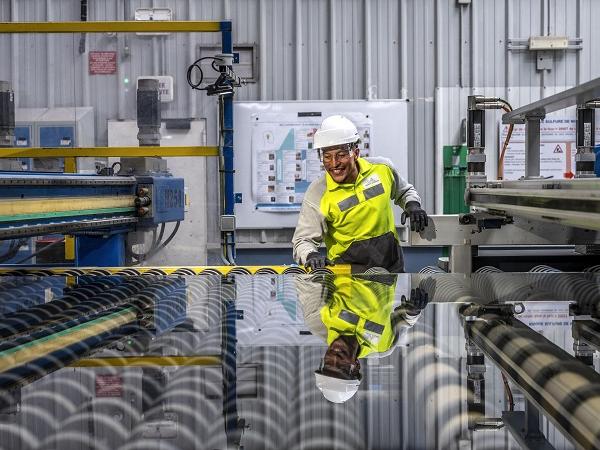
- improvements to production tools (e.g. work on furnace insulation; installation of more energy-efficient and/or variable-speed motors; improved metering and visualization of energy consumption, energy management system; reduction of equipment idling) and production processes (e.g. recovery of waste energy for heating or energy production),
- solutions to reduce the use of natural resources, through the reuse or recycling of raw materials: the use of recycled glass - cullet - for the production of flat glass or glass wool also has the advantage of emitting less energy during melting than sand,
- the development of lighter materials and products, which require less energy and fewer raw materials to manufacture.
Additional energy savings thanks to the investment of €100 million per year to reduce CO2 emissions
Saint-Gobain is earmarking a targeted investment and research and development budget of around €100 million per year until 2030 to reduce CO2 emissions and save energy, especially in the European plants.
Shifting the energy mix towards low-carbon and renewable sources
Throughout the world, the Group is accelerating the switch to green energy sources, with very concrete results in Mexico, Brazil, Poland, Spain and the United-States. In the latter, for example, the Group doubled in 2021 its share of renewable electricity in its global electricity consumption to nearly 40%.
Mobilizing all Group employees
In addition to these initiatives, the Group is mobilizing all its employees worldwide to save energy, with numerous initiatives in offices, sales outlets, logistics centers, research centers and on sustainable mobility:
- Renovation of our current buildings,
- Systematic installation of LEDs, presence detectors, time-based controls, daylighting,
- Limiting the use of heating and air-conditioning, lowering the temperature in offices (-1.5°C at Group headquarters),
- Deployment of photovoltaic solutions, in particular on plant roofs and parking lot shelters,
- Reduction of business travel and development of soft mobility and carpooling.
 600450










Add new comment