
Date: 11 August 2026
Lasers cut, drill, texture and mark glass – from fenestration to consumer electronics. But changing over to this technology is more than just a change of machinery. Dr. Christoph Hermanns (MDI Advanced Processing GmbH) explains why a holistic approach is needed and which applications will become especially relevant in future.
A tool for sophisticated glass processing
Be it vacuum insulation glass, smartphone displays or directly applied data codes: lasers have become established in many industrial glass processing areas. They make for contactless glass processing and applications which would scarcely be realisable or not economically viable using conventional technologies.
In fenestration, for example, precise openings for vacuum glazing can be produced or fine textures for bird-friendly glass can be applied. In consumer electronics they cut displays and cover glass. In mass production permanently marked data codes help to make components seamlessly traceable.
“Laser processing has become firmly established in many industries today,” says Dr. Christoph Hermanns, Managing Director at MDI Advanced Processing GmbH.
The switch changes manufacturing entirely
As versatile as this technology is: it also reaches its technical limits. Since the energy is bundled in a very small focus it is not suitable for every task – such as large-surface heat treatment.
The biggest challenge is the process chain. “Laser processes must be thought holistically,” says Hermanns. “Merely replacing an old, conventional machine by a new laser system often makes no sense in existing lines – and precisely this insufficient system integration still makes it difficult to decide to get started in many places.”
Those wanting to leverage the full potential therefore have to attune the entire process to laser technology.
Market opens up new opportunities
That this step increasingly pays off can also be attributed to market trends. Over the past few years new suppliers have emerged, prices have come down and systems work more precisely. Advances are not only made in lasers themselves but also in optical components, scanners, controls, software and Industry-4.0 interfaces.
“We can realise processes today which were completely unthinkable 5 years ago,” says Hermanns.
This also shifts the perspective on the technology itself: it is no longer just a special tool for niche applications but increasingly becomes part of comprehensive industrial solutions – especially where precision, flexible geometries and stable processes are required.
Growth potential in fenestration, electronics and vehicle interiors
MDI Advanced Processing sees particularly big opportunities in areas where tight tolerances meet with complex requirements:
- Fenestration: here it applies to the so-called Edge Deletion – the targeted removal of functional coatings around a glass pane’s perimeter. Such process steps are important when coated glass has to be processed further, bonded or sealed.
- Design products: contactless processes provide new scope of design freedom. Complex shapes, small radii or fine contours often require a great deal of effort when using conventional methods like scratching, breaking, grinding or bevelling – especially for small quantities or frequently changing designs.
- Consumer electronics & automotive: other growth areas emerge in the fields of lenses for Augmented-Reality- (AR) and Infrared applications (IR). The demand for finished glass surfaces is also rising in vehicle interiors: integrated touch screens, smart displays and high-quality design elements make high requirements on surface quality, dimensional stability and process stability.
- Pharmaceuticals: the technology is also gaining in importance here, too. The precise control of energy input can efficiently replace classical mechanical tools or thermal processes such as gas flames in special applications.
Integration in the complete line is key
A key economic benefit is that several processing steps are combined in one contactless workflow. Depending on the application cutting, texturing, drilling or marking can be combined more efficiently than with separate conventional processes.
To make these benefits pay off in practice, equipment, automation and quality assurance have to work together closely. The interplay of application knowledge, line integration and stable mass production determines success rather than an individual machine.
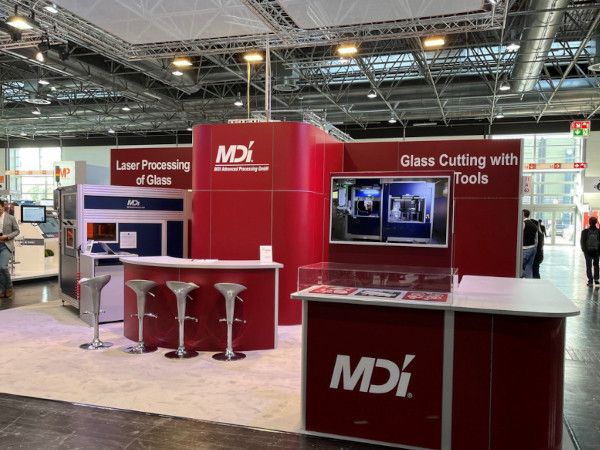
MDI Advanced Processing GmbH will exhibit its solutions for glass processing at glasstec 2026. The world-leading trade fair of the glass industry will be held in Düsseldorf from 20 to 23 October.
 600450





Add new comment