Date: 7 August 2026
This issue is examined by the “Bundesverband Glasindustrie e.V.” (Federal Association of the Glass Industry (BV Glas)) jointly with the “Institut für Energiewirtschaft und Rationelle Energieanwendung” (Institute for Energy Economics and Rational Energy Use (IER)) of Stuttgart University: at glasstec 2026 the study “Glass 2045 – Roadmap for the Decarbonisation of the German Glass Industry” will be tabled. In an interview Prof. Dr. Peter Radgen, Head of the Chair for Energy Efficiency at IER, already shared some insights with Messe Düsseldorf upfront.
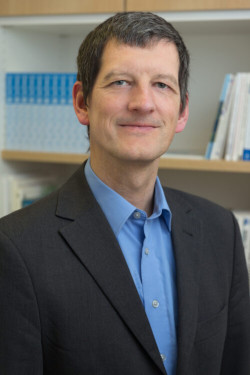
Foto: Institut für Energiewirtschaft und Rationelle Energieanwendung (IER)
glasstec: Professor Radgen, we are delighted you are able to give us a preview of the Glass 2045 study that BV Glas and the IER are presenting at glasstec 2026 in October. What are the key insights compared to the 2022 study?
Professor Peter Radgen: To begin on a positive note, the extensive decarbonisation of the German glass industry by 2045 is technically feasible. However, given the differing requirements of the flat glass, hollow glass and special glass sectors, there is no single, one-size-fits-all transition pathway. Instead, decarbonisation will require a combination of electrification, green hydrogen, hybrid solutions, circularity and complementary carbon management.
glasstec: What will be key to a successful transformation?
Professor Peter Radgen: The glass industry is currently having to drive its transformation forward under extremely challenging conditions. Key factors for success include internationally competitive energy prices, the accelerated expansion of renewable energy generation, power grid and hydrogen infrastructure, as well as evidence-based, reliable long-term policy frameworks.
glasstec: Are there regional differences in the transformation?
Professor Peter Radgen: Generally speaking, the uncertainties are making planning difficult for everyone. However, there are also region-specific barriers that are slowing the transformation. The prospects for success depend, for example, on the regional availability of renewable electricity, grid capacity, electricity storage facilities and hydrogen infrastructure. Companies whose glass melting furnaces are not located close to the planned hydrogen core network will face greater challenges in successfully implementing this transition pathway. Whether they choose to transport the hydrogen or switch to a different energy source ultimately also depends on the costs.
glasstec: In that case, is electricity likely to be favoured over hydrogen?
Professor Peter Radgen: In principle, hydrogen would be the simpler option, because it would allow the industry to continue using existing melting unit technology. In fact, this issue has already sparked a heated debate, and many companies are waiting for the future hydrogen core network. Ultimately, however, cost is the decisive factor. Hydrogen is not yet economically viable – it is currently around five times more expensive than natural gas – which is why progress has stalled. Electrification is also a key driver for research and development into new melting unit concepts.
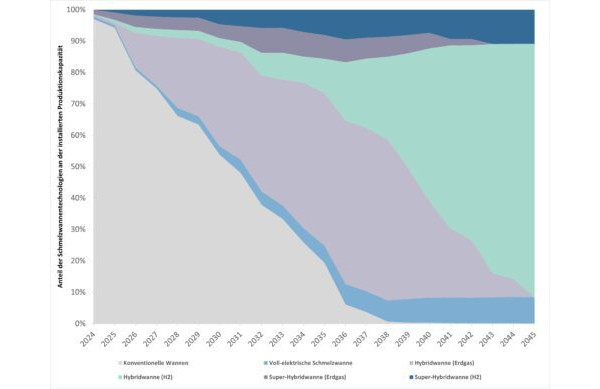
Fig.: ©IER, Universität Stuttgart
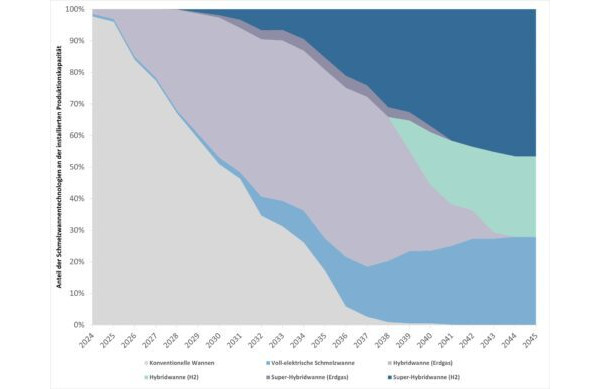
Fig.: ©IER, Stuttgart University
glasstec: Are hybrid melting concepts merely a stopgap solution, or will they remain an integral part of glass production?
Professor Peter Radgen: I suspect they will become a permanent stopgap solution. Hybrid systems perform well, even when hydrogen is used instead of natural gas. However, what is feasible will ultimately depend on the location. Companies without access to hydrogen – whether through the hydrogen core network or economically viable transport options – will have to rely on electricity alone.
glasstec: How has the overall situation changed?
Professor Peter Radgen: In our latest study, we expected glass production to remain stable or increase slightly. Unfortunately, we are now seeing a decline in production. Some manufacturers may be postponing cold repairs to their melting units while there is still uncertainty about the most appropriate decarbonisation pathway. This is a sensitive issue, because missing the window for a cold repair during a technology transition could mean being locked into the current system for another ten to twenty years. Some units might even end up being permanently decommissioned. The situation is particularly challenging at sites with only one melting unit. Shutting down that unit could impact the future of the entire infrastructure.
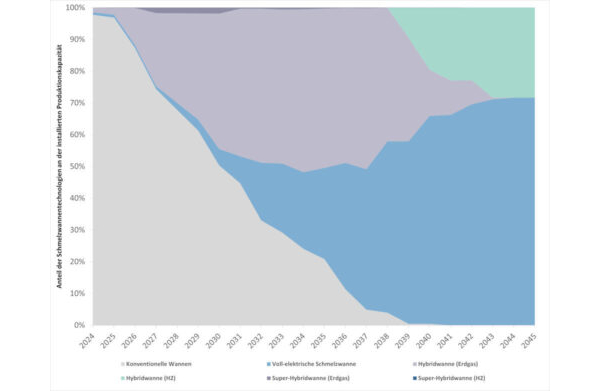
Fig.: © IER, University Stuttgart.
glasstec: What about carbon management? Have there been any new developments?
Professor Peter Radgen: Carbon capture and storage (CCS) and carbon capture and utilisation (CCU) are viewed far more favourably today than they were four years ago. Back then, for example, Germany still lacked a legal framework for the transport and storage of CO₂. This has generally been possible since November 2025, which is why we examined this option for addressing process-related and residual emissions in the current study. These are the greenhouse gas emissions that cannot be eliminated by the consistent implementation of all technically and economically viable mitigation measures. They include, for example, CO₂ released during the deacidification of carbonate-containing raw materials. Process-related and residual emissions, as well as unavoidable emissions associated with the transport and manufacture of refractory materials for furnaces, fall within Scope 3 and were not considered in our study. Avoiding these emissions as well and achieving net zero across all scopes would require the additional measure of permanent carbon dioxide removal (CDR).
glasstec: What role could the use of CO2 play in the future?
Professor Peter Radgen: Generally speaking, it makes a lot of sense to incorporate captured CO2 into durable products. Another potential alternative is chemical products such as sustainable aviation fuels (SAF) which could contribute to the decarbonisation of the aviation industry. CO₂ can also be used as a nutrient in greenhouse horticulture, a popular practice in the Netherlands. Unfortunately, however, greenhouses only require CO₂ during the spring and summer growing season. At present, the total volume of CO₂ emitted is far too high, and there are still too few viable applications for its use.
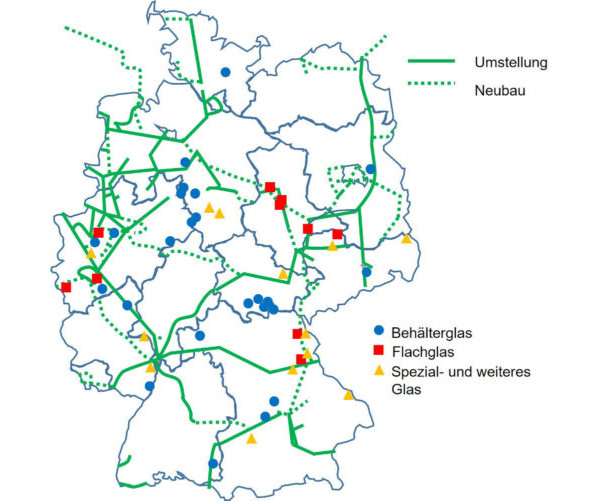
Fig.: ©IER, University of Stuttgart
glasstec: Which infrastructure measures should be supported by policymakers and implemented as a priority over the next five to ten years?
Professor Peter Radgen: Policymakers need to focus on the expansion of renewable energy generation and the power grid, as well as connecting industrial sites up to the grid. Progress could also be accelerated if the requirement to lay power lines underground were relaxed. Ultimately, the pace of the transition depends on the supporting infrastructure. Glass manufacturers have no control over whether the hydrogen network will reach their sites or whether sufficient grid capacity will be available. At the same time, it’s difficult to make long-term decisions if measures such as electricity price compensation are only in place for three years. Businesses need a reliable framework that enables long-term planning.
glasstec: If you could convey a few key messages from the roadmap to policymakers, what would they be?
Professor Peter Radgen: Take a broader yet more differentiated view of the industrial sectors. The current narrow focus on cement, steel and the chemical industry has not proved helpful. Value chains must be considered holistically and strengthened across the board. We also need evidence-based, reliable policies that set a clear direction and support the expansion of renewable electricity generation, gas and CO₂ infrastructure, as well as the transition process itself.
glasstec: And what are your messages to the glass industry?
Professor Peter Radgen: Build your own renewable energy supply wherever possible. In most cases it will be cost-effective, even if it ultimately represents only a small fraction of your overall energy demand. Exploit efficiency potential even more systematically, for example through batch and cullet preheating, and make use of available funding schemes. Carbon capture is another area where significant work still lies ahead. The glass industry should prepare for this now and invest more heavily in research and development. We are happy to support the sector in this regard by providing scientific support for pilot projects.
glasstec – Once the publication date for the study has been confirmed, will you let us know?
Professor Peter Radgen: I'm sure BV Glas already has a publication date in mind. In any case, I have a conference slot at glasstec and look forward to discussing the findings with industry representatives.
Hot Topic Decarbonisation
Decarbonisation is a key concern for the glass industry worldwide and will therefore once again be one of the central hot topics at glasstec 2026.
 About the Author
Marc Everling studied media education and has been a communications and marketing specialist in the glass industry for more than 20 years. In 2021 he founded his networking agency specialising in communications consulting and press liaison for companies and associations that work and produce sustainably in the interests of the ecological transformation.
 600450



Add new comment