Date: 21 November 2023
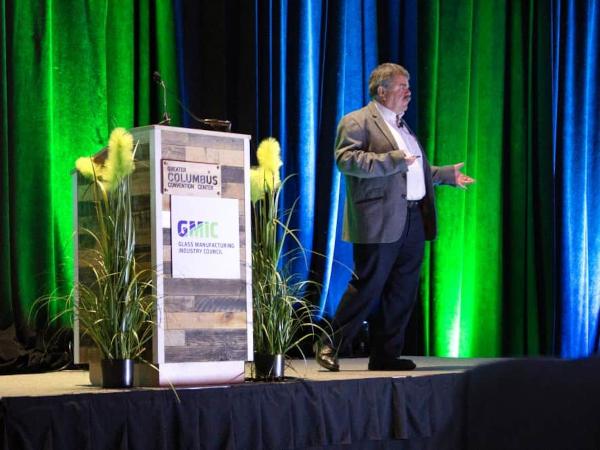
[Image above] Neil Simpson, president of Simpson Combustion & Energy Ltd., describes how his company demonstrated potential energy savings by improving process automation for regenerators. Credit: ACerS
The glass industry is a well-oiled machine, producing more than 209 million tonnes of glass annually just for the container, flat glass, and domestic sectors.
Current processes and materials allowed glass manufacturers to achieve this impressive output. But industry experts know not to become complacent. All aspects of glass production, from raw materials selection to flue gas cleanup, benefit from frequent evaluations to determine if new or modified devices and processes can improve the system’s efficiency.
Opportunities for expanding possibilities in the glass manufacturing industry served as the unifying theme for talks presented at the 84th Conference on Glass Problems (GPC), which took place last week in Columbus, Ohio, from Nov. 6–8, 2023.
GPC is the largest glass manufacturing conference in North America. It is coorganized by The Glass Manufacturing Industry Council (GMIC) in partnership with Alfred University. The annual conference aims to provide a platform for leading experts and manufacturers to share information on new innovations and methods to deal with challenges the industry faces with manufacturing glass.
This year, almost 400 attendees converged on the Greater Columbus Convention Center to participate in the conference. Student attendance was funded in part by a $15,000 donation from the Air Products Foundation given to GMIC and the Ceramic and Glass Industry Foundation to foster innovation by the next generation of ceramic and glass professionals.
The talks on Tuesday and Wednesday were arranged into several tracks that helped pinpoint critical areas throughout the glass production process that are especially ripe for innovation. While some of these areas were predictable, such as replacing fossils fuels with hydrogen during firing, others were surprising reminders not to take any aspect of the process for granted.
For instance, during the Combustion track on Tuesday morning, Neil Simpson of Simpson Combustion & Energy Ltd. described how his company demonstrated potential energy savings by improving process automation for regenerators. Traditionally, end fired furnaces run on 20-minute reversals regardless of pull rates or glass type. His company instead used a simple control algorithm to modify reversal times based on these factors, allowing for extended firing periods and reduced off-cycles.
It will be the summation of small modifications such as these that ultimately lead to the necessary gains in efficiency, according to Xavier d’Hubert of XDH-energy. During his talk on Tuesday, he argued that focusing only on the maturation of carbon capture and storage technologies will not achieve the emission reductions that are required to ensure long-term sustainability of the industry.
The talks this year also benefited from including academic and government perspectives alongside the industry presentations. S. K. Sundaram and W. C. LaCourse, both of Alfred University, gave the first presentation of the conference, describing a potential multi-forehearth approach to glass manufacturing. Hope Wikoff of the National Renewable Energy Laboratory gave the last presentation of the conference, on the use of glass in the solar energy industry.

In addition to the talks, the 84th GPC provided an opportunity for GMIC executive director Kerry Ward to announce some exciting updates and initiatives taking place at GMIC, including a new website, new logo, and new strategic plan.
GMIC also launched a new awards program to celebrate both individual and organizational achievement in the glass industry. The first two recipients were recognized during the opening session on Tuesday morning: Jeff Smith, senior glass engineering technician at Johns Manville, received the 2023 Glass Manufacturing Excellence Award, while Rod Gravley, president of Precision Partners LLC, received the 2023 Certificate of Appreciation.
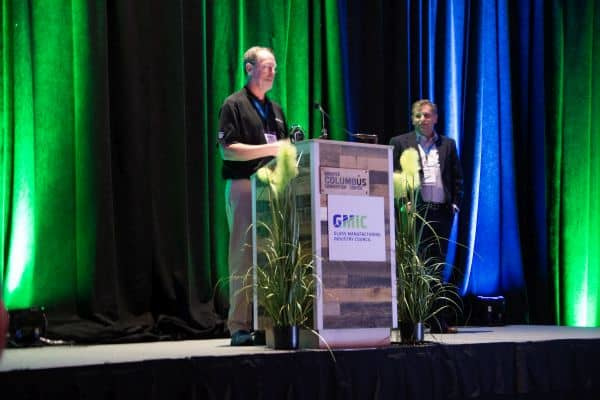
This year is Ward’s first as GMIC executive director, and he says he was excited to manage his first GPC and GMIC/GlassTrend Symposium, which bookended the conference on Thursday.
“I think both events went well, and our attendees seemed very happy with the quality of the education sessions. I was especially happy that we could launch our new awards program to recognize the folks that make this industry special,” he says.
Next year, GPC and GMIC/GlassTrend Symposium will move from its traditional home in Columbus to the so-called “Glass City” of Toledo, Ohio. It will also take place earlier than usual, in September 2024.
View more photos from GPC 2023 on ACerS Flickr page.
 600450





Add new comment