Date: 3 June 2026
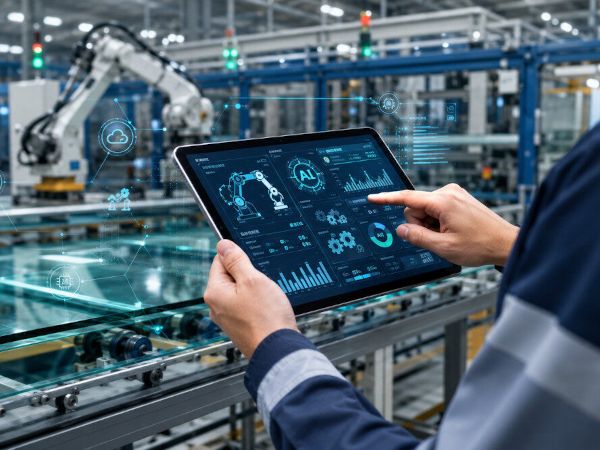
Artificial intelligence and digital technology are increasingly making inroads into the glass industry. Current applications range from automated quality assurance and AI-assisted process control to simulation tools, intelligent assistance systems and data-based production optimisation.
Here the focus is on the concrete industrial practice: companies in the glass industry are already deploying AI where large data volumes, standardised processes and high quality requirements come together.
At glasstec 2026 “AI & Digital Technologies” are among the three key Hot Topics. International exhibitors show which solutions are already in productive use today – and which developments will shape the next steps in the industry.
Image recognition today, self-learning optimisation tomorrow: The journey to AI-assisted manufacturing

BENTELER Maschinenbau clearly states what already works today – and what is to follow as the next step of evolution:
“Control processes in this field have already proven their worth along our production lines. The same can be said for image recognition used for inspection purposes or glass positioning. The self-learning optimisation of complex overall processes is currently still under development – this is the next step we plan to take.”
Olaf Patsch-Berkemann, Head of Sales Architectural Glass, BENTELER Maschinenbau
Autopilot, Batch Optimizer, White Haze Scanner: Where AI already “delivers” in glass processing

Riku Färm at glaston defines the prerequisites for reliable AI – and flags up how three concrete systems improve quality, capacity and energy efficiency in production:
“AI solutions are already working reliably today where big data, clearly defined processes and repetitive workflows exist. In glass processing this especially applies to process control, production optimisation and quality monitoring. Systems such as the Glaston Autopilot completely automate complex glass pre-stressing processes and make them reproducible. The Glaston White Haze Scanner uses AI algorithms for the objective classification of surface defects so far not reliably detectable manually. AI-based solutions are already established in production planning such as for the optimal charging of plants.
Our AI applications improve quality assurance through objective, consistent and automated assessment of glass products. When it comes to energy efficiency, the Glaston Batch Optimizer makes for optimised batch patterns and bed utilisation thereby reducing the energy consumption per sheet. The Glaston Autopilot stabilises and optimises pre-stressing, minimises rejects and make for consistent high quality and energy efficiency. In this way, AI creates the foundation for more efficient processes, more sustainable production and new creative freedom in glass design.”
Riku Färm, VP Solutions & Product Management, glaston
From production control to customer meetings: AI along the entire value chain

In CLARIA™ Guardian Glass has developed an AI assistant that fundamentally simplifies glass selection and specification for customers – and AI use goes even further internally:
“Visitors at glasstec will be able to experience CLARIA™ - our AI-assisted digital assistant that eases the selection and specification of glass. Introduced as a prototype at glasstec 2024, CLARIA™ was launched on our website in September last year and is now available for all customers. It uses advanced AI to provide instant guidance on product performance, applications and technical data and helps users to efficiently take well-informed decisions. This innovation reflects our on-going commitment to digitalisation and improved customer support.
AI provides data-based insights that support process optimisation and quality assurance while human expertise remains key to decision-making. By analysing big production data, it helps to improve manufacturing yield and energy efficiency. Today, we use AI in such areas as product quality, raw material optimisation and logistics. Beyond this, we deploy AI along our entire value chain – in the supply chain, in financials, in customer experience and on digital platforms.”
For architects and planners this approach is complemented by digital tools:
“Over the past few years, we have made substantial investment in digital tools that support architects and glass specifiers during the entire planning process. Our Glass Analytics Suite – including the Performance Calculator and Acoustic Assistant – is under continuous further development. In addition, our more recent solutions such as the Glass Visualizer, Digital Glass Selector, Project Locator and Static Calculator all assist in product selection, performance analysis and glass specification.”
Guus Boekhoudt, Executive Vice President, Global Commercial, Guardian Glass
Materialflow simulation as a planning tool: AI is speeding up quotation processes

For LiSEC AI not only adds value in production but even before during the planning stage – with simulation tools that leverage real project data:
“Visitors will experience the use of material flow simulation as an engineering tool that virtually analyses, assesses and optimised production systems. The focus here will be on such concrete issues as throughput, bottlenecks and layout validation – rather than merely visualisation.
In addition, AI-assisted functions are used: automatic retrieval of layout legends as well as cross-customer evaluation of technical issues based on existing data.
Added value for customers: faster quotation processes, individually optimised plant concepts and well-founded decisions on the basis of real project data – for custom-fit, efficient and future-proof solutions.”
Markus Jandl, Director Product Management, LiSEC
From edge computing to preventive maintenance: Smarter batch and cullet systems

Zippe Industrieanlagen banks on AI functions along all relevant process steps – from data management to line monitoring:
“Batch and cullet systems are getting increasingly smarter. We will showcase innovative technologies across all relevant steps of the process: from our smart 360° tool with integral AI functions to performance edge computing to smart solutions for data analysis and preventive maintenance – for maximum efficiency, transparency and future proofness.”
Dr. Philipp Zippe, CEO Zippe Industrieanlagen GmbH, Zippe Industrieanlagen GmbH
What AI already delivers in the glass industry today
The statements by these industry insiders show: AI is no longer an abstract topic of the future in the glass industry. It already supports operations today where processes are complex, data volumes big and quality requirements are high – from quotations and plant planning to process control and quality assurance all the way to energy efficiency, logistics and digital customer service.
It becomes clear at the same time: the biggest added value is not created by individual AI functions but by their embedding in concrete industrial workflows. AI can help to make more informed decisions, design more stable processes and deploy resources more efficiently.
Hot Topic AI & Digital Technologies
AI and digital technologies are a major focus for the glass industry worldwide and are therefore once again one of the key hot topics at glasstec 2026. Which solutions are already in use and which developments are to be expected will be showcased at glasstec from 20-23 October 2026 in Düsseldorf.
 600450


Add new comment