Date: 27 April 2026
In terms of size, attendance of qualified professionals, and density of technological innovation, the Shanghai exhibition once again proved to be a key crossroads for expansion strategies in the Asian market.
The Italian Presence: Success of the Italy Pavilion
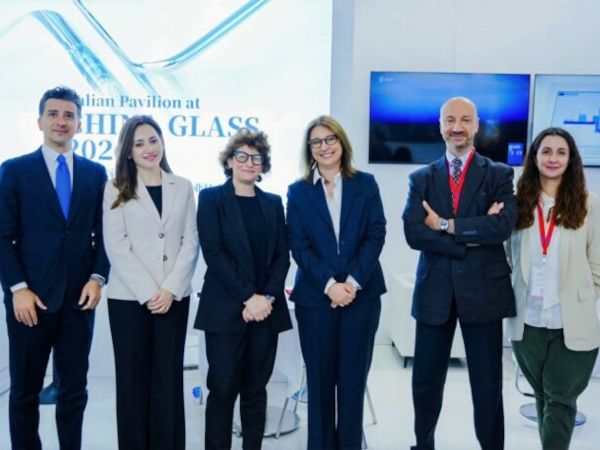
In a complex and highly competitive market, the strength of a collective approach has proven to be an essential added value. Through close collaboration with ICE Shanghai, GIMAV coordinated the creation of the Italy Pavilion, hosting 15 leading companies from Italy’s advanced machinery sector. Alongside them, a strong group of member companies participated independently, further reinforcing the global standing of the Italian glass industry.
GIMAV Director Lucia Masutti shared a highly positive assessment of the mission:
“Italy’s presence in Shanghai was significant, and the feedback we gathered leads us to expect even greater participation next year. This shows that, despite its complexities, the Chinese market remains fertile ground for those offering high-end technology.”
Institutional Coordination and Financial Support
One of the most important aspects of the Shanghai mission was the institutional networking carried out behind the scenes. For GIMAV, the fair was not only an exhibition opportunity but also a crucial moment to define concrete support tools for companies.
Through discussions with representatives from SACE and Intesa Sanpaolo, the Association worked on strategies to support Italian companies in their commercial expansion into China (also in light of the latest developments following the approval of the 15th Five-Year Plan). These synergies aim to facilitate both future production investments and the search for reliable partners and suppliers, providing member companies with essential financial and advisory support for operating in Asian markets.
The Challenge of China’s Technological Dynamism
An analysis of the Chinese glass industry reveals an ecosystem in constant and rapid evolution. Direct engagement with local players highlighted a level of technological dynamism that challenges the pace of Western markets. In China, innovation moves at a significantly faster speed compared to Europe.
According to Masutti, this comparison is strategically essential for the Italian sector:
“The glass industry in China shows strong technological dynamism. It is a reality we must engage with to seize innovation opportunities that, for structural reasons, are more difficult to achieve in Italy at the same speed.”
This rapid execution, supported by a different regulatory and structural environment, serves both as a warning and a motivation for GIMAV members to invest in increasingly integrated and responsive R&D.
Association Diplomacy: From NGA to the Community of Glass Associations
On the international relations front, GIMAV used the China Glass platform to strengthen existing alliances and build new ones. Particularly noteworthy was the meeting with LaKeisha Purnell-Woods, President of the U.S. National Glass Association (NGA), aimed at creating new bridges between Italian excellence and the North American market.
At the same time, constructive dialogue continued with the Chinese Ceramic Society, organizer of China Glass and an active partner within the Community of Glass Associations. This global platform, promoted by GIMAV, aims to establish long-term collaborations, seize shared opportunities, and harmonize industry standards on an international level.
“In light of all the interactions carried out during this edition of China Glass,” concluded Masutti, “we can say without doubt that the key word for us has been ‘synergy’: a strategic axis for GIMAV’s future policies, both toward international players and foreign counterparts, and toward the Italian system and institutions worldwide.”
 600450




Add new comment