
Date: 26 February 2025
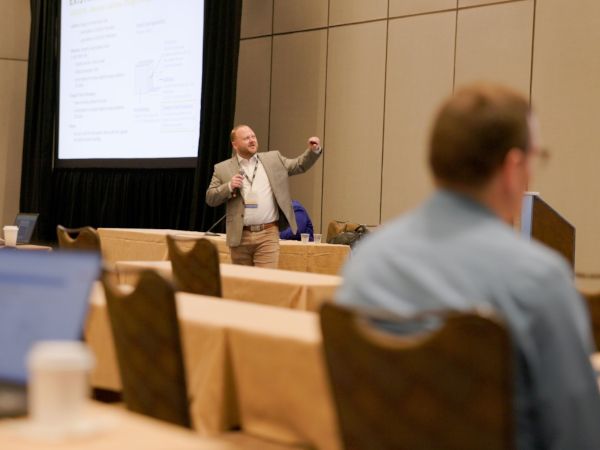
Those participating in the Fenestration and Glazing Industry Alliance (FGIA) Annual Conference in Orlando, FL, learned about the building, energy and stretch codes in the state of Massachusetts in a presentation about the complexity of backstop calculations from presenter Christopher Grey (Simpson Gumpertz & Heger). In this presentation, Grey provided an overview of the 2023 Massachusetts Stretch Code updates that impact façade design including requirements for air leakage, thermal bridging and the envelope backstop calculations. He reviewed the 2020 and 2023 backstop calculations and discuss the implications on building enclosure designs with a focus on impacts to fenestration system design and use.
The current Massachusetts stretch energy code and base code provides amendments to the 2018 International Energy Conservation Code (IECC). These amendments require buildings permitted after November 2020 to demonstrate compliance with an envelope performance backstop. This envelope backstop is intended to limit tradeoffs to offset lower-than-code performance for building enclosure systems with higher-performance mechanical and lighting systems. Moving forward, buildings permitted after July 1, 2023, will need to comply with the 2023 Massachusetts Stretch Code.
Additionally, Massachusetts implemented a new Specialized Energy Code that is quickly being adopted across the state. This new energy code includes:
- More stringent air leakage documentation, construction and compliance
- Requirements to account for thermal bridging
- Updates to the backstop calculation to strictly compare the above grade wall systems’ U-values and areas against the prescriptive code requirements
“Being an enclosure consultant is interesting,” said Grey. “We see a wide range of around 100 projects among a team of 10 people. We see enclosure issues and different performance. We see different clients with wildly different expectations.”
Massachusetts is the first state to implement a code this restrictive, according to Grey, noting that others will likely follow. “Public benchmarking is occurring across the U.S., or identifying and calculating how much energy a building is using,” he said, adding that cities like Cambridge and Boston require that information is reported back to the city. Passive House (PH) is also becoming a code requirement in some states. “As consultants, we are always pushing for higher-performing enclosures, but few want to pay the cost,” said Grey.
More attention has been paid to enclosure performance in recent years, including the addition of three energy packages per project, such as whole building air leakage testing and a 15% improvement over prescriptive code. “In 2023, Massachusetts become hyper focused on enclosure performance, closing the triple glazing loophole and requiring increased energy efficiency and increased electrification,” Grey said. The code went into effect July 1, 2023, based on Massachusetts modifications to IECC 2021. “There are some gray areas in the code and many teams are still struggling to understand what they have to do,” said Grey. “And the code affects every part of a project.”
Grey shared that there are three buckets for code compliance one can fall into: base, updated stretch and special opt-in. Major changes to the stretch code that could impact companies the most include the following: existing building, prescriptive thermal performance, air leakage, thermal bridging/back stop, additional efficiency, solar readiness and roof insulation, Grey stated. “The thermal envelope of every building, regardless of size, must be tested for air leakage,” he said.
Passive House has a particularly strict air leakage requirement, according to Grey, who noted that PH requires testing of the whole building and then also each individual apartment unit for air leakage. “Ideally, you would want to do all that testing before the cladding is put on, so you can still go in there and fix things, but no construction schedule allows for that,” lamented Grey.
Grey advised manufacturers and fabricators to use model derating, meaning a 2D or 3D finite element analysis heat transfer model, to help with calculations. “Windows need to get better overall for a project to be approved when it comes to thermal bridging/back stop calculation,” he said. He also encouraged them to be ready with better publicly available thermal performance information to help designers. “Finally, you should continue to innovate and improve thermal performance of fenestration systems,” Grey said, sharing the following examples of such system innovations: warm edge spacers, multiple low-E coatings, triple glazing, vacuum insulated glazing and fiberglass/thermal breaks.
For more coverage about the FGIA Annual Conference, visit FGIAonline.org/news.
 600450


Add new comment