
Date: 25 February 2025
Last year, GMIC was awarded a three-year, $3 million grant from the Department of Energy to research advanced electric melting to decarbonize commercial glass.
The objective of the project is to demonstrate melting processes which reduce scope-1 greenhouse gas emissions by 85+% for large volume, commercial glass production. The focus will be on overcoming three barriers which have hindered adoption of all-electric glass furnaces:
- Production of dark/reduced colored glasses (e.g. amber)
- Improve quality of clear glass
- Furnace lifetime
The project launched in the last quarter of 2024, and accomplishments last quarter included:
- Establishing the project lab and modeling capabilities
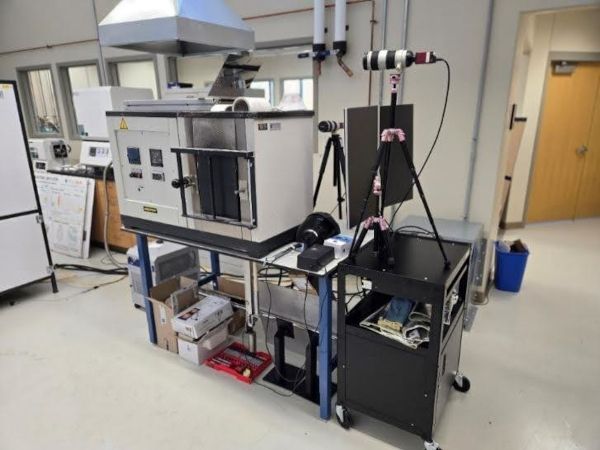
- Setting up the Cold-Top Melting Furnace
- Testing the pelletizing set up
- Completing the CFD grid of the Cold-Top furnace
- Establishing the future workflow plans
In addition, the team established base line recipes for the amber and flint tests. These recipes were chosen to represent real industrial glass melt formulas and be consistent across project members conducting tests in the CelSian lab, the PNNL lab, and through CFD modeling. Industrial-grade raw materials and post-consumer flint cullet were obtained from industrial steering committee partner Gallo Glass to maintain consistency with real-world industrial processes. Internal flint cullet was also obtained from a separate glass plant because of ease of acquisition.
For the quarter, five successful cold-top experiments were run on the Cold-Top furnace:
- Container batch containing 30% post-consumer flint cullet at 2.0 ton/m 2 /day
- Container batch containing 30% internal flint cullet at 2.0 ton/m 2 /day
- Container batch containing 30% internal flint cullet at 1.75 ton/m 2 /day
- Container batch containing 70% internal flint cullet at 2.0 ton/m 2 /day
- 100% internal flint cullet at 2.0 ton/m 2 /day
The project partners are Celsian (lead investigator), RoMan Manufacturing, TECO, and the Pacific Northwest National Laboratory (PNNL).
 600450

Add new comment