Date: 1 September 2026
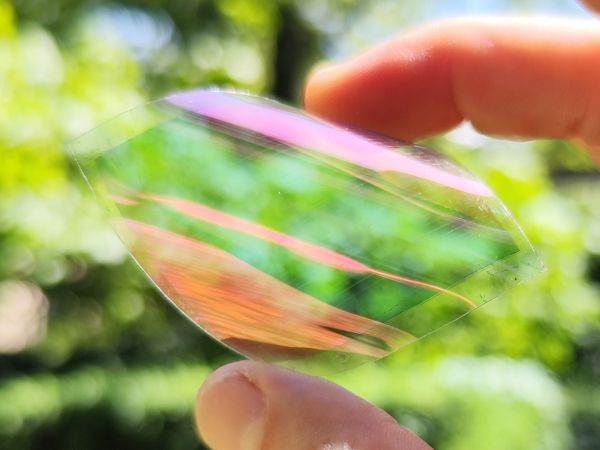
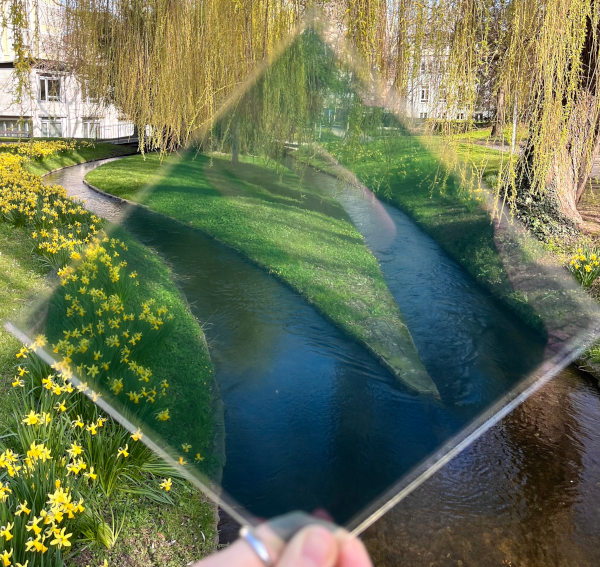
Wavelength-dependent transparency, in particular, is a major strength of organic photovoltaics. Researchers at the University of Freiburg and the Fraunhofer Institute for Solar Energy Systems ISE have now succeeded in building 14.5 by 14.5- centimeter organic PV modules with an average transparency of 43.2 percent and an efficiency of up to 9.26 percent. To achieve this, they used a combination of sputtering and slot-die coating – both processes that are industrially proven and highly scalable to large module areas.
“Scaling up to larger areas is one of the major challenges in organic photovoltaics,” explains Dr. Uli Würfel, head of the Organic and Perovskite Photovoltaics Department at Fraunhofer ISE. Good laboratory results with small, hand-made solar cells often cannot be transferred to industrial production because their manufacturing process does not work on larger areas.
“The fact that we have now, for the first time, successfully and with virtually no loss applied all the layers of the solar cells using the slot-die process is a major breakthrough for us.” The back electrodes of the solar cells are applied in the preceding process step using a sputtering process, which is also an established manufacturing method.
In the development of semi-transparent organic photovoltaics, a trade-off is always made between light transmittance and the inevitable loss of efficiency associated with it, expressed as light utilization efficiency (LUE). With the 210.25-square-centimeter semi-transparent organic photovoltaic modules, the researchers achieved an efficiency of up to 9.26 percent with an average visible-light transmittance of 43.2 percent. This corresponds to a LUE of up to 4.0 percent. The project’s results were published in the leading journal “Joule” in early August.
“Now that we have the manufacturing process under control, we are optimistic that we can significantly increase transparency without compromising efficiency,” adds Uli Würfel.
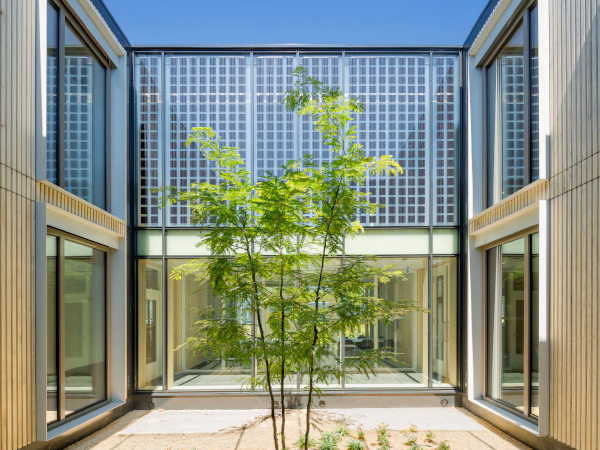
Organic solar modules with light transmittance well over 50 percent could be used in place of window glass in building facades or greenhouses. In contexts where tinted glass is desirable – for example, in car roofs and façade elements – lower transparency can even be an advantage.
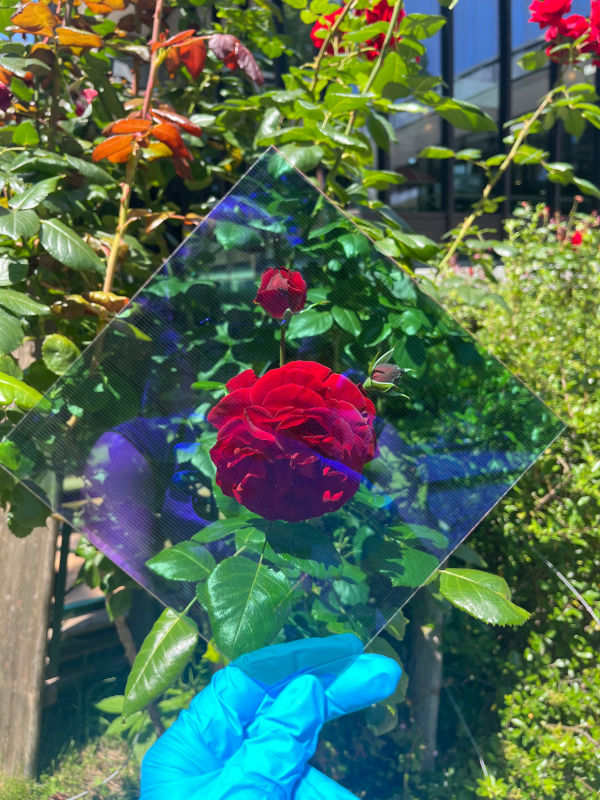
In each module, more than 100 solar cells were interconnected using laser structuring. The solar cells consist of a back electrode that reflects near-infrared light, which was deposited onto a glass substrate via sputtering; an absorber layer made of organic semiconductors; and a metal-free top electrode made of the polymer PEDOT:PSS, which was applied in multiple layers using a slot die. Heraeus Epurio developed a new PEDOT:PSS formulation for this top electrode, which helped the PV modules achieve higher transparency.
Slot-die coating is compatible with roll-to-roll processes and is therefore also suitable for the production of solar modules on film. “As part of the project, we have already produced the first flexible, organic PV modules that retain 100 percent of their original efficiency after 1,274 bending cycles over a rod with a diameter of 15 millimeters,” explains Dr. Mathias List, research associate for organic and perovskite photovoltaics at Fraunhofer ISE. The company ROWO Coating manufactured the films for this purpose. “The next step is to achieve larger module areas here as well.”
The research findings are part of the project “Transparent PV – Development of Organic Solar Modules with High Visual Transparency,” supported by the Federal Ministry for Economic Affairs and Climate (BMWK, BMWE). Projects partners included Heraeus Epurio, ROWO Coating, ASCA, and the University of Freiburg.
 600450





Add new comment