
Date: 28 February 2023
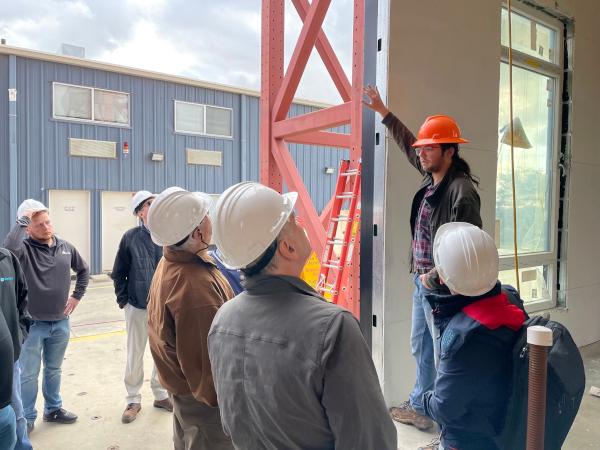
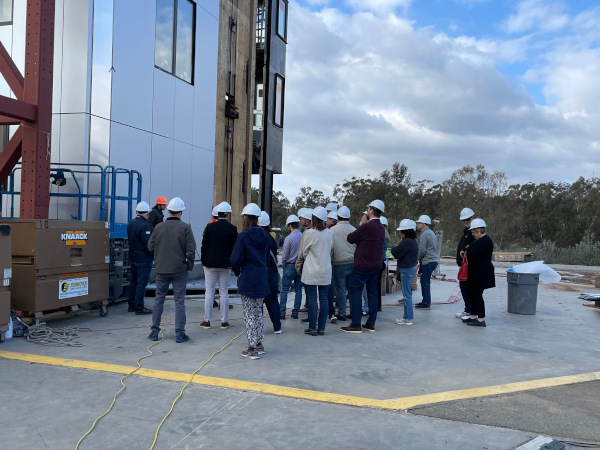
The Natural Hazards Engineering Research Infrastructure (NHERI) TallWood Project shake table test will take place in the San Diego area, just miles away from where the conference was held in Coronado, CA. Those on the tour were able to see outside, inside and beneath the structure built on top of the shake table. At 10 stories tall, this is the largest test of its kind, and its construction is nearly complete.
“My team is leading an effort to test exterior facades as part of a test of a 10-story timber building,” said Dr. Keri Ryan, University of Nevada, Reno, who is a co-investigator of the project, which began in 2016. The shake table facility completed a multi-year upgrade last spring, to extend the shaking capabilities from one direction to three axis translation and rotation. The construction of the building itself started in July. “We designed and will test a 10-story building with mass timber products. The main focus is its seismic resilient timber rocking walls, built with massive timber panels.”
Two FGIA members donated windows to the project: Winco Window Company and Innotech Windows + Doors. Ryan said she and her research team anticipate the building can go through large earthquakes with very little damage. The exterior façade is made up of four sub-assemblies at the base of the building, all of which are attached to the main wood frame structure. The first three sub-assemblies feature cold-formed steel (CFS) framing with exterior aluminum composite (ACM) finish and windows, while the fourth is a curtain wall. All are detailed for drift compatibility, by providing horizontal and vertical joints. “None of this has been tested in this way before,” said Ryan.
- CFS 1: This sub-assembly is platform framed with horizontal drift joints at the top of the wall. “Slip is intended to occur between those two tracks,” said Ryan. “The corner uses special joints that expand. We have the joint on two of the three stories.” The third story without the joints serves as a reference, so the researchers can compare the performance with and without joints.
- CFS 2: This sub-assembly is bypass framed with drift clips that allow the studs to slip relative to its diaphragm. “In this one, we expect the floors to move, and the walls should basically stay straight,” said Ryan. “At the corner, we expect up to 10 inches of drift to be accommodated.”
- CFS 3: Featuring spandrel units with ribbon windows, this sub-assembly also has slip joints at the top of the windows, between the window and the spandrels, while the spandrel framing is fixed to the diaphragm. The first and third story use Winco and Innotech windows that wrap around the corner. On the second story, a drift joint was used at the corner, similar to CFS 1.
- CFS 4: This final sub-assembly is a finished, fire-rated glass curtain wall assembly whose glass rotates within its frame. It has steel mullions and 1 1/16 inches of thick fire-rated glass and was framed on site. “It was designed for two-and-a-half percent drift, which is what we expect to see in the test itself,” said Ryan.
“In most cases, we don’t expect the windows to be subjected to a lot of drift,” said Ryan, with the exception of the corner window units on CFS 3.
Beneath the building sits the shake table itself. Actuators drive the shake table platform in all directions. The table moves a maximum of 35 inches in the East-West direction, 15 inches in the North-South direction, and 5 inches up and down, according to Site Manager, Koorosh Loftizadeh. At a payload capacity of 1100 kips, about twice that of the timber building, the peak acceleration capacity is 1.6g, 1.2g, and 0.6g (“g” referring to acceleration of gravity at Earth’s surface) in East-West, North-South and vertical directions, respectively. To be ready for testing, more than 700 sensors and approximately 60 video cameras need to be installed in the building.
During the Seismic and Wind-Induced Inter-Story Drift Review Task Group (AAMA 501.4 and 501.7) meeting held at the FGIA Annual Conference, Ryan provided an update on how testing will go. “We will impose a range of intensities over a four-week period, starting with a low level of shaking and building up to larger earthquakes through design level shaking to maximum considered earthquake (MCE),” she said. “We plan to scale up from low level drifts up to 2 percent inter-story drift. Some of the input motions will have peak acceleration over 1g.”
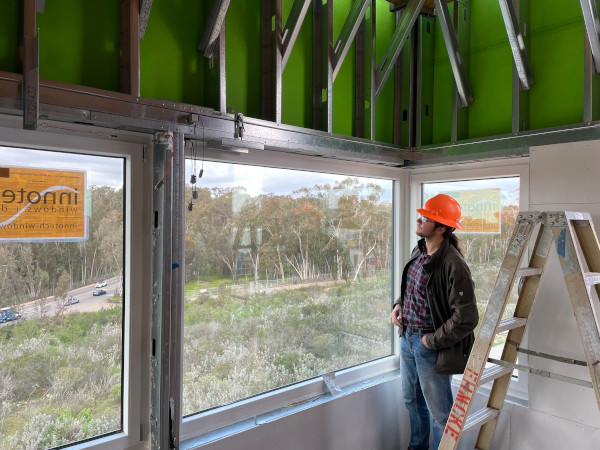
William Roser, research student, shared some predictions for the test. “We are modeling the structure to predict the responses during the test,” Roser said. “As we change the design of the building and the mass of the building itself, that has caused our expected drift to be different from original drifts. The drifts are not quite as high as originally predicted.” Ryan added that the team will adjust accordingly if the model is too conservative. The group hopes to begin testing at the end of March. Multi-camera streaming of the construction site can be seen online and will be available to view this spring when the four-week test begins.
“It will be great to see it in action on that live feed,” said Tanya Dolby, Chair of the FGIA task group.
For more information about FGIA and its activities, visit FGIAonline.org.
 600450







Add new comment