Date: 14 September 2026
Glass can be recycled completely in a closed loop in the melting units of the flat glass industry. An even higher potential for CO2 savings may lie in keeping existing glass sheets, IGUs and complete façade components in the useful cycle as long as possible: A current study carried out by the CircuClarity initiative headed by Prof. Dr. Linda Hildebrand (Office for Circularity in the Built Environment, c u b e) and Dr. Lisa Rammig (Director Eckersley O’Callaghan, USA) shows that Re-Use and Re-Manufacturing are now taking the step from individual pilot projects towards market-ready solutions in the industry. Which procedures already work and what is still standing in the way of successful scaling will also be revealed to those attending the “Circularity Two” Conference moderated by the two experts at glasstec 2026 in Düsseldorf on 20 and 21 October.

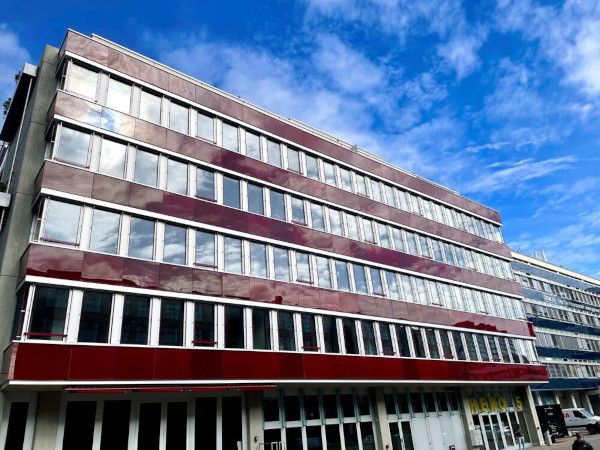
Photo: Marcel Bilow
CircuClarity was initiated by Dr. Linda Hildebrand and Dr. Lisa Rammig at glasstec in 2022, developing since then from a small impulse event into an international network with more than one hundred stakeholders. What makes it special is the networking along the complete value chain: experts from raw material supply, float glass production and processing, façade construction and engineering, architecture, project development and science all bring their respective perspectives to the table. In terms of content, the work ranges from energy and secondary materials to recovery systems and design for disassembly to product development and data – with a view to driving innovations for more circularity in the glass, architecture and façade sectors. Here, however, the group will focus on the topics of re-use and re-manufacturing.
The current status quo: high-quality insulation glass can last for decades in windows or façades. If a building is demolished, this is unfortunately where its “product life” ends, because it is recycled as cullet, mixed with low-grade mineral construction materials to be used for other applications such as container glass or insulation material. In the best-case scenario it is returned to flat glass production as cullet after building demolition. The flat-to-flat recycling ratios of waste glass, however, rarely exceeded 1% according to the study “Readiness for Circularity and Climate Neutrality in the Glass Industry” by Hildebrand and Rammig. Instead of disassembling buildings and using them as material banks, glass is destroyed during demolition most of the time and mixed with mineral buildings materials – making high-quality reclamation impossible. Even in this scenario, high-quality recycling is just one of the possible circularity strategies. The use of higher amounts for cullet leads to a reduction in direct CO2-emissions since cullet replaces part of the primary raw materials and requires less energy for melting in comparison. But the grey energy already “contained” in the glass, i.e. the energy spent on its production, transport, storage and sales etc. is still lost. However, it can be conserved if the glass sheet, the insulation glass or even complete façade modules are reused in other places.
Re-use and re-manufacturing
Hildebrand and Rammig distinguish between re-use and re-manufacturing: in re-use a component is installed again without material changes after its suitability has been tested. In re-manufacturing products are taken apart, components are cleaned, tested and documented and then assembled with existing or new components into a functional product again.
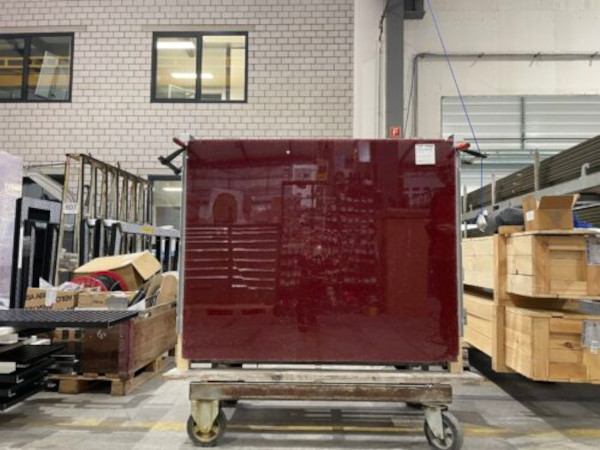
Photo: Philippe Willareth, LMP Engineering Zürich / Enrico Cutri, DOW
A project by LMP Engineering and DOW documented in this Study shows that this approach can also be applied to façade glass. Used glass panes were recovered, tested and developed further into new façade elements by means of a silicone reinforcement. Commenting on this Enrico Cutri, DOW, says: “It is not sufficient for façade glass to look intact to be reused. We have to rate its residual performance and develop a new structure capable of withstanding technical loads on this basis.
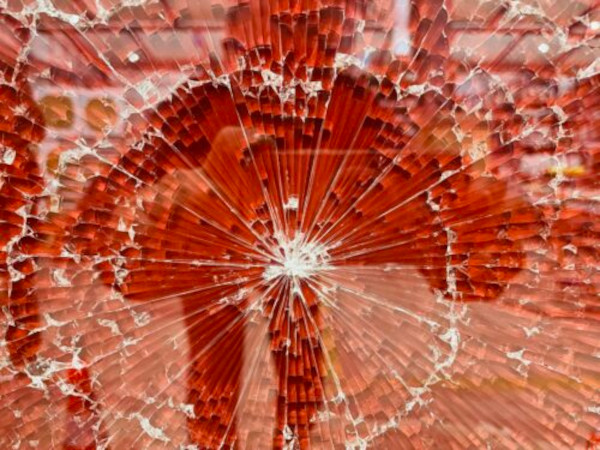
Photo: Philippe Willareth, LMP Engineering Zürich / Enrico Cutri, DOW
Our example shows that existing glass must not necessarily become – as valuable as it may be – a raw material for the next melt but can also go through another lifecycle as a component.” The potential seems to be substantial: Case studies used by Hildebrand and Rammig as examples indicate up to 48% reductions in greenhouse-gas emissions for recycled versus new glass (Source: Wernli, S.; Hildebrand, L.; Teich, M. (2025) “Circular IGUs – Modellbasierte Abschätzung des Treibhauspotenzials der Wiederaufbereitung rückgebauter Bestandsverglasungen” (Circular IGUs – Model-Based Assessment of Greenhouse-Gas Potential of Reconditioning of Disassembled Existing Glazing) presented at the Austrian technical universities forum “18. Forschungsforum der österreichischen Fachhochschulen: Doing Research – Shaping the Future”, Vienna, 7/8 May 2025). At the same time, examinations performed on approx. 30-year-old float glass show that the impact of use on bending rigidity, for example, can be minimal under certain circumstances. This makes testing and assessment procedures that provide reliable proof of the further usability of a disassembled pane, increasingly important.
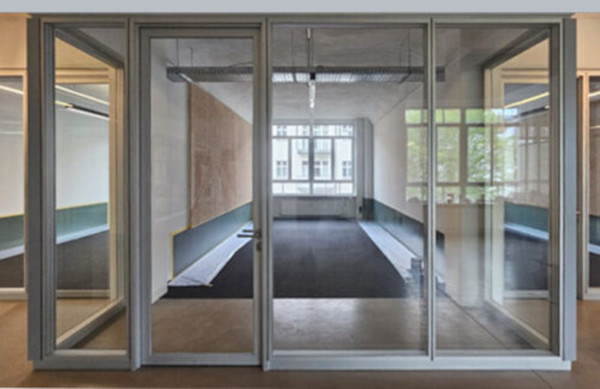
Photo: Concular
A second example described in the Study reveals just how low the threshold for circularity can also be: for the project St. Oberholz in Berlin glass partition walls were disassembled and initially stored for subsequent installation for an expansion of office space. According to the authors, indoor and partition walls are particularly suitable for such applications: their utilisation cycles are often shorter than the technical service life of the components so that disassembly provides availability of well conserved products most of the time.
Scaling up successful projects to processes
To scale up exemplary projects from individual pilots to standard practice, it is more than just the design that has to change. What is needed is selective disassembly, suitable logistics and return systems as well as information on which glass was installed where and which properties it has. EPDs, digital product and building resource passes as well as Materials Registers offer an important infrastructure for this, but so far these data structures are not sufficiently interlinked. The design for disassembly process also proves more complicated in practice than is often assumed. Tests run during the disassembly of façade systems revealed, for example, that allegedly reversible screw connections can be more time-consuming in manual disassembly than silicone bonding if suitable tools are used. Therefore, not only joining technology alone decides whether a component can actually be reclaimed in an economical, low-destruction and clean-grade way at the end of its first service life. The Study paints a differentiated picture: while major flat glass manufacturers are channelling significant technological efforts into the complete decarbonisation of the energy-intensive float glass production that remains a long-term task, secondary materials, cullet reclamation through the industry’s own return systems as well as re-use and re-manufacturing concepts are developing comparatively quickly – many approaches have already reached the transition to dynamic commercialisation. The technical question of whether glass can have a second life, has already been answered in initial projects – the next question reads how early collaboration in projects and good networking can make this an everyday routine in the glass, façade and demolition business.
This is why “CircuClarity Two – Beyond Progress: From Practice to Impact” shines a light on the path from technical feasibility to broad-based application at glasstec 2026. On 20 and 21 October experts from industry, architecture, engineering and research will take to Stage 3 at glass technology live in Hall 11 to discuss how proven circular solutions can be scaled up and translated into viable processes and standards.
For more information on CircuClarity Two
Complementing CircuClarity Two, the CircuClarity Award recognises innovative projects and solutions that drive the circular economy forward in the glass and façade industry. Applications for the CircuClarity Award 2026 are open until 18 September 2026. The award ceremony will take place as part of glasstec 2026.

Marc Everling studied media education (Technical University Brunswick) and has been a communications and marketing specialist in the glass industry for more than 20 years. In 2021 he founded his networking agency specialising in communications consulting and press liaison for companies and associations that work and produce sustainably in the interests of the ecological transformation of the construction sector.
 600450



Add new comment