Date: 7 April 2026
When evaluating a purchase of a glass processing machine, the pricelist price is only the starting point. The real cost of machinery is measured on 10,15 at times also 20 years of use and the individual expenditures that compose it, are way more than what appears in the estimate.
This article gives a practical framework to correctly evaluate a machinery investment.
The expenditures that compose the total cost of a glass processing machine
The total cost of a glass processing machine is divided into different categories:
Acquisition costs: purchase price, transportation, installation, training of the operators, any plant adaptations (electric, pneumatic).
Operative costs: energetic consumption, consumables (wheels, tools, lubricants), manpower for ordinary management.
Maintenance costs: programmed maintenance, spare parts, extraordinary interventions, assistance contracts.
Indirect costs: machine stops (lost production), waste and reprocessing, technical time for diagnosis and repairing.
Residual value: the reselling/exchange value at the end of the life cycle, which has to be subtracted from the total cost.
The variables that make the difference when buying glass processing machines
Not all the machines age the same way. The useful standard life for production machinery varies between 7 and 15 years, but this gap depends on precise factors:
Constructive quality: mechanic components, structural stiffness, quality of the materials. Machine built with less strong parts and materials may have a shorter life and request higher investments in a reduced period of time.
Availability of the spare parts: supply times, cost of the components, duration of availability over time (for how long does the manufacturer guarantee the spare parts?).
Technical assistance: reactivity, competence, geographic coverage, remote assistance intervention's availability.
Ease of use and maintenance: a machine which requests less training, with accessible maintenance, reduces indirect costs and minimizes stop times.
An example on 15 years in the purchase of a straight edger
Let's consider two hypothetical scenarios for a straight-line edger with a time horizon of 15 years (values are purely illustrative and are used to show the order of magnitude of the differences. Real costs vary according to the model, use and operative context).
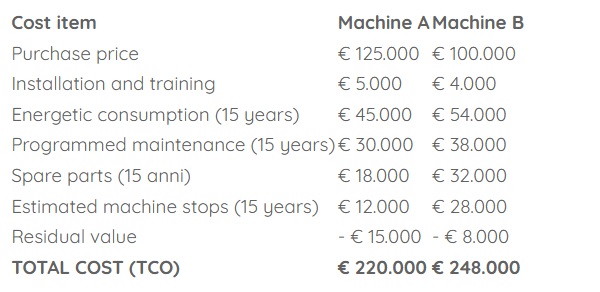
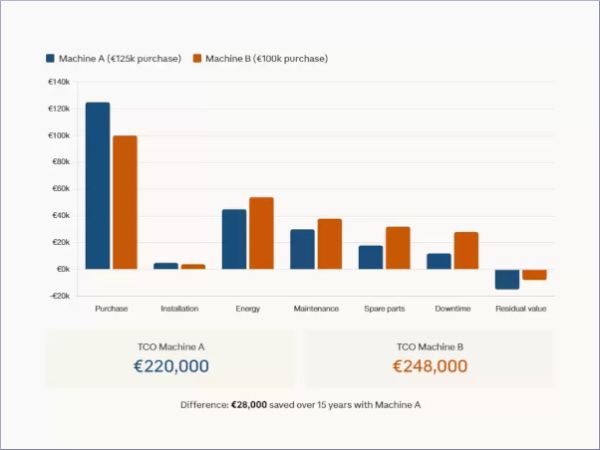
In this example, the glass machine A costs 25% more at the purchase, but 18% less on the total cost in 15 years. The €41.000 difference widely compensates the higher initial investment and by the end of the cycle, the machine A keeps a higher residual value.
Questions to ask before purchasing a glass edging machine
Before finalizing an investment in machinery, these questions help building a more complete picture:
1. Which is the expected useful life of the machine in my glassware's operative conditions?
2. Which are the annual costs for programmed maintenance?
3. How long are spare parts guaranteed for? At which cost?
4. Which is the effective energetic consumption (not only nominal)?
5. Which type of assistance is included? With what intervention times?
6. How many operators are needed for the managing? Which training do they require?
7. Are there verifiable references on similar machines, that have been working for years?
8. Which is the estimated residual value at the end of amortization?
In short
The purchase price typically represents only 30-40% of the total cost of ownership of an industrial machine.
The remaining items — energy, maintenance, spare parts, machine stops —accumulate year after year and cannot completely turn over the economic convenience of an investment.
Reasoning from TCO point of view doesn't necessarily mean spend more on the purchase. It means having instruments to compare different options on the base of what really will matter: the cost per year of actual use.
Contact us to have further details on our glass processing machines.
 600450


Add new comment